
MeetGeek
Meeting Assistants
MeetGeek is an AI meeting assistant that automatically records, transcribes, and summarizes video meetings across platforms like Zoom and Microsoft Teams
transcribe-meetings
Free planView →

Fetcher is an AI-powered recruiting automation platform that sources and engages candidates for open positions
Useful for recruiters who want a steady drip of AI-sourced candidates delivered to their inbox without manual boolean searching. The caveat is that automated sourcing still needs human vetting, and match quality depends heavily on how well you calibrate the initial criteria.
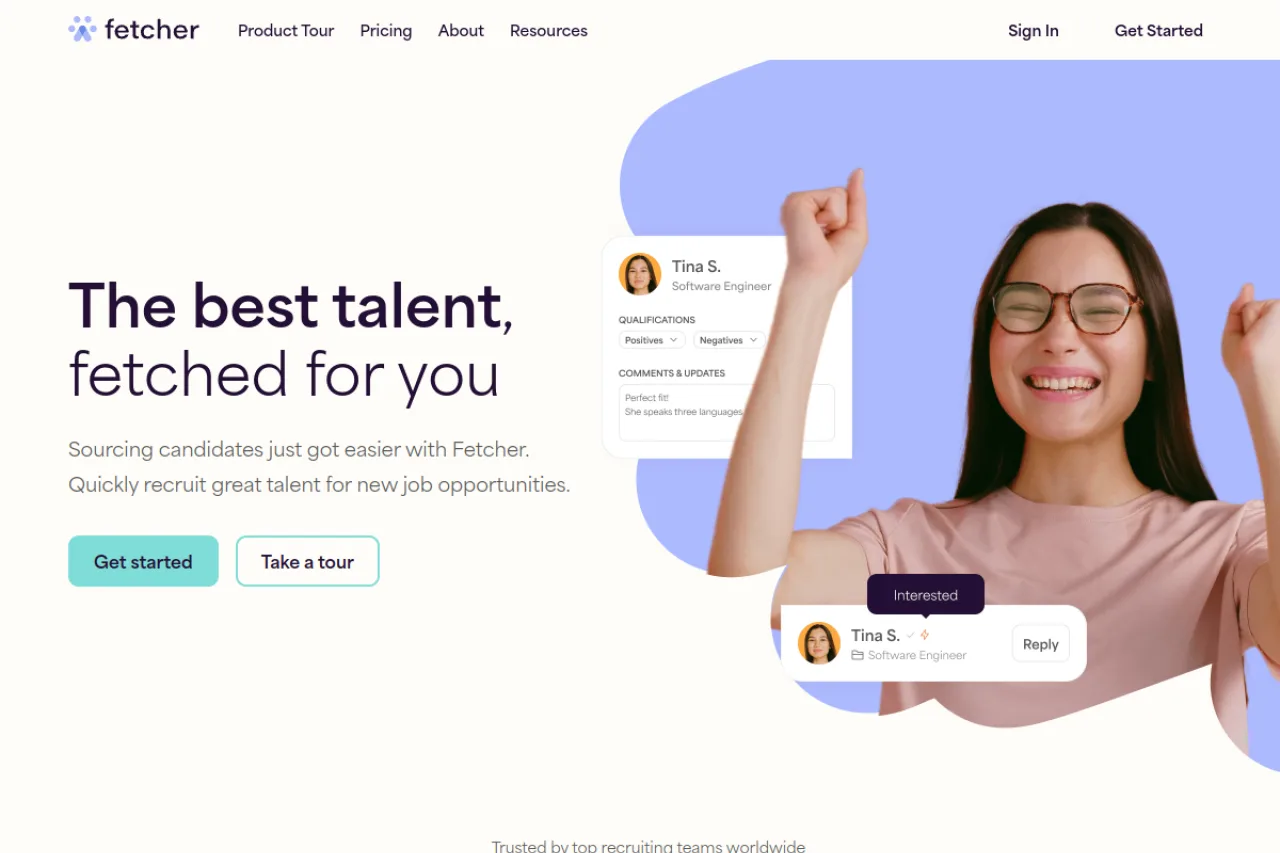
Fetcher is an AI recruiting automation platform that sources qualified candidates from a large database and engages them through personalized email sequences. It offers both self-service sourcing and a full-service model with dedicated sourcing experts, plus inbound applicant review, candidate relationship management, and ATS integration. It's well suited to talent acquisition teams that want to automate top-of-funnel sourcing, though its tier-gated features and per-seat limits can push costs up for larger organizations.
Fetcher is an AI-powered recruiting automation platform built to take the manual grind out of candidate sourcing. It draws on a large candidate database to surface qualified profiles for open roles, then supports outreach with templatized, personalized email sequences that keep prospects engaged from first touch to interview. The result is a workflow that lets talent acquisition teams spend less time hunting for candidates and more time evaluating them. A defining feature is Fetcher's flexibility between self-service and full-service models. Recruiters who prefer hands-on control can source candidates themselves using AI recommendations and a LinkedIn sourcing plugin, while teams that want extra capacity can lean on Fetcher's dedicated sourcing experts, who curate candidate slates for specific roles. Higher tiers assign a dedicated sourcer covering several concurrent openings, effectively adding recruiting bandwidth without new headcount. The platform recently expanded beyond outbound sourcing with inbound recruiting features, allowing teams to review and manage candidates who apply directly alongside those they proactively source. Combined with candidate relationship management, email integration, and applicant tracking system connectivity, Fetcher aims to serve as a single hub for both passive and active pipelines. Fetcher is used by recruiting teams at a range of organizations, from individual recruiters with modest hiring needs to enterprise talent teams running many searches at once. Pricing scales accordingly, starting with an affordable self-serve tier and climbing to full-service plans that bundle sourcing capacity, dedicated experts, and success support. As with any recruiting tool, buyers should confirm current pricing, seat limits, and feature availability on Fetcher's official site, since tier-gated features and per-seat caps can meaningfully affect total cost for larger teams.
Fetcher is an AI-powered recruiting automation platform that sources qualified candidates from a large database and engages them with personalized email outreach. It offers both self-service sourcing and a full-service model with dedicated experts, plus inbound applicant review and ATS integration. Pricing ranges from an affordable self-serve tier to mid-premium plans that scale with candidate volume and seats.
Fetcher builds AI recruiting automation software focused on sourcing and engaging candidates for open positions. According to available research, the company's founders include Andres Blank, Santiago Aimetta, Christopher Calmeyn, Javier Castiarena, and Genevieve Wolff Jurvetson. The platform positions itself as an AI recruiter for both passive and active sourcing, aiming to help recruiting teams find great talent faster.
The company markets itself to recruiting teams worldwide, offering a mix of AI-driven tooling and human sourcing expertise. Its mission centers on simplifying candidate sourcing so talent teams can focus on evaluating and hiring rather than manual prospecting.
Fetcher's core capabilities span a 500M+ candidate database, AI-powered candidate recommendations, and a LinkedIn sourcing plugin for active sourcing. Outreach is handled through templatized, personalized email sequences with email integration, while candidate relationship management keeps pipelines organized. Basic analytics and profile refreshes support ongoing recruiting operations.
Beyond self-service sourcing, higher tiers add Fetcher-sourced talent curated by dedicated experts, with a dedicated sourcer typically covering four to six roles and a US-based success team. The platform also recently introduced inbound recruiting features, letting teams review direct applicants alongside sourced candidates, and it connects to applicant tracking systems to move candidates into downstream hiring workflows.
Fetcher serves talent acquisition teams across a wide range of organization sizes, from individual recruiters with modest sourcing needs to enterprise teams running many concurrent searches. Its tiered plans map to hiring volume, making it relevant to startups scaling headcount, in-house recruiting teams, and larger companies or agencies needing high-capacity sourcing.
Recruiters and sourcers who use Fetcher day to day to find candidates, launch outreach sequences, and manage pipelines. They value time saved on manual sourcing and a steady flow of relevant candidate recommendations.
Directors and heads of talent acquisition who evaluate ROI, seat allocation, and candidate volume caps against their hiring plans. They weigh the tradeoff between self-service tiers and full-service plans with dedicated sourcing support.
Recruiting operations leaders, HR technology owners, and hiring managers who influence tool selection based on ATS compatibility, sourcing efficiency, and pipeline quality.
A talent acquisition team with consistent, recurring hiring volume that wants to automate top-of-funnel sourcing and outreach, integrate with an existing ATS, and optionally add dedicated sourcing capacity without expanding headcount.
Fetcher (legally Scout Technologies) has raised around $40 million. Its $27 million Series B, announced in May 2022, was led by Tola Capital with participation from G20 Ventures, KFund, and Accomplice. The company reports serving more than 1,000 organizations; no valuation has been disclosed.
Fetcher's self-serve plan starts around $115 per month ($99 with annual commitment), with a Growth tier at roughly $379 per month and Amplify at about $649 per month on annual billing. Each tier includes different candidate volume caps and seat allowances, and full-service or enterprise plans are quoted directly. Because features are tier-gated, verify current pricing and limits on Fetcher's official site before committing.
You define a role and search criteria, and Fetcher's AI surfaces matching candidates from its 500M+ candidate database. You can then engage those candidates through templatized, personalized email sequences and track their status in the built-in candidate relationship management tools. On higher tiers, a dedicated sourcer can curate candidate slates on your behalf.
Yes, Fetcher offers ATS integration so sourced candidates can flow into your existing hiring system. It also includes email integration and a LinkedIn sourcing plugin to fit into common recruiting workflows. Available integrations vary by plan, so confirm the specifics for your ATS on the official integrations page.
Yes. Fetcher recently introduced inbound recruiting features that let you review and manage candidates who apply directly. This means both proactively sourced and inbound applicants can be handled in one platform, with inbound applicant review volumes set by your plan tier.
Self-serve and Growth plans are largely do-it-yourself, giving you AI recommendations and tools to source and reach candidates directly. Amplify and enterprise plans add Fetcher-sourced talent and a dedicated sourcer who covers roughly four to six roles, plus a US-based success team. This lets teams add sourcing capacity without hiring more recruiters.
Fetcher fits talent acquisition teams and recruiters with consistent hiring volume who want to automate top-of-funnel sourcing and outreach. Individual recruiters can start on the affordable self-serve tier, while enterprise teams running many concurrent searches benefit from higher-capacity plans. It's less ideal for organizations with very sporadic hiring, where the higher tiers can be hard to justify.
No, Fetcher does not offer a free plan or free trial. The lowest-priced option is the Self-serve plan at $115/month (or less with annual billing), designed for individuals with modest sourcing needs.
Fetcher offers ATS (Applicant Tracking System) integrations, with recent enhancements to these integrations mentioned in their December 2024 product update. Specific ATS platforms supported were not detailed in available research — check the official website for the current integration list.
According to G2 reviews, top Fetcher alternatives include SeekOut, hireEZ, and LinkedIn Recruiter. Fetcher distinguishes itself by combining AI automation with optional dedicated sourcing experts, whereas many competitors focus solely on self-service tools. However, Fetcher's pricing is positioned at the premium end compared to some alternatives.
Side-by-side pages for pricing, features, and best-fit use cases.
Salesloft excels at revenue orchestration, but teams often need simpler prospecting tools, better data enrichment, or lower costs. Here are six alternatives.
Relay.app excels at AI-powered workflow automation, but teams often need open-source flexibility, enterprise-grade agents, or specialized recruiting tools.
Make excels at visual workflow automation, but these six alternatives offer stronger AI orchestration, recruiting focus, or enterprise ML capabilities.
MeetGeek is an AI meeting assistant that automatically records, transcribes, and summarizes video meetings across platforms like Zoom and Microsoft Teams

Bolt is an AI-powered full-stack application builder that generates websites and apps through natural language chat

n8n is an open-source workflow automation platform that lets users build complex automations through a visual, node-based interface

Relevance AI is an enterprise AI workforce platform for building and managing business agents at scale