
Lindy
Ai Agents
Lindy is a no-code AI agent platform that automates email management, meeting scheduling, call notes, and workflow tasks across sales, marketing, support, and recruiting
automate-workflowsmanage-schedule
View →

Relevance AI is an enterprise AI workforce platform for building and managing business agents at scale
Best for building custom AI agents and multi-step automations without heavy coding, useful for ops and go-to-market workflows. The caveat is real reliability still requires careful prompt and tool design, so it is not truly no-effort.
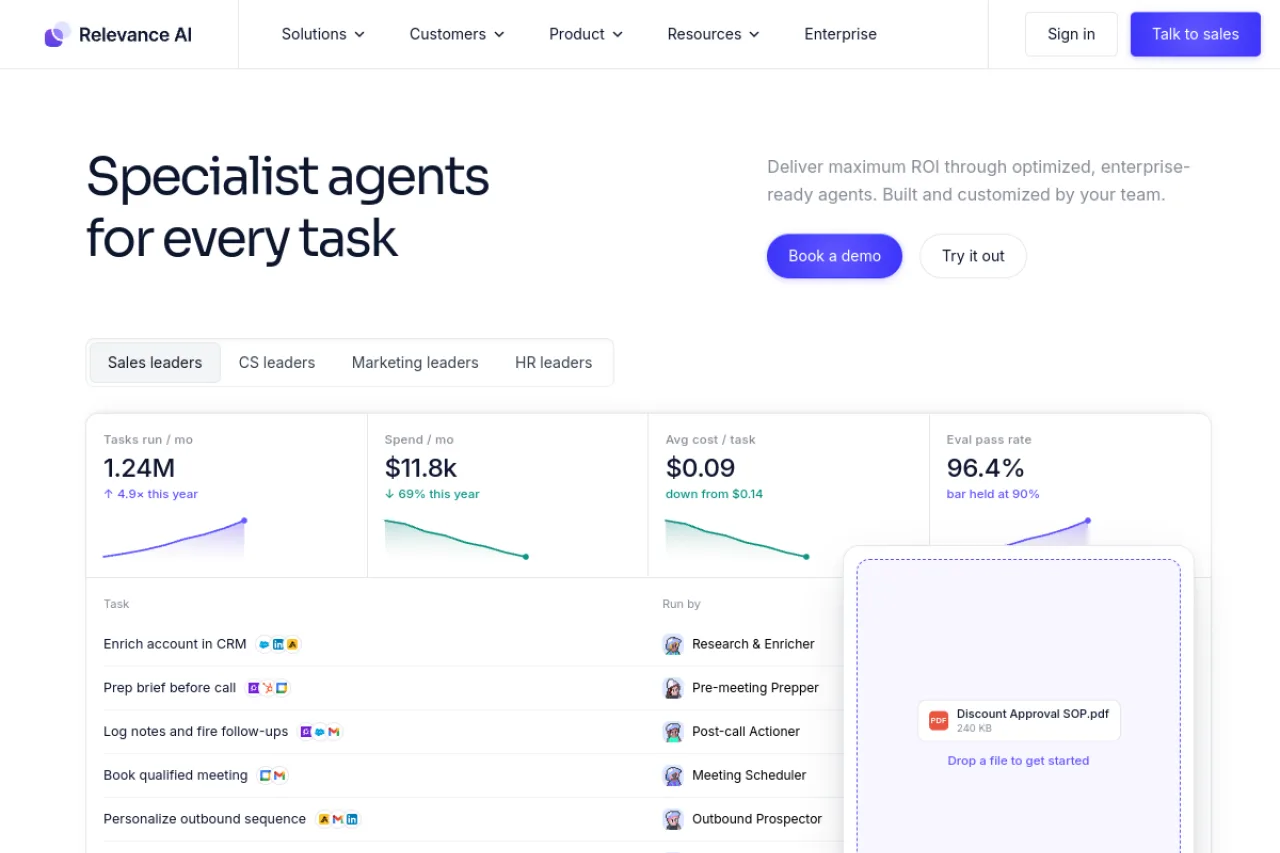
Relevance AI is an enterprise platform for building and managing teams of AI agents that automate go-to-market and operational work. It combines a visual agent builder, multi-agent orchestration, a marketplace of pre-built agents, and broad integrations with tools like HubSpot, Salesforce, and Slack. With enterprise governance features and a no-per-agent-fee model, it targets GTM and operations teams that want to scale AI-driven work under proper controls.
Relevance AI is an enterprise platform for building, deploying, and managing teams of AI agents that carry out real business work across go-to-market and operational functions. Rather than treating agents as one-off chatbots, the platform frames them as a managed 'AI workforce' that domain experts on your team supervise, evaluate, and iterate on. The emphasis is on getting reliable, auditable results at scale rather than on quick demos. At the core is a visual builder for creating agents, tools, and multi-agent workforces, paired with orchestration features that let those agents hand off tasks and collaborate. Relevance AI leans heavily into GTM use cases such as prospecting, lead research, and sales support, and it ships with a marketplace of pre-built agents that teams can customize instead of starting from scratch. Enterprise triggers, agent evaluations, and A/B testing give operators tooling to measure and improve agent output over time. Integration breadth is a defining strength: the platform connects to popular systems like HubSpot, Salesforce, Slack, Gmail, Apollo, and Gong, and its enterprise tier advertises access to thousands of integrations. This positions it to sit inside existing revenue and operations stacks rather than replacing them. Enterprise governance is treated as a first-class concern, with SSO, role-based access control, and audit logs available on the top tier alongside a dedicated account manager. The pricing model notably avoids per-agent fees, so teams can scale the number of agents and tools without linear cost growth — though the platform uses a credit-plus-usage structure that buyers should model carefully. Relevance AI is best suited to companies that want to operationalize AI across a team with proper controls, and less suited to individuals looking for a simple personal assistant. As always, buyers should confirm current plan limits, action allowances, and pricing on the official site before committing.
Relevance AI is a San Francisco-based enterprise platform for building and managing teams of AI agents that automate go-to-market and operational work. It combines a visual builder, multi-agent orchestration, a marketplace of pre-built agents, deep integrations, and enterprise governance, priced without per-agent fees. It targets GTM and operations teams that want to scale AI-driven work under proper controls, and has raised $37M in total funding.
Relevance AI, operating as OnSearch Pty Ltd, is a San Francisco-based company building an enterprise 'AI Workforce' platform. It was founded by Daniel Vassilev, Jacky Koh, and Daniel Palmer. The company positions itself as the home of the AI Workforce, aiming to help businesses decouple growth from headcount by deploying teams of AI agents supervised by human domain experts.
The platform serves a range of notable organizations, with customers and case studies featuring companies such as Canva, KPMG, Autodesk, Lightspeed Commerce, Rakuten Advertising, Qualified, and Send Payments. Its mission centers on making AI agents trustworthy and manageable at enterprise scale, especially for high-growth go-to-market teams.
The core product is a visual builder for creating AI agents, tools, and multi-agent workforces without per-agent fees. Agents can be built from scratch or customized from a marketplace of pre-built options, then connected to business systems and orchestrated to hand off tasks between one another. Enterprise triggers, calling and meeting agents, agent evaluations, and A/B testing with analytics give operators tools to measure and improve agent performance.
Integration coverage is extensive, spanning tools like HubSpot, Salesforce, Slack, Gmail, Apollo, and Gong, with the homepage citing 100+ integrations and the Enterprise tier advertising 2,000+. Enterprise governance features include SSO, role-based access control, audit logs, unlimited users and projects, and a dedicated account manager. Together these capabilities support deploying and controlling large numbers of agents across an organization.
Relevance AI primarily serves mid-market and enterprise organizations, with a strong focus on go-to-market and revenue teams alongside broader operational functions. Its buyers are typically companies seeking to scale output — pipeline generation, sales coverage, research, and process automation — without proportionally growing headcount. The enterprise emphasis on governance and integrations targets larger companies with existing CRM and operations stacks.
Sales reps, BDRs, and operations staff who work alongside agents, plus the domain experts who build and supervise them via the visual builder. They rely on agents to handle research, prospecting, and repetitive multi-step tasks.
VPs of Sales, RevOps leaders, and heads of operations who own scaling output and evaluating enterprise tooling. They care about ROI, integration fit, governance, and predictable costs.
IT and security teams evaluating SSO, RBAC, and audit requirements, and technical leads assessing orchestration and integration depth. Sales enablement and marketing ops teams also weigh in on GTM fit.
A mid-market to enterprise company with an established go-to-market motion and CRM stack that wants to deploy many AI agents across teams under enterprise governance. Ideal customers value avoiding per-agent fees and need controls, integrations, and evaluation tooling to trust agents in production.
Relevance AI raised $24 million in Series B funding led by Bessemer Venture Partners, with returning investors King River Capital, Insight Partners, and Peak XV participating, bringing total funding to $37 million. Third-party estimates have cited figures around $12.6M ARR and a $37.8M valuation, though these should be treated as unverified benchmarks.
Relevance AI is freemium, with a free entry point and paid tiers that independent coverage places roughly from $0 up to around $349/month, plus a custom-priced Enterprise plan. The free tier typically includes limited monthly actions and bonus vendor credits, unlimited agents and tools, but a single user. Because pricing blends credits with usage, model your expected action volume and verify current numbers on the official pricing page.
You build agents using a visual builder, either from scratch or by customizing pre-built agents from the marketplace. Agents are equipped with tools and connected to your systems, then combined into multi-agent 'workforces' that hand off tasks to each other. Operators supervise, evaluate, and A/B test agent output to improve reliability over time.
The platform integrates with popular GTM and operations tools including HubSpot, Salesforce, Slack, Gmail, Apollo, and Gong. The homepage cites 100+ integrations, while the Enterprise tier advertises access to 2,000+ integrations. This lets agents read from and act inside your existing CRM, communication, and sales tooling.
Yes — the Enterprise tier includes SSO, role-based access control, and audit logs, plus a dedicated account manager. These governance features are designed for organizations that need oversight and compliance when deploying agents at scale. Confirm specific certifications and data handling details with their team during evaluation.
The visual workflow builder and library of pre-built agents are designed so domain experts, not just engineers, can create and manage agents. Simple use cases can be set up quickly, but building robust multi-agent workflows with proper evaluation still takes some ramp-up. Non-technical teams should budget time to learn orchestration concepts.
Agents excel at go-to-market and operational work such as lead research, prospecting, sales support, and automating repetitive multi-step business processes. Customer examples highlight results like automated conversations, faster call handling, and increased output across teams. Design-heavy or creative visual outputs are a weaker area.
Relevance AI offers a free tier with 200 actions per month and 1,000 Vendor Credits for new signups. There is no traditional free trial. The free tier includes unlimited agents, tools, and workforces, but action limits may restrict usage for active deployments.
Relevance AI integrates with 2,000+ tools including HubSpot, Salesforce, Slack, and Gmail. The platform emphasizes connectivity across business systems, though specific integration details for individual tools should be verified on their official documentation.
Relevance AI is frequently compared to UiPath Agentic Automation, n8n, Lindy, and Langflow. It's positioned as an enterprise-focused agent orchestration platform rather than a pure workflow automation tool. Alternatives like n8n may offer more control for technical users, while Relevance AI emphasizes ease of use and pre-built agent templates for business teams.
Side-by-side pages for pricing, features, and best-fit use cases.
CrewAI excels at multi-agent orchestration, but these alternatives offer visual builders, enterprise workflows, or specialized B2B automation.
Relay.app excels at AI-powered workflow automation, but teams often need open-source flexibility, enterprise-grade agents, or specialized recruiting tools.
Relevance AI excels at enterprise agent deployment, but teams often need simpler automation, open-source flexibility, or sales-specific workflows.
Lindy is a no-code AI agent platform that automates email management, meeting scheduling, call notes, and workflow tasks across sales, marketing, support, and recruiting

A no-code canvas for building AI-powered automations and agents.

Cognition's autonomous AI software engineer that takes on tasks end to end.
Open-source local-first AI workforce coordinated by a Commander through one chat