
Relevance AI
Ai Agents
Relevance AI is an enterprise AI workforce platform for building and managing business agents at scale
automate-workflowswrite-code
Free planView →

Cognition's autonomous AI software engineer that takes on tasks end to end.
The most 'hands-off' coding agent — you assign a task and it works async. Impressive for routine work, still needs supervision on anything complex.
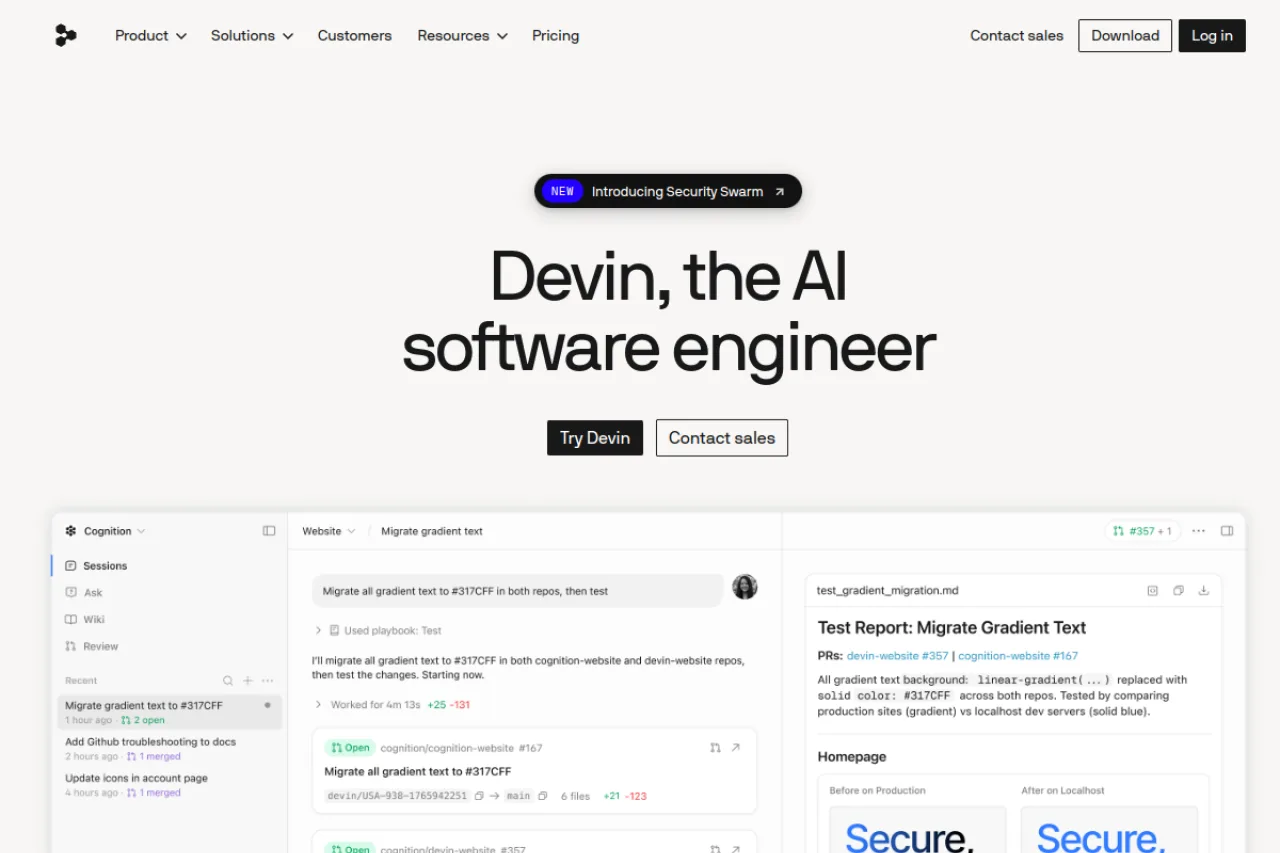
Devin, from Cognition, is an autonomous AI software engineer that plans and executes coding tasks end to end in its own environment, handling bug fixes, small features, and routine work asynchronously.
Devin is Cognition's autonomous AI software engineer — an agent you assign tasks to rather than a coding assistant you type alongside. Given a ticket, Devin plans, writes code, runs it, tests, and iterates in its own cloud environment, then opens a pull request for review. It's aimed at offloading routine engineering work — bug fixes, small features, migrations — so human engineers can focus on harder problems. It's a paid product priced for teams. Devin is genuinely impressive on well-scoped tasks, though like all agents it still needs human oversight and can struggle with ambiguous or highly complex work.
Devin is an autonomous AI software engineer developed by Cognition AI. It plans and executes complete engineering tasks, writing, debugging, testing, and deploying code with limited human intervention. Devin 2.0 introduced a lower entry price along with features such as interactive planning, repository search, and automated documentation. It targets engineering teams that want to delegate development tasks to an AI agent, with plans ranging from a free tier to enterprise.
Devin is built by Cognition AI (Cognition Labs), a US-based startup founded in 2023 and led by CEO Scott Wu. The company focuses on autonomous AI agents for software engineering and launched Devin publicly in 2024, describing it as an AI software engineer.
Cognition develops Devin as an agent that can independently take on coding tasks end to end. The company has expanded its engineering tooling portfolio, including through acquisitions, and positions Devin as a way to augment or automate developer workflows at scale.
Devin can take a natural-language task and produce a step-by-step plan before executing it, then write and edit code, run and debug it, and carry work through to deployment. Devin 2.0 added interactive planning, Devin Search for natural-language repository exploration, and Devin Wiki for automated architecture documentation.
Devin operates with its own sandboxed development environment, including a shell, editor, and browser, and integrates with source control and collaboration tools. It is designed to work on multiple tasks in parallel and to collaborate with human engineers who review and guide its work.
Devin targets software engineering teams and organizations that want to offload well-defined development tasks, backlogs, migrations, and maintenance work to an autonomous agent. It appeals to startups and enterprises seeking to increase engineering throughput, with tiers scaling from individual developers to large teams.
Software engineers and development teams delegating tasks to the agent.
Engineering leaders, CTOs, and VPs of engineering purchasing seats and enterprise plans.
Senior engineers, technical architects, and developer productivity leads.
Engineering organizations that want to automate defined coding tasks with an autonomous AI software engineer.
Cognition AI has raised significant venture funding. It raised a USD 175 million Series A led by Founders Fund at a reported USD 2 billion valuation in 2024, and by March 2025 its valuation had roughly doubled to about USD 4 billion. Subsequent rounds reportedly raised the valuation to around USD 10.2 billion, with further large fundraising reported in 2026 at higher valuations. Investors have included Founders Fund and other prominent venture firms.
No — Devin is a paid product aimed at engineering teams.
An autonomous AI software engineer that plans and executes coding tasks and opens pull requests for review.
Devin is more hands-off (assign-and-wait), while Cursor and Claude Code keep a human in the loop as they work.
Side-by-side pages for pricing, features, and best-fit use cases.
Devin markets itself as an autonomous software engineer that owns whole tasks; GitHub Copilot is an in-editor assistant. Two very different levels of hand-off.
Cursor is the right choice for most developers: it is an AI-native IDE where you stay in control, editing and reviewing alongside the AI. Devin is a fully autonomous agent you delegate whole tasks to, running in its own cloud environment, which shines for parallelizable, well-scoped work but needs more oversight and costs more per task. They are complements more than direct rivals.
DeepSeek V4.1-Flash undercuts frontier pricing, Cognition raises $2B and ships SWE-2, OpenAI opens full-duplex voice to developers, and Sora’s API dies September 24.
You know prompt engineering. "Looping" is the next idea: instead of one prompt and one answer, the AI acts, checks the result, and tries again until the job is done. Here is what that means, with examples.
Devin, Claude Code, and Cursor represent three points on the AI coding spectrum — from fully autonomous agent to agentic IDE. Here's how to choose.
Relevance AI is an enterprise AI workforce platform for building and managing business agents at scale

Lindy is a no-code AI agent platform that automates email management, meeting scheduling, call notes, and workflow tasks across sales, marketing, support, and recruiting
Open-source local-first AI workforce coordinated by a Commander through one chat

Framework and platform for building LLM apps and agents