
Tabnine
Coding
Tabnine is an AI coding assistant that provides inline code completions, in-IDE chat, and agentic workflows with a focus on privacy and enterprise control
write-code
Free planView →

Bolt is an AI-powered full-stack application builder that generates websites and apps through natural language chat
One of the fastest ways to go from prompt to a running full-stack app in the browser — great for prototypes; production still needs a real dev's eye.
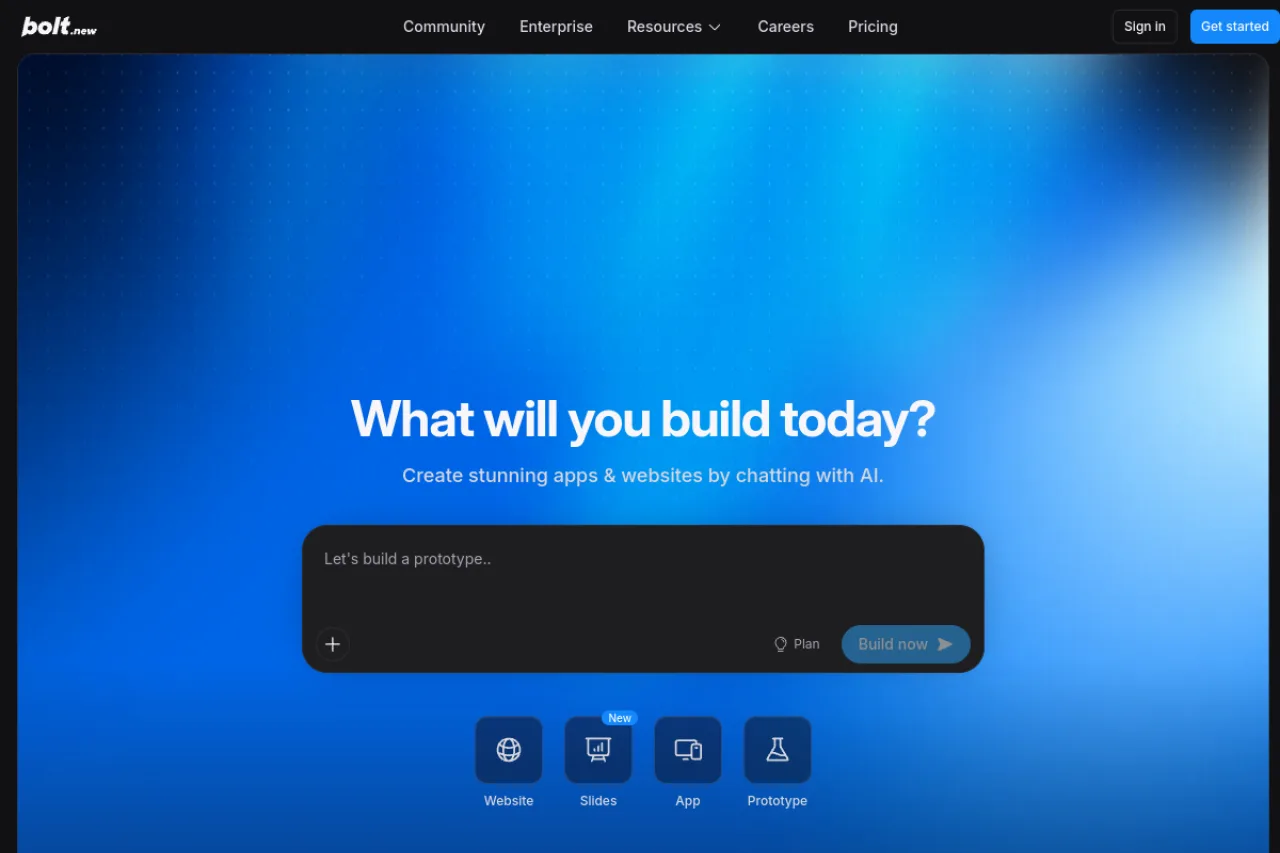
Bolt is StackBlitz's AI-powered full-stack application builder that turns natural-language chat into working websites and apps, complete with generated code, automated iteration, and one-click deployment. Its integrated Bolt Cloud layer adds hosting, databases, authentication, and analytics, while design-system imports keep output on-brand. It's strong for rapid prototyping and small-to-medium apps, though complex builds may still need manual review, and its token-based pricing rewards careful usage management.
Bolt is an AI-powered full-stack application builder from StackBlitz that lets you create websites, apps, and prototypes by describing what you want in natural language. Instead of scaffolding projects by hand, you chat with Bolt's coding agent, which generates complete project structures, writes the code, and iterates on it in a live in-browser environment. The goal is to move from an idea to a working, deployable product without leaving a single interface. The platform pairs code generation with Bolt Cloud, an integrated backend layer that bundles hosting, unlimited databases, user authentication, analytics, custom domains, and file storage. This is a meaningful differentiator: rather than stitching together a separate database provider, auth service, and host, builders get enterprise-grade infrastructure inside the same workflow. Bolt also supports importing from Figma and GitHub, and it can build against established design systems and brand component libraries so that output stays on-brand and production-oriented rather than generic. Under the hood, Bolt automatically routes each task to an appropriate model, balancing quality and cost, and offers a higher-capability tier for more demanding work. Recent iterations emphasize larger project context handling and automated testing and refactoring to reduce the errors that commonly plague AI code generation. The result is a tool aimed squarely at rapid, iterative building rather than one-shot output. Bolt works well for prototyping, landing pages, internal tools, and small-to-medium applications, and it appeals to a broad range of roles, from product managers and marketers to entrepreneurs and agencies. As with most AI app builders, more complex applications can still surface errors and require manual code review and intervention, so it suits teams that value review hygiene alongside speed. Pricing is freemium, with usage governed by a token system that scales with how heavily you lean on AI generation, plus paid tiers and custom enterprise plans. Because token-based costs and plan details can shift, prospective buyers should verify current pricing and limits on the official site before committing.
Bolt is StackBlitz's AI-powered full-stack application builder that generates websites and apps from natural-language chat and deploys them via the integrated Bolt Cloud backend. It targets fast-moving builders, from founders and product managers to agencies and students, and excels at prototyping and small-to-medium apps. Token-based pricing and the need for manual review on complex builds are the main trade-offs.
Bolt (bolt.new) is developed by StackBlitz, the venture-backed company behind WebContainer browser technology, with co-founder Eric Simons among its leadership. The product launched publicly in October 2024 and grew explosively — reaching around $20 million in ARR within two months and surpassing 2 million registered users.
Bolt has continued to expand beyond pure code generation into a fuller platform, adding Bolt Cloud for backend infrastructure and emphasizing larger project context handling, automated error reduction, and design-system-driven, production-oriented output. The company positions Bolt as a professional building tool that adapts to a range of roles rather than a single audience.
At its core, Bolt converts natural-language prompts into complete, deployable full-stack projects within a live in-browser environment. A coding agent generates project structure and code, then tests, refactors, and iterates to reduce errors, while automatic model routing selects an appropriate model per task to balance quality and cost. A higher-capability tier is available for more demanding work, and the platform is built to handle substantially larger projects than earlier versions.
Bolt Cloud extends the product into backend territory, providing hosting, unlimited databases, user management and authentication, analytics, file storage, custom domains, and SEO optimization inside one interface. This lets builders ship a working, hosted product without assembling separate services.
Bolt also supports importing from Figma and GitHub and building against established design systems and brand component libraries, so teams can produce on-brand, production-oriented interfaces rather than generic scaffolds.
Bolt serves a broad set of product-building roles rather than a single developer niche. Its primary segments include entrepreneurs and startup founders launching MVPs, product managers prototyping concepts, marketers spinning up campaign and landing pages, agencies scaling delivery, and students or indie builders learning by shipping. Custom enterprise plans extend the reach to organizations that need enterprise-grade backend infrastructure and dedicated terms.
Founders, product managers, marketers, agency staff, and student builders who want to turn ideas into working apps and pages by chatting with AI rather than coding everything by hand.
Startup founders, agency owners, and small-team leads who pay for plans to accelerate prototyping and delivery; enterprise buyers procure custom plans for backend infrastructure and team needs.
Engineering leads and designers who weigh in on code quality, design-system fit, and platform dependence, plus finance stakeholders concerned with token-based cost predictability.
A fast-moving small-to-mid-sized team or solo builder that prioritizes speed from idea to live product, values an integrated backend, and is comfortable applying code review on more complex builds.
Bolt is a product of StackBlitz, which is venture-backed (not bootstrapped). StackBlitz has raised roughly $135M in total, including a $105.5M Series B in January 2025 led by Emergence Capital and GV (with Madrona, Greylock, Insight Partners, and Conviction), at a reported ~$700M valuation, following an earlier ~$22M Series A. Bolt's growth has been among the fastest ever for a software product — from $0 to about $20M ARR within two months of its October 2024 launch and roughly $40M ARR by March 2025, with over 5 million registered users. The company has pushed hard into enterprise: in May 2026 it added a Microsoft Azure/Microsoft 365 partnership, and Bolt reports that a majority of the Fortune 500 now use the platform.
Bolt is freemium, so you can start for free without a credit card and build basic projects. Paid plans unlock more advanced features, and usage is governed by a token system that scales with how heavily you use AI generation. Annual billing carries a discount, and custom enterprise pricing is available on request; verify current rates on the official pricing page.
You describe what you want to build in natural language, and Bolt's coding agent generates the project structure and code in a live in-browser environment. You iterate by chatting, and Bolt tests, refactors, and adjusts the project as you go. When ready, you can deploy directly through the platform.
Yes. Bolt supports importing from Figma and GitHub, so you can start from an existing design or repository rather than from scratch. It also lets you build against established design systems and your team's component libraries to keep output on-brand.
Bolt automatically routes tasks to an appropriate model, balancing quality and cost, and offers a higher-capability tier for more demanding work. On the backend, Bolt Cloud provides hosting, unlimited databases, authentication, analytics, file storage, and custom domains inside the same interface.
Bolt markets enterprise-grade backend infrastructure through Bolt Cloud, including user management and authentication, and offers custom enterprise plans. It works well for prototypes, landing pages, internal tools, and small-to-medium applications. For complex builds, plan for manual code review since AI-generated output may still need correction.
Recent iterations introduced Bolt Cloud, bringing built-in databases, hosting, authentication, analytics, and file storage to address deployment friction. Bolt also expanded its context handling to manage far larger projects and added automated testing and refactoring to reduce errors during generation.
Yes, Bolt offers a free plan with 1M tokens per month (300K daily limit), public and private projects, website hosting, up to 333K web requests, and unlimited databases. The free plan includes Bolt branding on websites and has a 10MB file upload limit.
Bolt supports imports from Figma and GitHub. The Teams plan includes private NPM registries support. The platform also integrates design systems from brands like Porsche, Material UI, Chakra UI, Shadcn, and Washington Post for building with custom components and brand guidelines.
Compared to alternatives like Lovable and Claude Artifacts, Bolt offers integrated hosting and databases which addresses deployment gaps. However, reviewers note that Claude Artifacts produces cleaner, more maintainable code, while Bolt sometimes generates bloated templates. Lovable's team pricing ($50/month shared) is cheaper than Bolt Teams ($30/month per member), though Bolt's free plan offers better value than Lovable's free tier.
Side-by-side pages for pricing, features, and best-fit use cases.
From AI code editors to full-stack app builders—we reviewed 8 leading AI coding tools to help you find the right fit for your workflow and project needs.
Tabnine excels at privacy-first code completion, but developers need different tools for full-stack generation, UI design, and code review workflows.
Replit AI excels at turning natural language into full apps, but developers need alternatives for privacy-first coding, UI-only generation, or local control.
Tabnine is an AI coding assistant that provides inline code completions, in-IDE chat, and agentic workflows with a focus on privacy and enterprise control

Replit AI is an AI-powered coding platform that turns natural language into apps and websites, integrated into the Replit development environment

GitHub Copilot is an AI-powered coding assistant that works across multiple environments including IDEs, terminals, and GitHub itself

AI-native code editor with agents, full-codebase context, and multi-model support