
Bolt
Coding
Bolt is an AI-powered full-stack application builder that generates websites and apps through natural language chat
write-codebuild-appsbuild-websites
Free planView →

Tabnine is an AI coding assistant that provides inline code completions, in-IDE chat, and agentic workflows with a fo...
Our assessment — not a user rating. How we score
Verified against each vendor's own trust page. Not legal advice — confirm current status with the vendor.
Worth a look mainly for its privacy and self-hosting story — the pick for teams with strict data or compliance needs more than for raw capability.
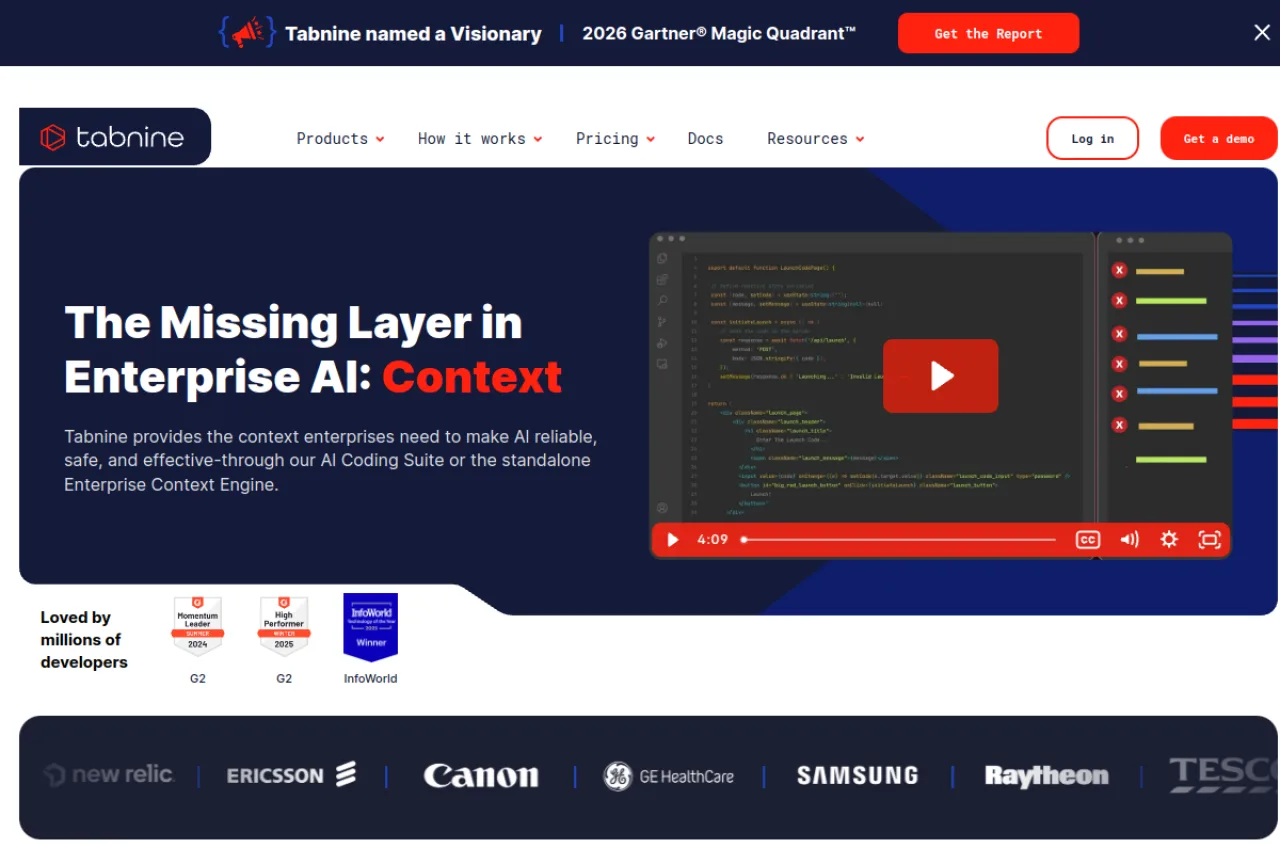
Tabnine is an enterprise-focused AI coding assistant offering inline completions, in-IDE chat, and agentic workflows, with a strong emphasis on privacy through self-hosted and air-gapped deployment options. It supports switchable and bring-your-own LLM endpoints, repository-level context via its Enterprise Context Engine, and IP-protection features like provenance and license-compliant models, making it well suited to regulated and security-conscious development teams.
Tabnine is an AI coding assistant built for teams and enterprises that need productivity gains without surrendering control of their source code. It combines inline code completions, in-IDE chat, and agentic workflows that can plan and execute multi-step development tasks across the IDE and the command line. As one of the earliest AI developer tools, Tabnine has evolved well beyond autocomplete into a broader platform spanning the software development lifecycle. A defining theme of the product is privacy and enterprise governance. Tabnine can be deployed as SaaS or fully self-hosted in a VPC, on-premises, or even fully air-gapped, and it supports zero data retention so proprietary code never leaves an organization's boundary. This positioning makes it a natural fit for regulated industries and security-conscious engineering organizations that cannot send code to a third-party cloud. The platform is model-flexible. Teams can switch between chat models, connect their own on-prem or cloud LLM endpoints, or use Tabnine-provided model access. This avoids hard lock-in to a single vendor model and lets organizations balance cost, performance, and compliance on their own terms. Tabnine's Enterprise Context Engine adds repository- and organization-level understanding so that agents and completions reflect a team's actual codebase, conventions, and architecture rather than generic patterns. Complementing this are IP-protection features such as code provenance and attribution and license-compliant models, which help reduce copyright and compliance risk from generated code. The assistant integrates with major IDEs and supports a wide range of programming languages, making it straightforward to roll out across diverse engineering teams. Buyers should confirm current plan details, model availability, and pricing on the official site, since the platform continues to evolve quickly.
Tabnine is a privacy-first AI coding assistant offering inline completions, in-IDE chat, and agentic workflows, with flexible deployment from SaaS to fully air-gapped on-prem. It supports bring-your-own LLM endpoints, repository-level context, and IP-protection features, making it especially strong for enterprises and regulated industries. Plans range from a free tier to a Dev plan around $12/user/month and Enterprise around $39/user/month, with model usage and self-hosting costs to consider.
Tabnine was founded by Dror Weiss and Jacob Jackson and is recognized as one of the original AI developer tools, predating much of the current wave of AI coding assistants. The company has evolved its product from AI-assisted code completion into a broader agentic platform spanning the IDE, CLI, and full software development lifecycle.
Tabnine positions itself around enterprise control, code privacy, and IP protection, with messaging centered on letting teams adopt AI coding without giving up control of their code. The company was named a Visionary in the 2026 Gartner Magic Quadrant for Enterprise AI Coding Agents.
Tabnine's core capabilities include inline code completions, in-IDE chat that supports the entire SDLC, and agentic workflows that can plan and execute multi-step tasks across the IDE and command line. It is model-flexible, with switchable chat models and support for connecting your own on-prem or cloud LLM endpoints.
The Enterprise Context Engine provides organization-level intelligence so agents and completions understand a team's real codebase, conventions, and architecture. Privacy and governance features include zero data retention, fully private deployment options up to air-gapped, code provenance and attribution, and license-compliant models. Tabnine is compatible with all major IDEs and supports a wide range of programming languages.
Tabnine primarily serves enterprise and team engineering organizations, with particular strength in regulated and security-conscious industries that require code to stay within their own infrastructure. It also serves individual professional developers through its Dev plan and a free tier, but its differentiation is clearest for organizations needing private deployment, governance, and IP protection at scale.
Software developers and engineers who use inline completions, in-IDE chat, and agentic workflows to write, refactor, and ship code faster within their existing IDE and terminal.
Engineering leaders, VPs of engineering, and procurement teams who evaluate AI coding tools against privacy, compliance, and total cost of ownership requirements.
Security, compliance, and platform engineering teams who assess data retention, deployment models, and IP-protection guarantees before approving adoption.
A mid-to-large enterprise or regulated-industry engineering organization that wants AI-assisted coding productivity but requires self-hosted or air-gapped deployment, model flexibility, codebase-aware context, and strong IP and code-privacy controls.
Tabnine, founded in Israel in 2012, has raised approximately $102 million. Its $25 million Series B closed in November 2023, led by Telstra Ventures with participation from Atlassian Ventures, Khosla Ventures, and others. No valuation has been disclosed.
Tabnine offers a free tier alongside paid plans, with a Dev plan commonly listed around $12 per user per month and an Enterprise plan around $39 per user per month. If you use Tabnine-provided LLM access, you also pay for reserved token consumption based on actual LLM provider prices plus a handling fee, while running your own LLM endpoint allows unlimited usage. Self-hosting adds GPU and infrastructure costs beyond the seat fee, so verify current numbers on the official pricing page.
Tabnine provides inline code completions as you type, an in-IDE chat for explaining, generating, and refactoring code, and agentic workflows that can plan and execute multi-step tasks. It works across the IDE and the command line via the Tabnine CLI, supporting coding tasks throughout the software development lifecycle. The Enterprise Context Engine feeds repository- and organization-level context into these features so output reflects your actual codebase.
Tabnine is compatible with all major IDEs and supports a wide range of programming languages. It is model-flexible, letting teams switch between chat models or connect their own on-prem or cloud LLM endpoints rather than being locked to one vendor model. This lets organizations balance cost, performance, and compliance on their own terms.
Privacy is central to Tabnine's design, with support for zero data retention and fully private deployment via SaaS, VPC, on-premises, or fully air-gapped environments. This keeps proprietary code within an organization's boundary, which suits regulated and security-conscious teams. It also includes IP-protection features such as code provenance and attribution and license-compliant models to reduce copyright risk.
Yes. Tabnine can be deployed self-hosted in a VPC or on-premises, with the option to be fully air-gapped so no data leaves the environment. Teams choosing this route should budget for additional GPU and infrastructure costs on top of the per-seat license. Running your own LLM on-prem also unlocks unlimited usage without per-token charges.
Tabnine has introduced the Enterprise Context Engine to give agents organization-level, system-aware understanding of a codebase, along with the Tabnine CLI for running AI-powered coding and automation in the terminal. It also added provenance and attribution capabilities to minimize IP liability from generated code. Tabnine was named a Visionary in the 2026 Gartner Magic Quadrant for Enterprise AI Coding Agents.
Tabnine previously offered a free plan with basic code completion and chat, but that free tier has been discontinued. The lowest paid tier now starts at $12 per user per month for individual developers, with enterprise plans at $39 per user per month.
Tabnine integrates with third-party IDEs and works across IDE and CLI environments. The research confirms good integration with major development environments, though specific IDE names were not detailed in the available materials.
Tabnine is positioned as a privacy-first alternative to GitHub Copilot, with self-hosted options that appeal to enterprises. However, user reviews suggest its free tier was inferior to Copilot's, and some users report switching back to Copilot due to quality issues. Tabnine's main advantage is privacy and compliance features rather than raw code generation performance.
Side-by-side pages for pricing, features, and best-fit use cases.
Tabnine is an AI coding assistant for inline completions and enterprise workflows, while v0 is Vercel's AI-powered UI generation tool for React components.
Compare Tabnine's privacy-focused AI coding assistant with Windsurf's agent-based IDE. Both offer freemium plans with different approaches to AI development.
Compare Replit AI's natural language app builder with Tabnine's privacy-focused coding assistant. Both offer freemium plans starting at different price points.
From AI code editors to full-stack app builders—we reviewed 8 leading AI coding tools to help you find the right fit for your workflow and project needs.
Tabnine excels at privacy-first code completion, but developers need different tools for full-stack generation, UI design, and code review workflows.
Replit AI excels at turning natural language into full apps, but developers need alternatives for privacy-first coding, UI-only generation, or local control.
Bolt is an AI-powered full-stack application builder that generates websites and apps through natural language chat

GitHub Copilot is an AI-powered coding assistant that works across multiple environments including IDEs, terminals, and GitHub itself

Replit AI is an AI-powered coding platform that turns natural language into apps and websites, integrated into the Replit development environment

AI-native code editor with agents, full-codebase context, and multi-model support