
Replit AI
Coding
Replit AI is an AI-powered coding platform that turns natural language into apps and websites, integrated into the Replit development environment
write-codebuild-apps
Free planView →

v0 is Vercel's AI-powered UI generation tool that creates React components using Next
Our assessment — not a user rating. How we score
Generates working React, Tailwind and shadcn interfaces from prompts and pushes straight to Vercel, a fast path from idea to live UI. It is happiest inside the Next and Vercel world, and the output still needs a developer to refine, so treat it as a starting point not a finished app.
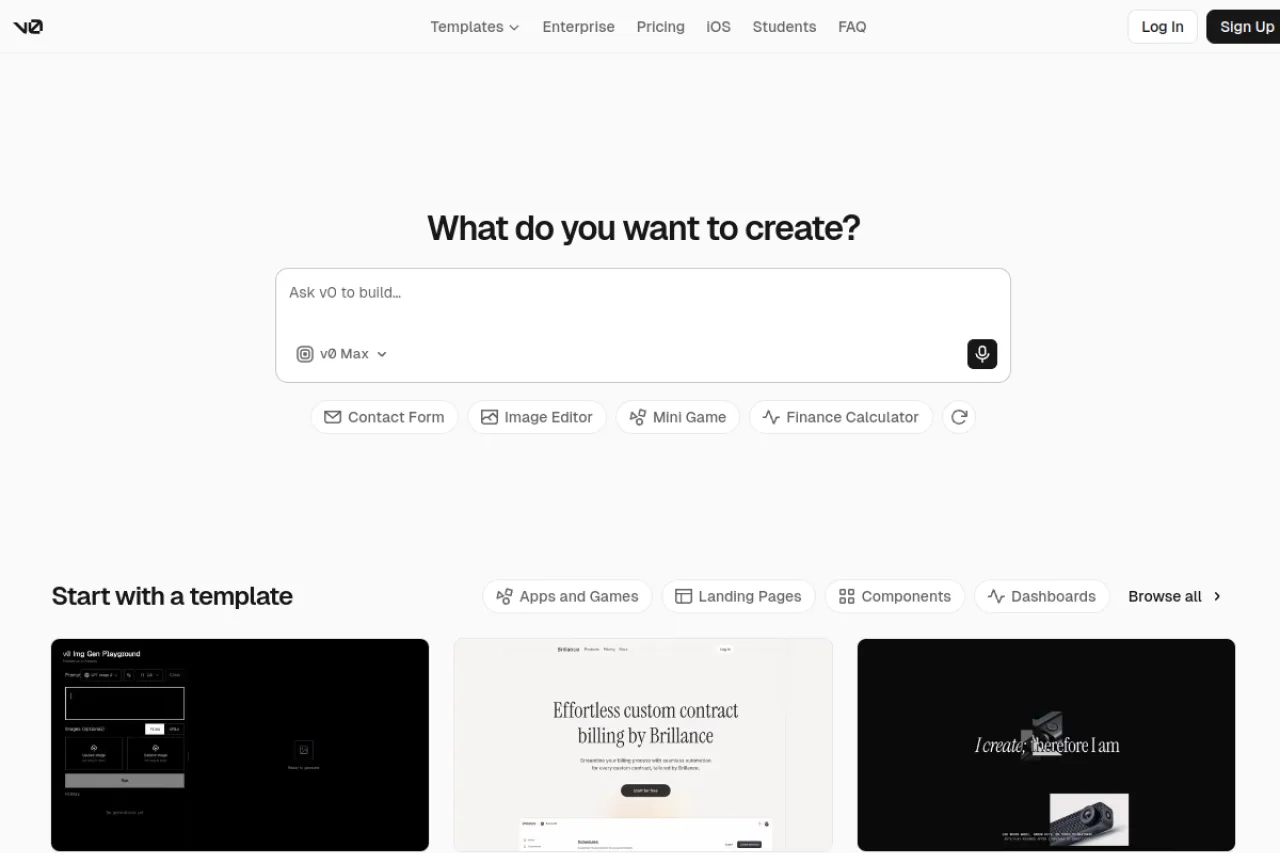
v0 is Vercel's AI tool for generating React user interfaces from natural-language prompts, producing editable code that aligns with Next.js, Tailwind CSS, and shadcn/ui. It pairs a chat workflow with a visual Design Mode, GitHub sync, and direct deployment to Vercel, making it a fast path from prompt to live frontend. It's strongest for React/Next.js developers and Vercel-native teams, with credit-based pricing across free, team, business, and enterprise tiers.
v0 is an AI-powered generative UI tool from Vercel that turns natural-language prompts into working React interfaces. It generates code that integrates naturally with Next.js, Tailwind CSS, and shadcn/ui components, making it especially well-suited to developers already building within the Vercel ecosystem. Rather than producing static mockups, v0 outputs editable, production-leaning component code you can iterate on directly. The platform combines a chat-driven workflow with a visual Design Mode, so you can refine layouts by prompting or by editing on the canvas. It also offers GitHub sync and one-click deployment to Vercel, which compresses the path from idea to a live, shareable URL. Users can start from scratch or pick from a large template library spanning landing pages, dashboards, components, and apps. While v0 originally launched as a focused UI generation tool, Vercel has broadened its positioning toward building full-stack web apps. In practice it still shines brightest on the frontend — generating polished components, marketing pages, and dashboards — and is most powerful when your stack matches the React/Next.js/Tailwind conventions it favors. Pricing is credit-based and tiered, with a free plan, individual and team options, and an enterprise track. Because usage is metered by tokens across several model tiers (Mini through Max Fast), heavy or complex generation can consume credits quickly, so buyers should map their expected workload to the model and plan that fit. Always verify current pricing and limits on the official site.
v0 is Vercel's AI-powered generative UI tool that turns natural-language prompts into React components built with Next.js, Tailwind CSS, and shadcn/ui. It combines a chat workflow with a visual Design Mode, GitHub sync, and one-click deployment to Vercel, and has expanded toward full-stack web app building. Pricing is credit-based across Free, Premium, Team, Business, and Enterprise tiers.
v0 is a product from Vercel, the company behind Next.js and the Vercel deployment platform. It was announced as a generative UI tool and has since broadened into an AI assistant for designing, iterating on, and scaling full-stack web applications. The product is deeply tied to Vercel's broader ecosystem, leaning on Next.js, Tailwind CSS, and shadcn/ui conventions and offering native deployment to Vercel.
Vercel positions v0 as appealing to a wide range of users, from professional developers to marketers and non-technical founders. The mission centers on collapsing the path from idea to a live, deployable web interface using AI-generated, editable code.
v0's core capability is generating React user interfaces from text prompts, producing editable code aligned with Next.js, Tailwind CSS, and shadcn/ui. Users can begin from scratch in a chat interface or start from an extensive community template library covering landing pages, dashboards, components, and apps.
Beyond generation, v0 offers a visual Design Mode for editing UIs on a canvas, GitHub sync to bring generated code into repositories, and direct deployment to Vercel for live URLs. It exposes multiple model tiers — v0 Mini, Pro, Max, and Max Fast — that trade speed against intelligence and are metered by token usage.
For teams, v0 adds shared chats, collaboration, centralized billing through Vercel, and training opt-out on higher tiers, with enterprise options including SAML SSO, role-based access control, priority performance, and support SLAs. A v0 iOS app extends access to mobile.
v0 primarily serves frontend and full-stack developers working in the React and Next.js ecosystem, especially those already deploying on Vercel. It also reaches designers and product builders who want to prototype interfaces quickly, as well as startups, solo builders, and non-technical founders building landing pages and apps. Higher tiers target collaborative product teams and enterprises that need governance, security, and data-protection controls.
Frontend and full-stack developers, designers, and product builders who generate and iterate on React UIs through prompts and Design Mode. They value fast prototyping and code that drops cleanly into Next.js and Tailwind projects.
Engineering leads, startup founders, and team managers who choose v0 to accelerate frontend work and shipping. They weigh credit-based costs against the productivity gains and the convenience of Vercel-native deployment.
Senior engineers, design system owners, and platform teams already standardized on Next.js, Tailwind, and Vercel who advocate for v0 because its output matches their existing conventions.
A React/Next.js-centric team or solo builder deploying on Vercel that wants to compress UI prototyping and shipping, and is comfortable with credit-based, token-metered pricing. Larger organizations are best served by Business or Enterprise tiers for data protection and governance.
Vercel, v0's parent company, has raised about $863M in total funding from investors including Accel, CRV, GGV Capital, and Bedrock. Its most recent round was a $300M Series F in September 2025 at a $9.3 billion valuation. Vercel's revenue has scaled rapidly — reaching an estimated ~$340M revenue run-rate by March 2026 (up from ~$200M ARR in May 2025), with roughly 84% year-over-year growth. v0 itself had roughly 3.5 million users as of the September 2025 Series F, and Teams and Enterprise plans reportedly account for more than half of v0's revenue.
v0 offers a free plan with $5 of included monthly credits and a 7-message daily limit. Paid tiers include Team at $30/user/month and Business at $100/user/month, both with $30 of monthly credits per user plus $2 in free daily login credits, and an Enterprise plan with custom pricing. Usage is metered by tokens, and you can buy additional credits on demand, so your real cost depends on how heavy and complex your generations are.
You describe the interface you want in a chat prompt, or start from a template, and v0 generates working React components using Next.js, Tailwind CSS, and shadcn/ui. You then iterate by prompting further or editing visually in Design Mode. Generation is powered by tiered models — v0 Mini, Pro, Max, and Max Fast — that trade speed against intelligence.
v0 syncs with GitHub and deploys directly to Vercel, so you can push generated code to a repository and ship it to a live URL with minimal setup. If you already have a Vercel account, billing and projects can be centralized there. It generates code aligned with the Next.js, Tailwind CSS, and shadcn/ui ecosystem.
On the Business plan, training opt-out is enabled by default, and on the Enterprise plan your data is never used for training. Lower tiers do not carry the same default protection, so teams with strict data requirements should choose Business or Enterprise. Always confirm the current data and training policy on Vercel's site.
Yes, Vercel offers a v0 iOS app in addition to the web experience, so you can start chats and work with projects from a mobile device. The core building and deployment workflow still centers on the web app. Check the official site for the latest platform availability.
v0 began as a generative UI tool and has expanded toward building full-stack web apps, now positioned as a collaborative AI assistant for designing and scaling web applications. In practice its strongest results are still in frontend component, landing page, and dashboard generation. Complex backend and application logic remain more limited than its UI capabilities.
Yes, v0 offers a free plan with $5 of monthly credits and basic features. However, the free tier is limited to 7 messages per day. Paid plans start at $20/month (Premium) with $20 in monthly credits, or $30/user/month (Team) with $30 in credits per user plus $2 daily login credits.
v0 integrates directly with GitHub for code syncing and Vercel for one-click deployment. It generates code using Next.js, Tailwind CSS, and shadcn UI components. The platform also includes an integration marketplace accessible through the Vercel side for additional functionality.
v0 excels at generating precise frontend React components for existing projects, particularly within the Vercel/Next.js ecosystem. However, alternatives like Lovable generate full apps with Supabase backends, Bolt.new handles full-stack development, and AIDesigner focuses on premium UI design. If you need working applications with backend functionality rather than just UI components, alternatives may be more suitable.
Side-by-side pages for pricing, features, and best-fit use cases.
Compare v0's AI UI generation for React components with Windsurf's AI-powered IDE for managing local and cloud coding agents.
Tabnine is an AI coding assistant for inline completions and enterprise workflows, while v0 is Vercel's AI-powered UI generation tool for React components.
From AI code editors to full-stack app builders—we reviewed 8 leading AI coding tools to help you find the right fit for your workflow and project needs.
Tabnine excels at privacy-first code completion, but developers need different tools for full-stack generation, UI design, and code review workflows.
Replit AI excels at turning natural language into full apps, but developers need alternatives for privacy-first coding, UI-only generation, or local control.
Replit AI is an AI-powered coding platform that turns natural language into apps and websites, integrated into the Replit development environment

Bolt is an AI-powered full-stack application builder that generates websites and apps through natural language chat

Tabnine is an AI coding assistant that provides inline code completions, in-IDE chat, and agentic workflows with a focus on privacy and enterprise control

GitHub Copilot is an AI-powered coding assistant that works across multiple environments including IDEs, terminals, and GitHub itself