Spellbook
Spellbook is an AI-powered contract drafting and review assistant designed specifically for lawyers and legal teams
Textio is an AI writing platform designed for HR teams to improve job descriptions, performance feedback, and intervi...
Textio is an enterprise AI writing platform purpose-built for HR and talent teams, offering real-time language analysis to reduce bias and improve job descriptions, performance reviews, and interview feedback. It splits into Textio Recruiting and Textio Feedback, integrates with ATS and performance management tools, and prices around covered headcount rather than active seats. It's a strong fit for large organizations investing in inclusive, consistent HR communications, though its enterprise cost may be hard to justify against cheaper general-purpose AI writing tools.
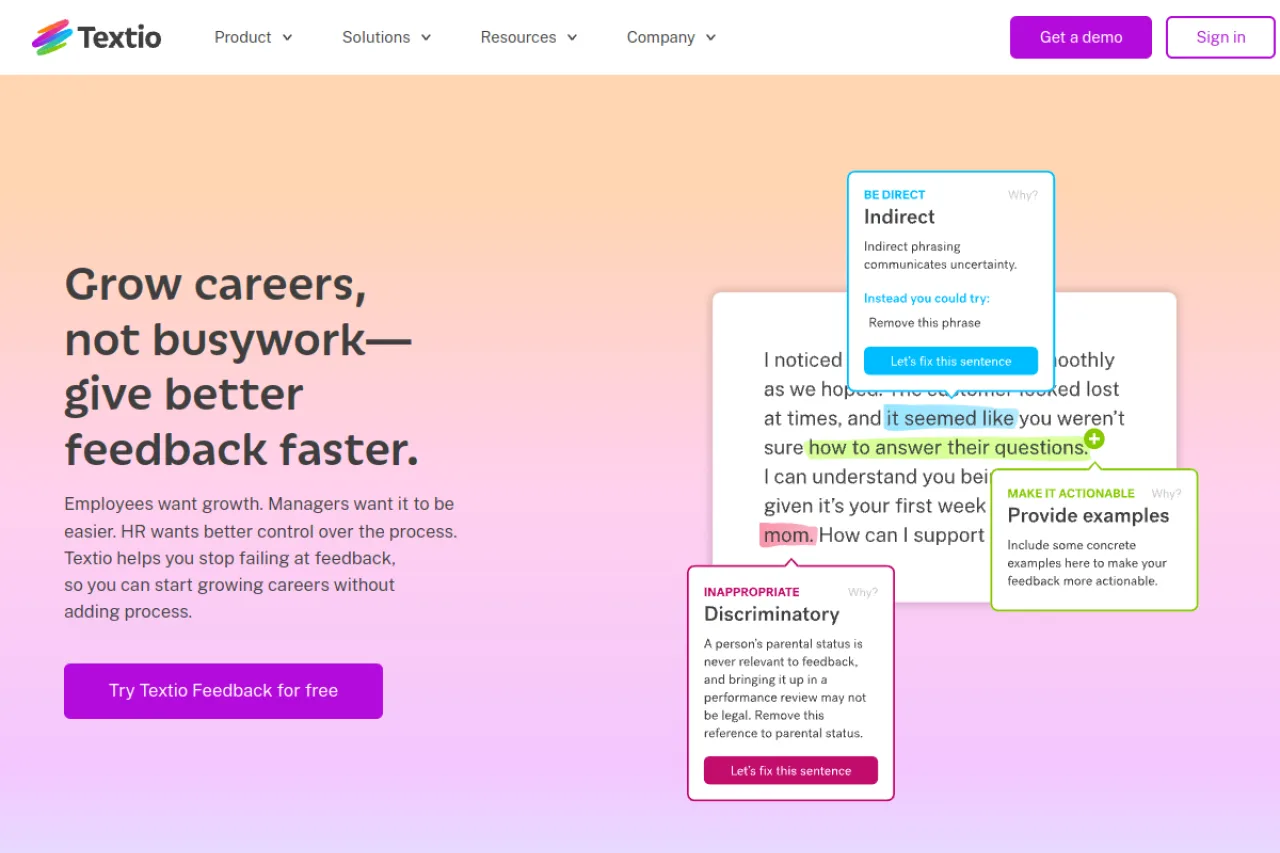
Textio is an AI-powered writing platform built specifically for HR and talent teams, rather than a general-purpose assistant retrofitted for HR use. The platform centers on two products: Textio Recruiting, which analyzes job postings and talent-acquisition content, and Textio Feedback, which supports managers writing performance reviews and interview feedback. A newer interview-feedback capability helps teams align questions to job requirements and document evaluations consistently across candidates. The defining feature is real-time language analysis. As users write, Textio surfaces phrasing that may introduce bias, weaken clarity, or drift from an employer's branding, and suggests more actionable, inclusive alternatives. For recruiting, this means job descriptions that read as more welcoming to a broader candidate pool; for feedback, it means reviews that are more specific and growth-oriented rather than vague or evaluative. Textio is designed for enterprise deployment. Teams can work directly in textio.com or extend the tooling into an existing applicant tracking system or performance management platform, which lets the analysis sit inside workflows managers already use. Pricing is oriented around covered employees—the total headcount whose reviews or feedback will be processed—rather than a simple per-active-user model, so cost scales with organizational size. The practical tradeoff is cost and predictability. Textio is quoted as enterprise software with meaningful annual minimums, and its value proposition rests on domain-tuned analysis for HR content specifically. Buyers weighing it against general AI tools should evaluate whether the specialized bias detection, D&I metrics, and workflow integration justify the premium over cheaper, broader alternatives. Prospective buyers should confirm current pricing, product scope, and covered-employee terms directly with Textio, as enterprise contracts vary by deployment and add-ons can affect the base contract value.

Textio is an enterprise AI writing platform purpose-built for HR and talent teams, split into Textio Recruiting for job descriptions and Textio Feedback for performance and interview feedback. Its real-time language analysis reduces bias and improves the clarity of HR communications, with pricing tied to covered headcount rather than active users. It suits large organizations investing in inclusive, consistent communications, though its enterprise cost is a meaningful hurdle versus cheaper general-purpose AI tools.
Textio was founded by Kieran Snyder and Jensen Harris, and positions itself as a platform that gives organizations tools to build high-performing teams by attracting diverse talent and supporting career growth. The company focuses squarely on HR and talent workflows rather than general-purpose writing, reflected in its product split between recruiting content and performance feedback.
Textio operates as an enterprise software vendor with a demo-led sales motion. According to research, the company reduced its workforce during 2024–2025, a factor buyers may consider when assessing roadmap and support continuity. Detailed funding, valuation, and revenue figures were not available in the research context.
Textio's core capability is real-time language analysis tuned for HR content. As users draft job postings, performance reviews, or interview feedback, the platform highlights biased, vague, or off-brand phrasing and offers more inclusive, actionable alternatives. This is delivered through two products: Textio Recruiting for talent-acquisition content and employer branding, and Textio Feedback for performance reviews.
A newer interview-feedback capability helps teams align interview questions to job requirements and document evaluations consistently for every candidate, supporting faster and fairer hiring decisions. The platform also surfaces quantifiable D&I and language metrics so HR leaders can measure communication quality across the organization.
Textio can be used directly at textio.com or extended into an existing applicant tracking system or performance management tool, letting managers and recruiters receive guidance inside familiar workflows. Deployment is designed to be simple to implement while scaling to large headcounts.
Textio primarily serves mid-size to large enterprises with dedicated HR, talent acquisition, and people management functions. It is well-suited to organizations that prioritize inclusive hiring, consistent performance feedback across many managers, and measurable D&I outcomes. Its enterprise pricing and covered-employee model make it a poor fit for individuals, very small teams, or budget-constrained buyers.
Recruiters, hiring managers, and people managers who write job posts, performance reviews, and interview feedback and want in-the-moment guidance to improve quality and reduce bias.
HR and talent leaders, VPs of People, and heads of talent acquisition who approve enterprise software budgets and own communication quality and inclusive hiring goals.
DEI practitioners, HR operations teams, and recruiting-ops leaders who evaluate integration with existing ATS and performance tools and champion measurable language improvements.
A mid-size to large enterprise with a formal performance review cycle and active hiring, that invests in inclusive communications and D&I metrics and is willing to commit to an annual, headcount-based contract.
Textio, based in Seattle, raised approximately $42.5 million through a Series B from investors including Emergence Capital and Scale Venture Partners. It remains independent and privately held; co-founder Jensen Harris became CEO in January 2024, succeeding Kieran Snyder, and the company undertook several rounds of layoffs between 2023 and 2025.
Textio uses enterprise pricing and does not publish a standard rate card; its standard plan is generally quoted starting in the low five figures per year, with custom pricing for larger organizations. Pricing is based on covered employees—the headcount whose reviews or feedback will be processed—rather than active users, and add-ons can raise the base contract value. Confirm current terms directly with Textio during a demo.
Recruiters and managers write content—job posts, performance reviews, or interview feedback—inside Textio or a connected tool, and the platform analyzes the text in real time. It flags biased, vague, or off-brand language and suggests stronger, more inclusive alternatives as you type. The goal is to improve the content before it's published or shared, not to fully automate the writing.
Yes. Teams can work directly at textio.com or extend Textio's analysis into an existing applicant tracking system or performance management platform. This lets managers and recruiters get suggestions inside the workflows they already use. Specific supported integrations depend on your stack, so verify compatibility with Textio for your ATS or HRIS.
Textio Recruiting focuses on talent-acquisition content such as job descriptions, improving inclusivity and alignment with employer branding. Textio Feedback supports managers writing performance reviews, with a newer interview-feedback capability that helps standardize hiring decisions. Organizations can adopt one or both depending on their needs.
Textio is built and priced for enterprise use, with annual contracts scaled to covered headcount. Small teams and individuals will likely find the cost hard to justify and may get comparable basic bias-checking from cheaper general-purpose AI writing tools. It's best positioned for mid-size to large organizations investing in HR communication quality at scale.
Textio added an interview-feedback product to help teams make faster, fairer hiring decisions by aligning questions to job requirements. The company also reportedly reduced its workforce in 2024–2025, which buyers may want to weigh when evaluating long-term roadmap and support. Ask about current product direction and support commitments during your evaluation.
No, Textio does not offer a free plan or free trial according to the research. Pricing is subscription-based starting at approximately $10,000 per year for the standard plan.
Integration details were not found in our research — check the official Textio website or contact their sales team for information about specific integrations with ATS, HRIS, or other HR systems.
According to G2 reviews, top alternatives include Datapeople (by Payscale), SeekOut, and Rippling. Cost comparisons suggest Textio has a premium price point — with a three-year TCO around $150,000 compared to $60,000 for Grammarly Business or $100,000 for Ongig. Some reviewers note that general AI tools like ChatGPT Plus offer similar bias-checking at much lower cost, though Textio provides HR-specific features and analysis.
Side-by-side pages for pricing, features, and best-fit use cases.
Spellbook focuses on AI-powered contract drafting for lawyers, while Textio specializes in HR writing for job descriptions and performance feedback.
Sudowrite is an AI writing assistant for fiction authors, while Textio focuses on HR writing like job descriptions and performance feedback.
Textio targets HR teams with specialized feedback and recruiting tools, while Wordtune offers a freemium AI writing assistant for general paraphrasing and rewriting.
Lavender excels at sales email coaching, but these six alternatives serve marketers, HR teams, teachers, and fiction writers who need AI writing help outside the SDR workflow.
Sudowrite excels at fiction writing, but alternatives like Rytr, HyperWrite, and others offer broader use cases, different pricing models, or specialized features.
HyperWrite offers web search and citations, but writers need different strengths. Compare 6 alternatives for fiction, paraphrasing, and enterprise use.
Spellbook is an AI-powered contract drafting and review assistant designed specifically for lawyers and legal teams
Writesonic is an AI search growth engine designed to help brands improve their visibility in AI-powered search platforms like ChatGPT, Perplexity, and other generative AI tools
TextCortex is an enterprise AI agent infrastructure platform that helps organizations deploy, organize, and govern AI agents across their workplace
Wordtune is an AI writing assistant that helps users paraphrase, rewrite, and refine their writing with grammar correction and summarization features