
NotebookLM
Research
NotebookLM is Google's AI-powered research assistant that helps you summarize, analyze, and query your own documents with source citations
do-researchorganize-notesanswer-questions
Free planView →

Paradox is an AI-powered conversational recruiting platform designed to automate hiring workflows for frontline and h...
Verified against each vendor's own trust page. Not legal advice — confirm current status with the vendor.
Its Olivia assistant excels at high-volume hourly recruiting, automating screening, scheduling, and candidate questions via text to cut time-to-hire. The honest caveat is it is built for enterprise volume hiring, not nuanced professional or executive roles.
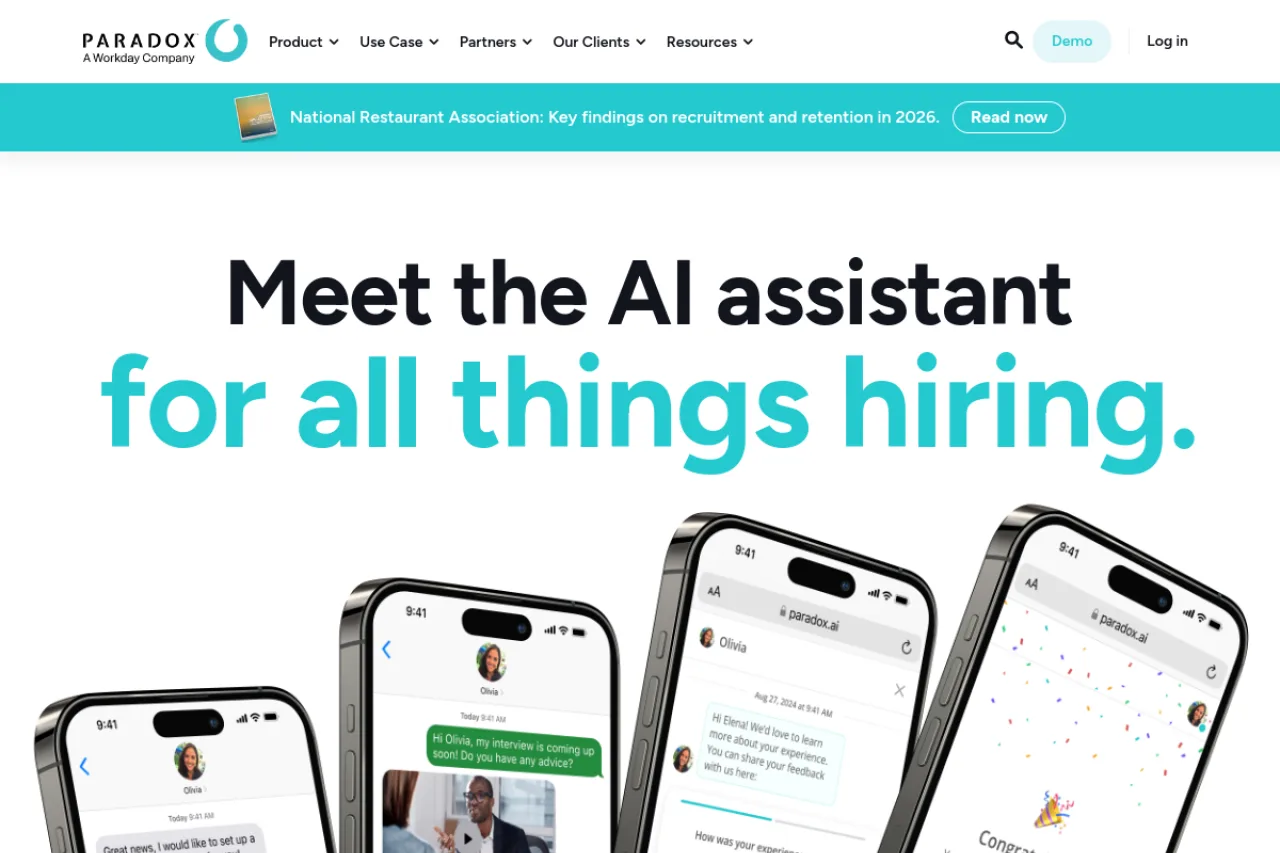
Paradox is an AI-powered conversational recruiting platform centered on an assistant named Olivia that automates screening, scheduling, and candidate communication for high-volume and frontline hiring. Delivered largely through two-way text and chat and integrated with systems like Workday, SAP SuccessFactors, and Indeed, it is aimed at enterprise employers in retail, restaurants, healthcare, and logistics that need to hire quickly and at scale. Pricing is enterprise-oriented and quoted based on volume, so it fits large organizations more than small teams.
Paradox is a conversational hiring platform built around Olivia, an AI recruiting assistant that automates the repetitive, high-volume parts of the hiring process. Rather than asking candidates to fill out lengthy web forms, Paradox lets them apply, screen, and schedule interviews through natural text and chat conversations — a model that fits the mobile-first, on-the-go reality of frontline job seekers in retail, restaurants, healthcare, logistics, and manufacturing. The platform is organized into a suite of conversational products: a Conversational ATS designed for frontline workers and managers, a Conversational CRM for pipelining and organizing talent, Conversational Career Sites, Conversational Apply for automated screening, Conversational Scheduling to eliminate calendar back-and-forth, and Conversational Events for campus and hiring-event management. Together these tools aim to automate a large share of routine recruiter work so hiring teams can move faster on high-volume requisitions. Paradox leans heavily on two-way SMS and chat as its primary interface, which suits industries where speed to hire and candidate responsiveness matter more than long-form portfolios or complex assessments. It integrates directly with major enterprise HR systems, most notably Workday, SAP SuccessFactors, and Indeed, so it can act as an automation layer on top of an organization's existing applicant tracking infrastructure. The product is positioned squarely at enterprise and multi-location employers that hire at scale. Its strengths are the automation of screening and scheduling and a candidate experience built for mobile, while its trade-offs include enterprise-oriented pricing and a text-first design that isn't built for video-heavy or portfolio-based evaluation. Buyers should confirm current pricing and product scope directly with Paradox, since deployments are typically quoted based on hiring volume and configuration needs.
Paradox is a conversational hiring platform built around an AI assistant named Olivia that automates screening, scheduling, and candidate communication for high-volume, frontline roles. It works largely through two-way text and chat and integrates with enterprise systems like Workday, SAP SuccessFactors, and Indeed. Pricing is custom and enterprise-oriented, making it best suited to large, multi-location employers hiring at scale.
Paradox, based in Scottsdale, Arizona and founded by Aaron Matos, makes conversational recruiting software built around its AI assistant Olivia, which automates screening, scheduling, and candidate communication for high-volume roles. In 2025 Paradox was acquired by Workday (announced August 21, 2025; closed October 1, 2025) and now operates within Workday.
Paradox's core is Olivia, an AI recruiting assistant that engages candidates through text and chat to handle applications, screening, and scheduling. The platform is packaged as a suite of conversational products: a Conversational ATS for frontline workers and managers, a Conversational CRM for pipelining and organizing talent, Conversational Career Sites, Conversational Apply for automated screening, Conversational Scheduling to remove calendar coordination, and Conversational Events for campus and hiring-event management.
Beyond these, Paradox offers capabilities spanning text recruiting, recorded video interviews, screening, onboarding, and surveys. The design is deliberately mobile-first and text-centric, optimized for fast, high-volume hiring rather than deep, multi-format candidate assessment.
The platform is built to sit on top of existing HR systems, with native partnerships including Workday, SAP SuccessFactors, and Indeed. The Workday integration enables candidate SMS communication and automated interview scheduling directly within that environment, allowing organizations to automate a large share of the hiring process without replacing their core ATS.
Paradox primarily serves large, often multi-location enterprise employers with high-volume, frontline hiring needs. Its industry solutions target retail, restaurants, franchise hiring, healthcare, logistics and trucking, manufacturing, financial services, and hospitality — sectors where speed to hire, candidate responsiveness, and mobile accessibility are critical. The platform is a poorer fit for small businesses with low hiring volume or teams focused on specialized professional roles.
Recruiters, hiring managers, and talent acquisition coordinators who use Olivia to automate screening, scheduling, and candidate communication for frontline roles. Frontline job candidates also interact directly with the platform via text and chat.
VPs and directors of talent acquisition, HR operations leaders, and procurement teams at enterprise organizations who evaluate and budget for recruiting technology.
HRIS and IT teams responsible for ATS integrations, recruiting operations analysts, and executive sponsors focused on reducing time-to-hire and administrative cost.
A large, multi-location employer in retail, restaurants, healthcare, or logistics that hires at high volume, already runs an enterprise ATS such as Workday or SAP SuccessFactors, and has budget for a configured, enterprise-grade automation platform.
Before its acquisition, Paradox raised a $200 million Series C at a $1.5 billion valuation, reaching unicorn status, from investors including Thoma Bravo, Sapphire Ventures, and Stripes. It was acquired by Workday in 2025 (deal closed October 1, 2025); terms were not disclosed.
Paradox uses custom, enterprise-oriented pricing rather than published self-serve plans, and quotes are typically based on hiring volume and configuration needs. Industry reviews place it in a custom pricing band consistent with enterprise conversational AI platforms, with starting points reported in the low thousands per month and annual budgets that can exceed several tens of thousands for large deployments. Confirm current figures and scope directly with Paradox.
Candidates interact with an AI assistant named Olivia primarily through text and chat, completing applications, answering screening questions, and self-scheduling interviews conversationally. On the recruiter side, this automation reduces manual coordination and administrative work, so teams can focus on qualified candidates. The workflow is designed to be mobile-first for frontline applicants.
Paradox is deployed as a configured enterprise solution rather than an instant sign-up tool, and it typically layers onto an existing applicant tracking system. Multi-location operations and bespoke ATS setups require more configuration effort, which adds to first-year total cost of ownership. Plan for an implementation phase when evaluating time-to-value.
Paradox offers native partnerships with major enterprise HR platforms, including Workday, SAP SuccessFactors, and Indeed. The Workday integration enables candidate communication via SMS and automated interview scheduling directly within that system. Paradox also maintains a broader list of supported partners and integrations for connecting to existing recruiting stacks.
Paradox is fundamentally a text- and chat-based conversational platform, and while it offers recorded video interviews as a feature, its core strength is high-volume screening and scheduling rather than in-depth evaluation. Organizations that rely heavily on video interviews, portfolio submissions, or multi-format assessments will likely need additional tools alongside it. It is best matched to roles where speed and volume matter more than detailed candidate portfolios.
Paradox is designed for large, often multi-location employers with high-volume, frontline hiring needs in industries such as retail, restaurants, healthcare, logistics, and manufacturing. Its automation and enterprise pricing model make the most sense for organizations already running a complex ATS and hiring at scale. Smaller teams with low hiring volume are less likely to see a return.
No, Paradox does not offer a free plan or free trial according to available pricing information. The platform operates on a custom enterprise pricing model, and specific costs are not publicly disclosed.
Integration details were not found in our research — check the official Paradox website or contact their sales team for information about ATS, HRIS, and other system integrations.
Paradox excels at scheduling automation and basic screening with a 4.7-star G2 rating, but alternatives like HireVue deploy faster (1-2 days vs. 2-3 months) and platforms like Alex conduct deeper conversational interviews with technical assessments. Paradox scores highest in Candidate Relationship Management (9.1) compared to competitors like Sense (8.8).
Side-by-side pages for pricing, features, and best-fit use cases.
NotebookLM is Google's AI-powered research assistant that helps you summarize, analyze, and query your own documents with source citations

Ada is an AI-powered customer service automation platform that handles support conversations across voice, messaging, and email channels

Zendesk AI is an AI-powered customer service platform that automates ticket resolution and assists support agents across multiple channels

MeetGeek is an AI meeting assistant that automatically records, transcribes, and summarizes video meetings across platforms like Zoom and Microsoft Teams