
Zendesk AI
Customer Support
Zendesk AI is an AI-powered customer service platform that automates ticket resolution and assists support agents across multiple channels
support-customersanswer-questionsautomate-workflows
Free planView →

Ada is an AI-powered customer service automation platform that handles support conversations across voice, messaging,...
Our assessment — not a user rating. How we score
Verified against each vendor's own trust page. Not legal advice — confirm current status with the vendor.
The strongest pick for scaling tier-one support without adding headcount, resolving routine inquiries across channels and languages. But outcomes hinge on the quality of your knowledge base, so it fits high-volume support orgs more than thin ones.
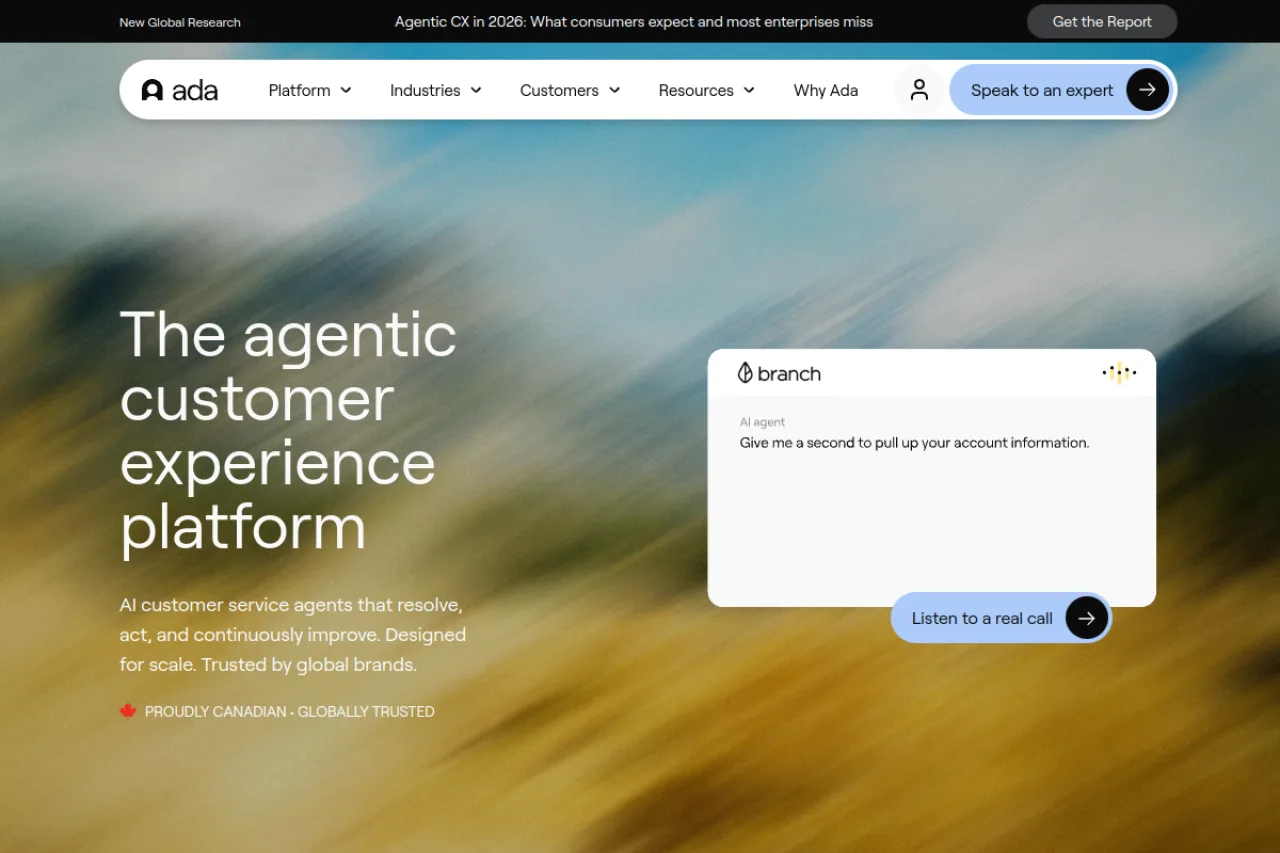
Ada is an enterprise-grade AI customer service platform that automates support conversations across voice, chat, email, and SMS using a multi-LLM reasoning engine and "Playbooks" for multi-step process automation. It emphasizes deep system integrations, multilingual support, and no-code flow building for non-technical teams, with volume-based pricing that suits high-throughput support organizations more than small businesses.
Ada is an AI-powered customer service automation platform that resolves support conversations across voice, messaging, email, and SMS channels. Rather than routing every inquiry to a human, Ada aims to automate a large share of routine and moderately complex interactions using a multi-LLM reasoning engine, freeing support teams to focus on the cases that genuinely require human judgment. At the center of the product is what Ada calls agentic AI paired with "Playbooks" — structured automations that encode standard operating procedures so the AI can execute multi-step processes rather than simply answering FAQ-style questions. Deep integrations connect Ada to CRMs, order systems, and internal tools, allowing responses to be personalized with real customer data and delivered in multiple languages. Ada is squarely an enterprise product. It is designed for organizations with high conversation volumes and dedicated support operations, and it serves industries such as ecommerce, financial services, gaming, health and property insurance, SaaS, and travel. Non-technical teams can generally build and manage automated flows without heavy engineering support, which lowers the barrier to ongoing iteration. Pricing is quote-based and volume-oriented, structured around automated conversations or AI resolutions rather than per-seat licensing. That model rewards scale but makes cost harder to predict for smaller teams, so prospective buyers should confirm current pricing and packaging directly with Ada before committing.
Ada is an enterprise AI customer service platform that automates support conversations across voice, chat, email, and SMS using a multi-LLM reasoning engine and agentic "Playbooks." It targets high-volume support teams in ecommerce, finance, insurance, gaming, SaaS, and travel with deep integrations and multilingual coverage. Pricing is quote-based and volume-oriented, reportedly starting around $30,000 per year, making it a better fit for established organizations than small teams.
Ada was founded by Mike Murchison and David Hariri and operates as a customer service automation company serving SaaS, B2B, and broader customer service markets. The platform's mission centers on automating a large share of support interactions so that businesses can deliver fast, personalized service at scale while reserving human agents for complex cases.
The company has grown into an enterprise-focused vendor serving customers across multiple industries and geographies, with a product strategy built around agentic AI, multi-channel coverage, and deep integration into existing business systems.
Ada's core is a multi-LLM reasoning engine that powers automated conversations across chat, email, voice, and SMS. Rather than tying itself to a single model, it can leverage multiple large language models to interpret intent and generate resolutions.
The standout capability is "Playbooks," which let teams encode standard operating procedures so the AI can execute multi-step tasks — such as order lookups, account changes, and refunds — instead of only answering questions. Integrations with CRMs and back-end systems enable personalized, data-driven responses, and multilingual support extends automation across global audiences.
Ada is designed for non-technical support teams to build and maintain flows through a largely no-code interface, with analytics to monitor and improve automation performance over time. Advanced features like multilingual AI, workflow automation, and detailed analytics tend to sit in higher pricing tiers.
Ada serves enterprise customer support and CX organizations with high conversation volumes. Its named focus industries include ecommerce, financial services, gaming, health insurance, property and casualty insurance, SaaS, and travel, and it is used by a range of technology and consumer companies. The platform's pricing and integration requirements make it best suited to established businesses rather than small teams or budget-constrained startups.
Support agents and CX operations staff who configure automated flows, monitor performance, and handle escalated conversations that the AI passes along with context.
CX and customer support leaders, VPs of support, and operations executives responsible for scaling support capacity and controlling cost per contact.
Support operations managers, IT and integration teams, and analytics owners who evaluate technical fit, data connectivity, and reporting needs.
A mid-to-large enterprise with high support volume across multiple channels and languages, existing CRM and back-end systems to integrate, and the budget for a quote-based, usage-priced automation platform.
Ada is an independent AI customer-service automation company based in Toronto, founded in 2016. It raised a $130M Series C led by Spark Capital (with Tiger Global) at a $1.2 billion valuation, reaching about $200M in total funding and unicorn status. Ada's Reasoning Engine orchestrates multiple LLMs to resolve multi-channel customer inquiries, serving 350+ enterprise customers including Monday.com, Pinterest, and Verizon.
Ada uses quote-based, volume-oriented pricing rather than simple per-seat plans, and it reportedly starts around $30,000 per year. Costs are driven by automated conversation or AI resolution volume, with additional charges for implementation, integrations, and premium support. Because pricing scales with usage and feature tier, you should request a current quote directly from Ada.
Ada uses a multi-LLM reasoning engine to understand customer questions and resolve them across chat, email, voice, and SMS. Its "Playbooks" let teams encode multi-step procedures so the AI can complete tasks — not just answer questions — while integrations pull in live customer data for personalized responses. Support teams configure and refine these flows through a largely no-code interface.
Ada is designed so non-technical support teams can build and manage automated flows without deep engineering work. That said, connecting it to CRMs and back-end systems and configuring Playbooks is an enterprise implementation effort, and Ada offers premium support and integration services for this. Note that certain content sources such as PDFs or historical tickets may not be directly ingestible, which can affect onboarding.
Ada connects to CRMs, order and account systems, and other internal tools so it can personalize responses with real customer data. Under the hood it runs a multi-LLM reasoning engine, meaning it can draw on multiple large language models rather than being tied to a single provider. Confirm the specific connectors and platforms your stack requires during the sales process.
Yes. Ada supports automated conversations in multiple languages, which is one reason it appeals to enterprise support organizations operating across regions. Advanced multilingual capabilities are typically bundled into higher pricing tiers, so verify language coverage and tier requirements for your use case.
Ada is built for enterprise support teams handling high conversation volumes across industries like ecommerce, financial services, gaming, insurance, SaaS, and travel. It is used by a range of technology and consumer companies. Its pricing and integration model make it a stronger fit for established organizations than for small teams or startups with light support needs.
No, Ada does not offer a free plan or free trial. Pricing is custom and based on conversation volume, with typical starting costs around $30,000 per year according to third-party pricing research.
Ada offers integrations to connect with existing systems for personalized support across channels and languages. According to alternative comparison sources, full feature functionality requires Zendesk or Salesforce integration, though the platform mentions custom API integrations and middleware capabilities.
Ada is positioned as an enterprise-focused platform with strong ease-of-use ratings. Alternatives like Fin by Intercom are cited as top competitors. Key differentiators for Ada include industry-specific playbooks and multi-channel support (voice, messaging, email), though alternatives may offer more transparent pricing, broader helpdesk support, and faster deployment times.
Side-by-side pages for pricing, features, and best-fit use cases.
Zendesk AI is an AI-powered customer service platform that automates ticket resolution and assists support agents across multiple channels

ElevenLabs is an AI audio and content creation platform offering three main products: ElevenCreative for generating speech, music, and video content across 70+ languages; ElevenAgents for deploying co

Claude is an AI chatbot developed by Anthropic, offering conversational AI capabilities with multiple model tiers (Opus, Sonnet, Haiku) and specialized products including Claude Code for software deve

Gemini is Google's multimodal AI chatbot that handles text, images, audio, and video understanding with real-time Google Search integration and deep Google Workspace compatibility