
Reflect
Note Taking
Reflect is an AI-powered note-taking app designed for personal knowledge management with networked notes and backlinks
organize-notes
View →
Mem is an AI-powered note-taking and knowledge management platform that automatically organizes notes, meetings, and ...
Good for people who want a low-friction notes app that auto-connects related notes and surfaces them via AI search instead of manual folders. The tradeoff is weak formatting and structure, so it suits idea capture more than polished long-form documents.
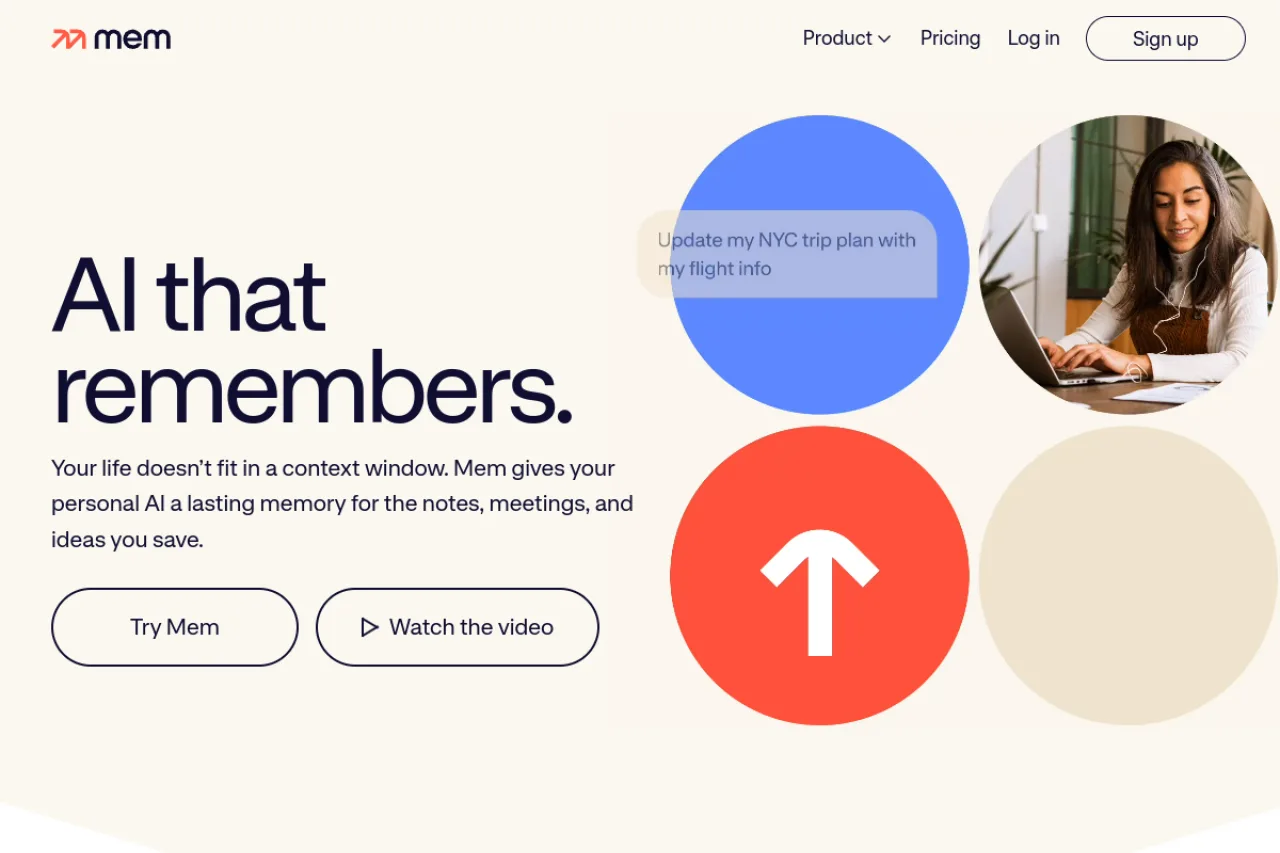
Mem is a paid AI note-taking and knowledge management platform that automatically organizes notes, meetings, and research so users don't have to build folders or tags. It captures input via voice, meeting transcription, a Chrome extension, and quick messages, then uses an AI chat interface to recall information, surface related context, and draft content from your accumulated notes. Mem 2.0 reached general availability in October 2025 with tiered pricing, and it fits knowledge workers, executives, and researchers who want retrieval-first, low-effort organization.
Mem is an AI-powered note-taking and knowledge management platform built around a simple promise: capture anything on your mind and let the software handle the organizing. Instead of asking users to build folder hierarchies or maintain tagging systems, Mem ingests voice memos, meeting recordings, web clippings, and quick text messages, then structures that material automatically into collections or surfaces suggested groupings based on context. At the heart of the product is an AI chat interface that treats your accumulated notes as a personal knowledge base. You can ask questions in natural language, recall details from past notes without remembering exact keywords, and have Mem draft or update content conversationally. A feature the company calls Heads Up proactively brings up related notes, timelines, and collections as you work, so relevant context appears without you searching for it. Capture happens across multiple channels. Mem records and transcribes meetings and can generate meeting notes on your behalf, a Chrome extension saves any web page in a single click, and quick messages let you dump ideas on the go. The platform positions itself as a "thought partner" or second brain rather than a traditional document editor, leaning into retrieval and recall over manual structure. Mem 2.0 moved from alpha to general availability on October 1, 2025, arriving alongside the company's first formal pricing structure. Recent additions include calendar integration, a Claude connector, and the ability for external LLMs to use your Mem notes as context. Buyers should confirm current plan details and feature availability on Mem's official pricing page, as the product and its tiers have evolved quickly. Mem is best suited to individuals and small teams who generate a high volume of unstructured notes and want AI to shoulder the organizational burden. Those who prefer local-first storage, offline access, or granular manual control over their data structure may find the automated, cloud-based approach less aligned with their needs.
Mem is an AI note-taking and knowledge management platform that automatically organizes notes, meetings, and research so users don't have to build folders or tags. It captures voice, meetings, web clips, and messages, then uses AI chat and proactive context surfacing to help users recall and reuse everything they save. Founded by Kevin Moody and Dennis Xu, Mem raised a $23.5M Series A in November 2022 and reached 2.0 general availability with tiered pricing in October 2025.
Mem Technologies is the company behind Mem, an AI-powered note-taking and knowledge management platform. The company was founded by Kevin Moody and Dennis Xu, and its product is positioned as an AI 'thought partner' or second brain that captures information and organizes it automatically, eliminating traditional folder-based systems.
Mem's mission centers on offloading the mental burden of remembering and organizing: users dump ideas, meetings, and research into the platform and rely on AI to structure, connect, and surface that information when it's needed. The company reached a major milestone when Mem 2.0 moved from alpha to general availability on October 1, 2025, alongside its first formal pricing structure. Mem is SOC 2 Type II compliant.
Mem's core capabilities span capture, organization, and retrieval. On the capture side, users can record and transcribe meetings, save web pages with a single click via the Chrome extension, dictate voice brain dumps that become structured notes, and send quick messages on the go. Captured material is organized automatically into collections, or grouped based on suggestions the AI generates from context.
Retrieval is where Mem differentiates itself. An AI chat interface answers questions about your notes, finds information you can describe but not name precisely, and drafts or updates content conversationally. The Heads Up feature proactively surfaces related notes, timelines, and collections without requiring a manual search.
Recent additions extend Mem's connectivity, including calendar integration, a Claude connector, AI model selection, connected emails, API keys, and beta features such as meeting briefs. The platform also lets external LLMs use a user's notes as context, turning Mem into a knowledge source for other AI tools.
Mem serves individual knowledge workers, executives, researchers, and small teams who produce large volumes of unstructured notes and want AI to handle organization and recall. Its pricing structure is designed to scale from individual users through small teams to enterprise clients, with free, Pro, and Teams tiers.
Individual professionals—founders, consultants, executives, and researchers—who capture ideas, meeting notes, and web research throughout the day and want to retrieve them effortlessly later without manual filing.
For personal use, the end user is typically the buyer, choosing a Pro subscription. For small teams, a team lead or manager evaluates the Teams plan for shared, AI-organized knowledge.
Productivity enthusiasts, second-brain and personal knowledge management advocates, and team members who champion AI tools that reduce administrative overhead.
A busy knowledge worker or small team that generates more notes and meetings than they can organize manually, values retrieval-first AI recall over rigid structure, and is comfortable with a cloud-based, subscription tool rather than a local-first alternative.
Mem's most recent funding round was a $23.5M Series A on November 10, 2022, from which its latest post-money valuation is dated. The OpenAI Startup Fund is associated with the company's funding.
Mem offers a limited free plan alongside paid tiers introduced when Mem 2.0 reached general availability on October 1, 2025. The most affordable paid option is Pro, listed at $14.99/month, with a Teams plan available for multi-user accounts. Confirm current pricing and what each tier includes on Mem's official pricing page, as plans have changed recently.
You capture information through voice, meeting recordings, web clips, or quick text messages, and Mem organizes it automatically into collections or suggests groupings by context. From there you interact with an AI chat that answers questions, recalls past notes, and drafts or updates content. A feature called Heads Up surfaces related notes and timelines automatically as you work.
You sign up and log in with Google or Apple, then begin capturing notes by voice, message, or web clip. Installing the Mem Chrome extension enables one-click web saving, and connecting your calendar and meetings enables recording and transcription. Mem is a browser and app-based product that requires a modern, up-to-date browser.
Mem supports AI model selection and has added calendar integration and a Claude connector, plus the ability for external LLMs to use your Mem notes as context. It also connects to email and provides API keys for programmatic access. Check the product's current integrations list for the latest connectors.
Mem is SOC 2 Type II compliant, indicating audited controls over how it handles user data. It is a cloud-hosted service rather than a local-first tool, so your notes are stored and processed on Mem's infrastructure. Review Mem's privacy policy and security documentation to confirm how your data is used and retained.
Mem 2.0 moved from alpha to general availability on October 1, 2025, and introduced the company's first formal pricing structure with free, Pro, and Teams tiers. The release accompanied a wave of updates including calendar integration, a Claude connector, a referral program, and beta features such as meeting briefs for Pro users.
The research indicates Mem does not currently offer a free plan or free trial. The platform was mentioned as moving from Alpha to General Availability in October 2025 with pricing structure details, but specific pricing tiers were not clearly documented in the available research.
Mem offers a Chrome extension for web clipping and appears to integrate with meeting platforms for transcription. However, G2 reviews specifically cite a lack of API integrations as a limitation. Detailed integration capabilities were not comprehensively documented in the research.
According to comparison research, Mem was unique in balancing simplicity with AI power. Alternatives like ClickUp, Fathom, and Scratchpad are mentioned as top competitors. Other tools either go deeper in features (Tana, Capacities), broader in scope (Evernote), or more customizable (Kortex). Users note there's no perfect Mem replacement due to its distinctive approach.
Side-by-side pages for pricing, features, and best-fit use cases.
Reflect is an AI-powered note-taking app designed for personal knowledge management with networked notes and backlinks
Open-source, local-first workspace combining docs, whiteboard, and an AI copilot

Fireflies.ai is an AI meeting assistant that automatically transcribes, summarizes, and analyzes conversations across Zoom, Google Meet, Microsoft Teams, and other video conferencing platforms.

MeetGeek is an AI meeting assistant that automatically records, transcribes, and summarizes video meetings across platforms like Zoom and Microsoft Teams