
Spellbook
Legal
Spellbook is an AI-powered contract drafting and review assistant designed specifically for lawyers and legal teams
write-contentanalyze-data
Free planView →

Luminance is an AI platform designed for legal professionals to analyze contracts and conduct due diligence
Verified against each vendor's own trust page. Not legal advice — confirm current status with the vendor.
Shines for enterprise legal teams doing high-volume contract review and due diligence, using its own models to flag anomalies across large document sets fast. The caveat is it is built for scale and enterprise budgets, so it is overkill for occasional or one-off contract work.
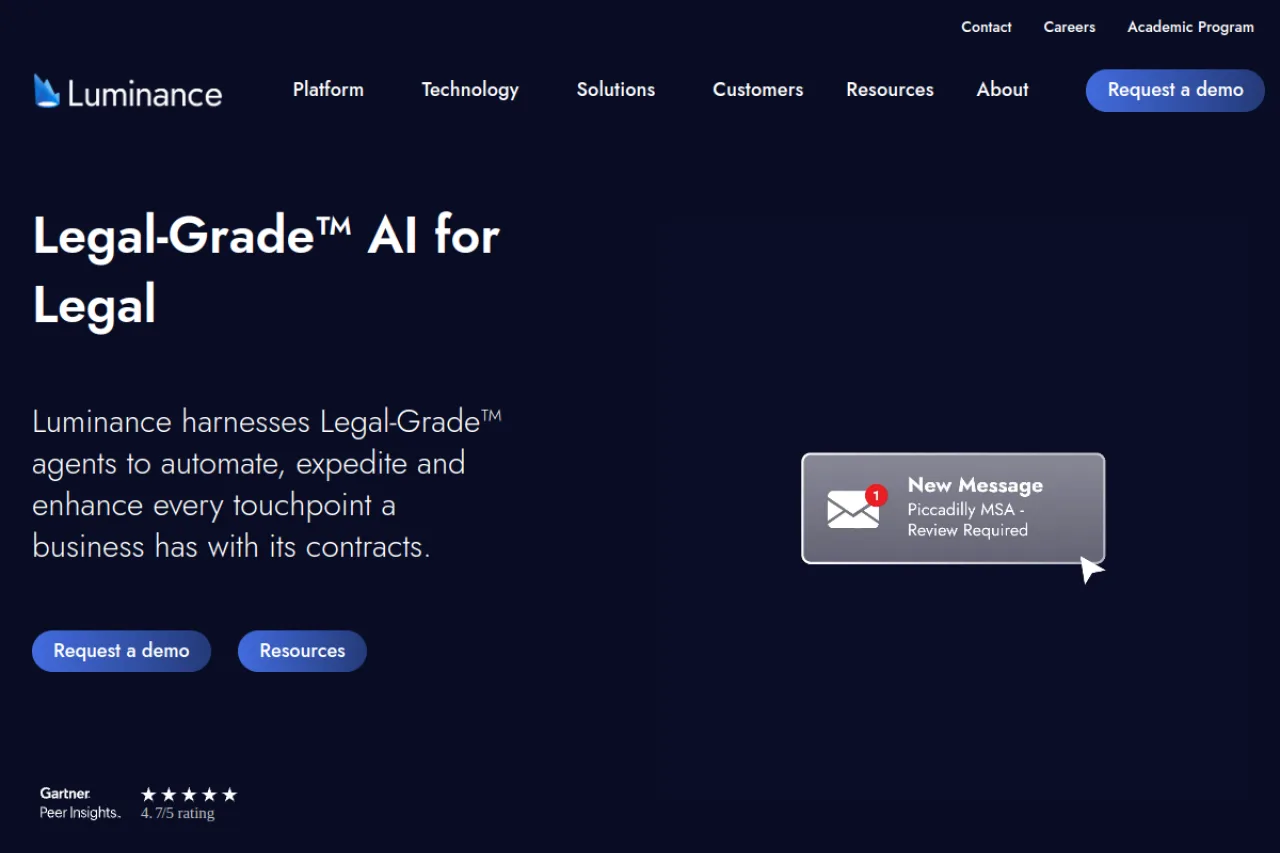
Luminance is a legal-focused AI platform for contract drafting, negotiation, analysis, compliance, and due diligence. It uses a multi-model architecture and features like Auto Mark-Up and Knowledge Banks to help legal teams review documents, catch non-standard clauses, and align language to house standards, with a Word plugin for in-workflow use. Pricing is quote-based rather than public, and results depend heavily on how well teams curate their clause logic and playbooks.
Luminance is an AI platform built specifically for legal professionals, focused on the full lifecycle of contract activity — from drafting and negotiation to analysis, compliance, and due diligence. Rather than positioning itself as a general-purpose assistant, it markets "Legal-Grade" AI designed around the workflows and accuracy expectations of in-house legal teams and law firms. The platform is organized around distinct capabilities that map to how legal work actually happens: drafting new agreements, negotiating and redlining incoming contracts, analyzing large document sets, and running compliance and investigative reviews. Its Auto Mark-Up feature helps reviewers flag non-standard clauses and suggest redrafts aligned to a company's preferred positions, while Knowledge Banks let teams codify their clause logic and playbook so the AI reflects house standards. Luminance emphasizes integration into existing tools legal professionals already use, including a Microsoft Word plugin so reviewers can work in a familiar editing environment. This is deliberately aimed at reducing the friction of adopting new software inside conservative legal departments where Word remains the center of gravity. As with most enterprise legal AI, the platform's effectiveness scales with the quality of the content and playbooks teams load into it. Well-curated Knowledge Banks and clear standards produce sharper mark-ups and more reliable clause detection, while thin or inconsistent inputs limit results. Buyers should treat implementation and internal curation as part of the real cost of value. Luminance does not publish pricing publicly and sells through a demo-and-quote motion, so prospective buyers should verify current terms, deployment options, and licensing directly with the vendor.
Luminance is a legal-grade AI platform for contract drafting, negotiation, analysis, compliance, and due diligence, built specifically for law firms and in-house legal teams. Its Auto Mark-Up and Knowledge Banks help align contract language to company standards, with a Word plugin for in-workflow use. Pricing is quote-based, and the company has raised substantial funding while expanding aggressively in North America.
Luminance is a legal AI company founded by Adam Guthrie and Graham Sills, with early seed backing from Invoke Capital in 2016. The company builds AI designed specifically for legal professionals, marketing a "Legal-Grade" platform that spans the contract lifecycle from drafting to due diligence. Its CEO is Eleanor Lightbody.
Luminance has scaled rapidly, growing headcount significantly and expanding its North American presence with new offices in San Francisco, Dallas, and Toronto alongside an expanded US headquarters in New York. The company positions itself as "the legal brain" of an organization, using multiple AI models to automate and enhance contract activity across the business.
Luminance's platform is organized into capabilities that map to legal workflows: Draft, Negotiate, Analyze, Comply, Investigate, and Collaborate. Its Auto Mark-Up feature identifies non-standard clauses and suggests redrafts aligned to a company's preferred positions, while Knowledge Banks let teams structure their own clause logic and negotiation playbooks so the AI reflects house standards.
The platform integrates into existing legal tooling, notably through a Microsoft Word plugin that keeps reviewers in a familiar editing environment. Luminance describes its underlying technology as a unique multi-model AI architecture built for legal accuracy, supported by a dedicated security posture aimed at the sensitivity of legal documents.
Luminance serves law firms and corporate in-house legal departments that handle high volumes of contracts and complex due diligence. Its buyers are typically legal operations leaders, general counsel, and firm partners seeking to standardize review, enforce playbooks, and accelerate document-heavy work across enterprise-scale legal functions.
Lawyers, paralegals, and contract reviewers who use Luminance day-to-day to analyze incoming agreements, apply mark-ups, and redraft clauses within the platform or Word.
General counsel, legal operations leaders, and law firm partners who evaluate and purchase the platform to standardize contract review and improve throughput.
Legal technology specialists, procurement teams, and IT and security stakeholders who assess integration, data handling, and fit with existing legal workflows.
A mid-to-large law firm or corporate legal department with high contract volume, established playbooks, and the internal resources to curate Knowledge Banks and drive adoption of an enterprise legal AI platform.
According to market research, Luminance has raised approximately $165 million in total funding. Early investors include Invoke Capital (seed funding in 2016) and Talis Capital, which led a $10 million Series A in 2017 at a $50 million valuation, with law firm Slaughter and May also among its backers. The company has since raised a $75 million round and reported five-fold customer growth and six-fold ARR growth over a two-year period; buyers should treat third-party financial figures as estimates.
Luminance does not publish pricing on its website and operates on a quote-based model accessed through a demo. Costs vary based on team size, deployment, and which parts of the platform you license. Prospective buyers should contact the vendor directly to get a tailored quote and verify current terms.
Legal teams upload contracts and document sets, and Luminance's AI analyzes them to surface non-standard or risky clauses. Its Auto Mark-Up feature suggests redrafts that align language to your preferred positions, and reviewers refine the output within the platform or in Word. Over time, teams shape results by building out Knowledge Banks that capture their clause logic and playbooks.
Yes, Luminance offers a Word plugin so reviewers can work within the editing environment legal professionals already rely on. This lets teams apply mark-ups and redrafts without leaving their standard drafting tool, reducing the friction of adopting new software.
Luminance describes its platform as using a multi-model AI architecture it markets as "Legal-Grade," designed specifically for legal accuracy and reliability. The company positions this as a unique architecture built for high-stakes contract work rather than a general-purpose language model. Details of the underlying models are covered in the vendor's technical white papers.
Luminance is aimed at law firms and in-house legal departments that handle sensitive contracts, and it maintains a dedicated security page describing its posture. Because deployment and data handling terms vary by contract, security-conscious buyers should review the vendor's documentation and confirm specifics such as data residency and access controls during procurement.
Luminance has grown rapidly, significantly increasing headcount and expanding its North American footprint with offices in cities including San Francisco, Dallas, and Toronto alongside its New York US headquarters. The company has raised substantial funding to fuel scaling and product innovation. Buyers should check the vendor's site for the latest product and coverage updates.
No, Luminance does not offer a free plan or free trial according to available data. Pricing is not publicly disclosed and requires contacting the vendor directly for a quote.
Luminance offers a Microsoft Word plugin for document drafting workflows. Additional integration details were not found in our research — check the official website for a complete list of supported platforms.
Luminance is positioned as a strong option for large-scale AI document review in due diligence and compliance contexts. Common alternatives mentioned include Kira, DocuSign Insight, and other contract lifecycle management platforms. Luminance has received 4.9 stars from 5 verified reviews on G2, indicating positive user sentiment among its customer base.
Side-by-side pages for pricing, features, and best-fit use cases.
Spellbook is an AI-powered contract drafting and review assistant designed specifically for lawyers and legal teams

Harvey is an AI platform built specifically for legal professionals and law firms, offering tools for document analysis, legal research, contract intelligence, and end-to-end workflow automation
AI legal drafting and review tools built into Microsoft Word
Agentic AI workspace for in-house legal and compliance teams