TextCortex
TextCortex is an enterprise AI agent infrastructure platform that helps organizations deploy, organize, and govern AI agents across their workplace
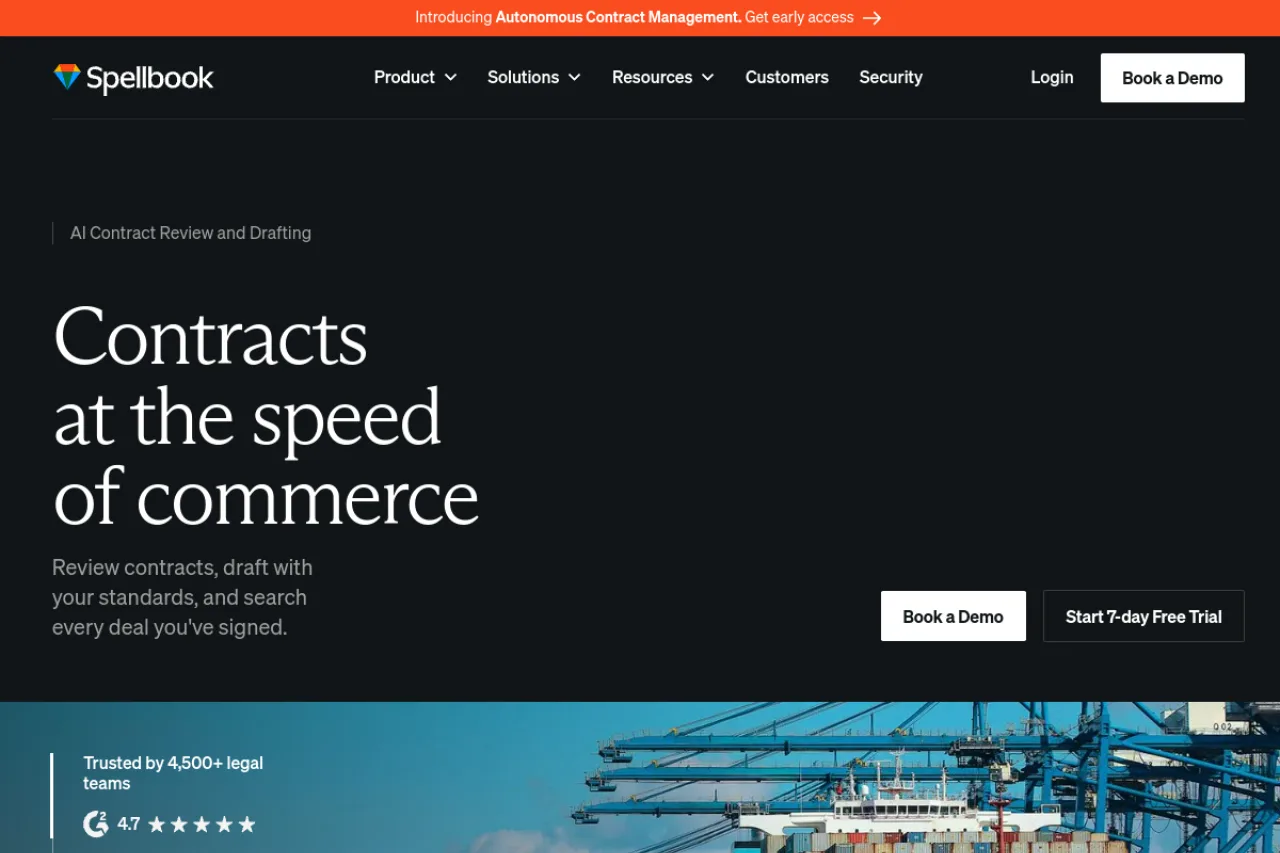
Spellbook is an AI-powered contract drafting and review assistant designed specifically for lawyers and legal teams
Spellbook is an AI contract drafting and review assistant built specifically for transactional lawyers, in-house legal teams, and law firms. It redlines contracts, drafts from templates or scratch, compares agreements to market standards, and lets teams encode their own positions through Playbooks, with an Associate capability for multi-document workflows. Priced as freemium with a 7-day trial and largely contact-based plans, it is best suited to teams that handle enough commercial contracts to justify a specialized legal AI tool.
Spellbook is an AI contract review and drafting platform built for legal professionals working with transactional documents. It operates as a copilot for lawyers, integrating with existing legal workflows to help teams redline agreements, catch risks, draft from scratch or saved libraries, and compare contracts to industry standards. The platform positions itself as one of the earliest generative AI tools purpose-built for the legal profession rather than a general-purpose assistant retrofitted for legal work. The product centers on a handful of core capabilities. Review helps lawyers redline contracts and surface problematic clauses, including issues in opposing counsel's drafts. Draft generates new language from scratch or from a firm's saved templates and libraries. Compare benchmarks agreements against market standards, and Ask answers complex questions about a document. The Playbooks feature lets teams encode their own legal standards so reviews consistently apply the firm's preferred positions, while the Associate capability handles multi-document workflows and deeper research across sets of agreements. Spellbook is aimed squarely at transactional and commercial legal work rather than case law research. It is designed for in-house legal teams and law firms handling volumes of contracts such as MSAs, vendor agreements, and other commercial documents, with industry-specific solutions spanning energy, healthcare, financial services, technology, manufacturing, and retail. The platform also supports citation of specific regulations, including tax code, and can summarize documents or flag non-standard terms. The company has recently introduced Autonomous Contract Management (ACM), described as an end-to-end AI system for contracts that is available through an early-access waitlist, signaling a move beyond point-in-time review and drafting toward broader contract lifecycle automation. Spellbook is offered on a freemium basis with a 7-day free trial, but published tiered pricing is limited and most plans require contacting the vendor. Buyers should confirm current pricing, seat costs, and feature availability directly with Spellbook before committing.

Spellbook is an AI contract review and drafting platform built specifically for transactional lawyers, in-house legal teams, and law firms. It redlines contracts, drafts from templates, compares agreements to market standards, and enforces firm standards through Playbooks, with an Associate capability for multi-document workflows. The Toronto-based company is a well-funded and fast-growing player in legal AI, with a freemium model and largely contact-based pricing.
Spellbook is a Toronto-based legal AI startup founded by Scott Stevenson, Daniel Maria, and Matt Mayers. The company describes Spellbook as the first generative AI copilot launched for lawyers, positioning itself around the mission of helping legal professionals do more of the substantive work they enjoy while automating repetitive contract tasks.
The company has grown quickly and is used by thousands of legal teams, including recognizable in-house departments. CEO Scott Stevenson has been a visible commentator in the legal AI space, notably raising concerns about how some AI startups inflate ARR metrics. Spellbook has continued to expand its product footprint, most recently with Autonomous Contract Management (ACM), an initiative to power contracts end-to-end.
Spellbook's core product is organized around several capabilities aimed at transactional legal work. Review helps lawyers redline contracts and catch risks, including issues in opposing counsel's drafts. Draft generates new agreements from scratch or from saved libraries and templates. Compare benchmarks contracts against market standards, and Ask provides quick answers to complex questions about a document.
Playbooks let teams encode their own legal standards so reviews consistently apply preferred positions, while the Associate capability supports multi-document workflows and deeper research across sets of agreements. The platform emphasizes a Word-based drafting experience and integration with existing legal systems, and it can cite specific regulations such as tax code, summarize documents, and flag non-standard terms.
Spellbook is also building toward broader contract lifecycle automation with Autonomous Contract Management (ACM), an AI system described as powering contracts end-to-end, currently available through an early-access waitlist.
Spellbook serves transactional and commercial lawyers, in-house legal teams, and law firms that handle significant volumes of commercial agreements. It offers industry-specific solutions across energy, healthcare, financial services, technology, manufacturing, and retail and consumer goods, and packages its offering for both in-house and law firm use cases. It is not aimed at case law research or litigation.
Transactional and commercial lawyers who draft, review, and negotiate contracts day to day, along with paralegals and legal operations staff supporting contract workflows. They value working within familiar drafting tools while getting AI assistance on redlining and standards enforcement.
General counsel, heads of legal operations, and managing partners who evaluate legal AI tools for their teams. They weigh contract volume, cost, security, and workflow fit against the specialized value of a purpose-built legal AI platform.
Legal innovation leads, IT and security reviewers, and senior associates who pilot the tool and shape adoption. Their assessment of accuracy, security posture, and integration with existing systems strongly influences purchase decisions.
An in-house legal team or contract-heavy law firm handling a steady flow of commercial agreements such as MSAs and vendor contracts. The ideal customer wants to enforce consistent standards through Playbooks, reduce repetitive drafting, and can justify a specialized legal AI investment based on contract volume.
Spellbook, a Toronto-based legal-AI company founded by Scott Stevenson, Daniel Di Maria, and Matt Mayers, raised a $50 million Series B led by Khosla Ventures (with Keith Rabois) in October 2025 at a $350 million post-money valuation, for more than $80 million in equity funding. In March 2026 it added a $40 million debt facility from RBCx to fund acquisitions, and reports approaching roughly $100 million in ARR.
Spellbook is offered on a freemium model with a 7-day free trial, but most pricing is provided on a contact-vendor basis rather than published tiers. Third-party estimates place per-user costs in a roughly $99–$199 per user per month range, though this can vary by plan and team. Confirm current pricing directly with Spellbook, as costs and packaging change over time.
Lawyers use Spellbook to review and redline contracts, draft new agreements from scratch or saved libraries, compare terms to market standards, and ask questions about a document. Teams can encode their preferred positions in Playbooks so reviews consistently apply the firm's standards, while the Associate capability supports research and review across multiple documents at once.
Yes. Spellbook is designed to work within existing legal workflows and connects with the systems legal teams already use for drafting. It emphasizes a Word-based drafting experience, so lawyers can work in familiar documents rather than a separate interface. Check the integrations page for the current list of supported connections.
Spellbook is built for transactional and commercial legal work, such as reviewing supplier MSAs, catching non-standard vendor terms, and reducing repetitive drafting. It serves both in-house legal teams and law firms across industries like energy, healthcare, financial services, technology, manufacturing, and retail. It is not primarily a case law research platform.
Spellbook maintains a dedicated security page describing its practices, which matters given the sensitivity of contract data handled by legal teams. As with any AI tool touching confidential documents, buyers should review its current security certifications, data handling, and retention policies before rolling it out. Larger firms and in-house teams should validate these details against their own compliance requirements.
Spellbook has introduced Autonomous Contract Management (ACM), described as an AI system that powers contracts end-to-end, currently available through an early-access waitlist. This signals a shift beyond point-in-time review and drafting toward broader contract lifecycle automation. Availability and capabilities may still be evolving, so confirm status with Spellbook.
No, Spellbook does not offer a free plan or free trial according to available research. The platform operates on a paid subscription model with pricing based on the number of team members on your license.
Spellbook is described as working with existing legal systems, and the website mentions an integrations page. However, specific integration partners were not detailed in the research available. Check the official integrations page at spellbook.legal for current compatibility.
Spellbook focuses on one-on-one contract drafting and redlining, whereas alternatives like Luminance emphasize large-scale document review across thousands of contracts. CoCounsel (owned by Thomson Reuters) is considered stronger for litigation research due to Westlaw integration. Spellbook's strength lies in transactional practice with features like playbook encoding and multi-document workflows.
Side-by-side pages for pricing, features, and best-fit use cases.
Lavender excels at sales email coaching, but these six alternatives serve marketers, HR teams, teachers, and fiction writers who need AI writing help outside the SDR workflow.
Sudowrite excels at fiction writing, but alternatives like Rytr, HyperWrite, and others offer broader use cases, different pricing models, or specialized features.
Wordtune excels at sentence-level rewrites, but these six alternatives offer stronger paraphrasing, specialized writing tools, or deeper integrations.
TextCortex is an enterprise AI agent infrastructure platform that helps organizations deploy, organize, and govern AI agents across their workplace
HubSpot AI (branded as Breeze AI) provides AI-powered tools integrated across HubSpot's CRM, marketing, sales, and service platforms
Textio is an AI writing platform designed for HR teams to improve job descriptions, performance feedback, and interview feedback
Lavender is an AI email coaching platform designed for sales teams, particularly SDRs and AEs