
11x
Sales
AI "digital workers" for sales, including the Alice SDR and Julian phone agent.
ai-sdroutbound-automationsales
View →

Komo is an AI-powered revenue engine that automates sales workflows from buyer signal detection to deal closure
Good for fast, clutter-free AI search with a privacy-leaning, community-flavored feel. The limitation is thinner sourcing and less analytical depth than heavyweight competitors, so it suits quick lookups more than serious research.
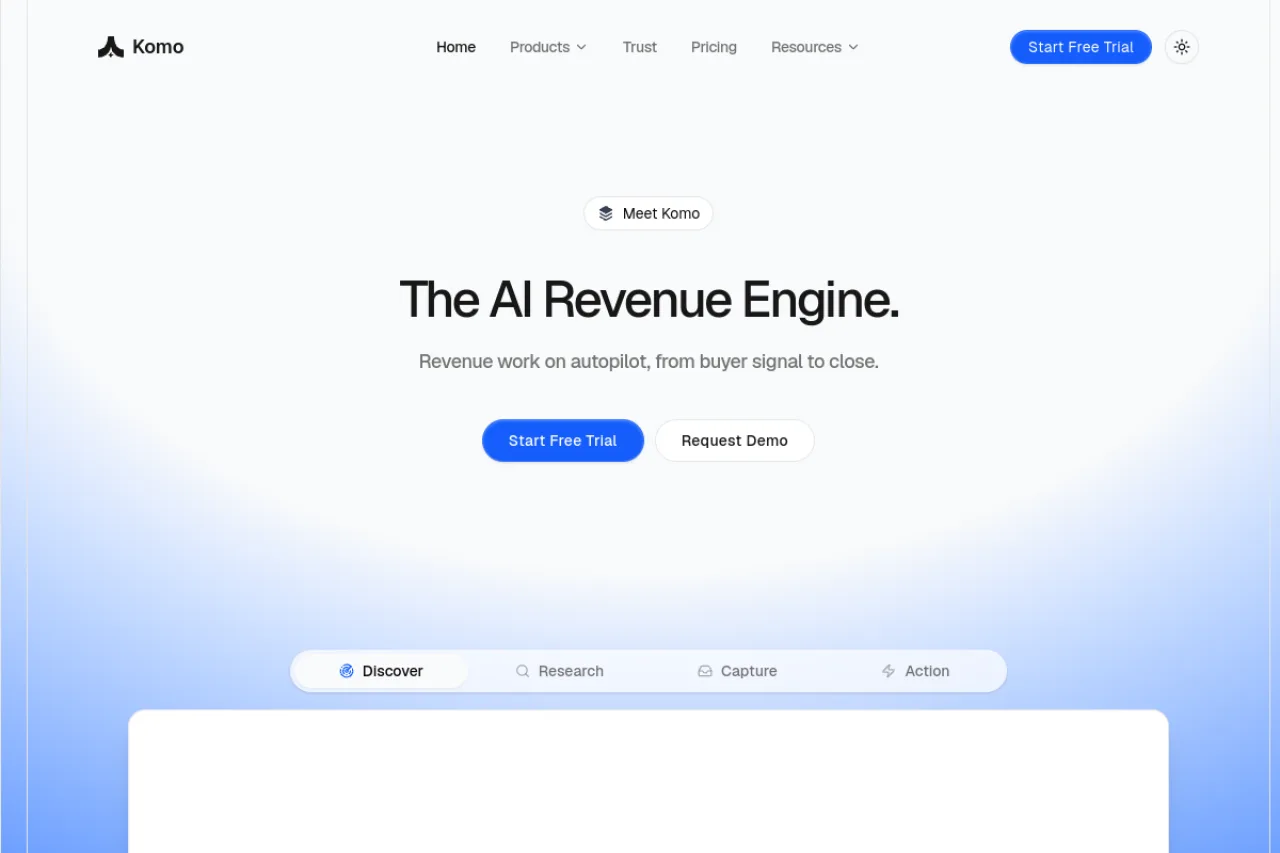
Komo is an AI revenue engine for B2B sales and RevOps teams that automates the workflow from buyer-signal detection through deal close. It monitors markets for ICP signals, scores your TAM by fit and timing, finds warm paths into accounts, and generates cited meeting briefs and account deliverables like QBRs and renewal decks from your calls, emails, and notes. The goal is to shift reps from doing manual research to approving work Komo has already prepared.
Komo positions itself as an AI revenue engine built for B2B sales and RevOps teams that want to automate the sales workflow from the first buyer signal all the way to close. Rather than acting as a passive CRM add-on, it continuously monitors your market for ICP signals, captures call and email interactions, and turns that raw activity into scored accounts and ready-to-review deliverables. At the discovery stage, Komo watches for warm intent — engagement, role changes, and topic signals from your target accounts — and surfaces the people most worth pursuing rather than handing reps a static cold list. It then scores your total addressable market by fit, timing, and connection, and works to identify warm introduction paths into priority accounts. Where Komo tries to differentiate is preparation and follow-through. The platform searches across your calls, emails, and notes to generate cited meeting briefs, so reps walk into conversations with context grounded in real interactions instead of guesswork. From there it can assemble QBRs, expansion decks, and renewal briefs from data it has already collected, tailored to each account. The underlying pitch is delegation: reps approve work Komo has already drafted instead of doing research and prep from scratch. That framing appeals to revenue teams focused on pipeline quality and clean execution, though it also means the tool is most valuable when it has enough connected data to act on. Buyers should confirm current pricing and plan limits on the official site, as public plan pages have shifted.
Komo is an AI revenue engine for B2B sales and RevOps teams that automates the workflow from buyer-signal detection to deal close. It monitors markets for ICP signals, scores the TAM by fit and timing, finds warm paths in, and generates cited briefs and account deliverables from a team's own calls, emails, and notes. Public data points to roughly $3.4M ARR and a $10.2M valuation, with pricing commonly cited at $15–$30/month.
Komo (Komo Technologies) operates komo.ai and positions its flagship product as "The AI Revenue Engine," designed to put revenue work on autopilot from buyer signal to close. Public sources associate the company with founder Glenn Morton and report a team of roughly 31 employees.
The company's messaging has evolved from an AI-powered search platform emphasizing verified citations and SOP automation toward a focused B2B sales and RevOps automation product. Its stated mission centers on freeing reps from manual research and prep so their time goes to closing deals, with an emphasis on traceable, cited context behind every automated action.
Komo organizes its capabilities across four stages. Discover monitors a team's market and engages ICP accounts as warm signals fire, surfacing intent rather than static cold lists. Research scores the entire TAM by fit, timing, and connection and identifies warm paths into target accounts.
Prepare searches across a team's calls, emails, and notes to generate cited meeting briefs reps can trust. Close & Manage automates late-funnel deliverables — QBRs, expansion decks, and renewal briefs — assembled from data Komo has already collected and tailored to each account. The overarching design goal is a delegation model where reps approve pre-drafted work instead of building research and documents manually.
Komo targets B2B revenue organizations, with a stated focus on sales representatives and RevOps teams that need quality pipeline, clean execution, and proof behind every agent action. It fits companies selling into well-defined ICPs — the homepage examples span logistics, retail, and enterprise SaaS accounts — where signal detection, prioritization, and call preparation are recurring bottlenecks.
Sales reps and account managers who use Komo daily to review warm accounts, approve cited meeting briefs, and generate QBRs and renewal materials.
Sales and revenue leaders (VP Revenue, VP RevOps) who evaluate the platform to improve pipeline quality, prep consistency, and rep productivity.
RevOps managers and sales operations specialists who assess integration fit, data connectivity, and how the tool standardizes execution across the team.
A B2B company with a defined ICP and an active sales motion whose reps and RevOps team already generate substantial call, email, and note data that Komo can capture, score, and turn into ready-to-approve deliverables.
Public third-party sources report Komo at approximately $3.4M ARR and a $10.2M valuation, with a Venture (Series Unknown) round noted and Spacecubed listed among recent investors. Specific round amounts and dates are not detailed in the available research and should be verified against primary sources.
Public listings describe a Basic plan around $15/month and a Premium plan around $30/month, with a free trial to start. Komo is offered on a freemium basis, but note that its official pricing page has returned errors and third-party figures vary, so confirm current tiers and limits on komo.ai before purchasing.
Komo runs across four stages: it discovers warm accounts by monitoring market signals, researches and scores your TAM by fit and timing while finding warm paths in, prepares cited meeting briefs from your calls and emails, and then closes and manages accounts by generating QBRs, expansion decks, and renewal briefs. In practice reps review and approve work Komo has already drafted rather than building it from scratch.
The platform is built to search across your calls, emails, and notes to produce grounded, cited briefs and to score accounts. That means its output quality scales with how much of your sales activity is connected — teams should plan to integrate their communication and note data during setup to get meaningful results.
Komo targets B2B revenue teams — particularly sales reps and RevOps functions that need quality pipeline, clean execution, and traceable context behind every action. It's aimed at organizations selling into defined ICPs where signal detection and account prep are recurring bottlenecks.
A core selling point is that meeting briefs and deliverables are cited from your own captured interactions rather than presented as unsourced guesses. The company maintains a dedicated Trust/security page; buyers with compliance requirements should review its current security documentation and data-handling terms directly.
Komo has been described in some coverage as an AI-powered search assistant with verified citations and SOP automation, but its current homepage positions it squarely as an AI revenue engine for sales workflows. Given this evolving positioning, verify which capabilities are live before evaluating it against a specific use case.
Komo operates on a freemium model according to directory data, but specific free plan features and limitations were not disclosed in available research. The platform appears to require a demo request to access pricing details.
Integration details were not found in our research — check the official website or request a demo for specific integration capabilities.
Research indicates alternatives in the digital experience and customer engagement space include Bloomreach, Kentico, and Webflow, though these comparisons may reference different Komo products (there appear to be multiple companies using the Komo name). The AI revenue engine version of Komo appears focused specifically on B2B sales automation rather than broader marketing engagement.
Side-by-side pages for pricing, features, and best-fit use cases.
Research Rabbit excels at visual citation networks, but these alternatives offer citation analysis, AI search, and document collaboration for different research workflows.
Explainpaper explains confusing text in papers. These alternatives add citation networks, search across millions of studies, or let you query your own documents.
Semantic Scholar excels at broad academic search, but researchers need specialized tools for citation analysis, visual discovery, and document collaboration.
AI "digital workers" for sales, including the Alice SDR and Julian phone agent.
AI sales research agent for account intelligence and personalized outreach
Real-time search engine for verified B2B sales leads and contact data
AI lead generation for local and SMB businesses with owner-level contacts