TextCortex
TextCortex is an enterprise AI agent infrastructure platform that helps organizations deploy, organize, and govern AI agents across their workplace
HubSpot AI (branded as Breeze AI) provides AI-powered tools integrated across HubSpot's CRM, marketing, sales, and se...
HubSpot AI (Breeze AI) is an integrated AI layer built into HubSpot's CRM, marketing, sales, and service Hubs. It offers content generation, natural-language CRM queries, contact enrichment, prospecting and data agents, and automated service replies, all grounded in a company's existing HubSpot data. Pricing runs on a credit-based consumption model on top of HubSpot subscriptions, with a free tier that includes Breeze Assistant and over 100 embedded AI features. It's a strong fit for teams already standardized on HubSpot, though credit consumption can make costs less predictable at scale.
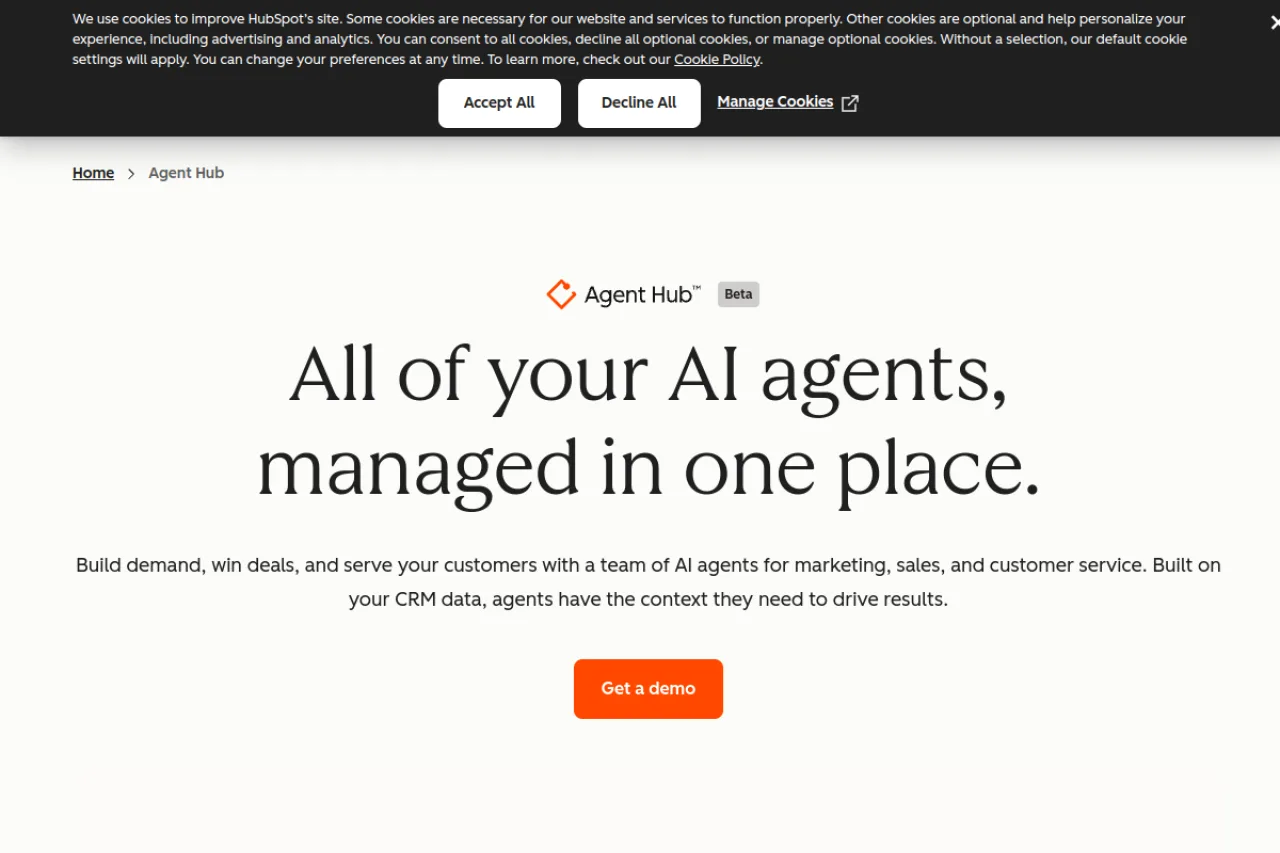
HubSpot AI, marketed as Breeze AI, embeds artificial intelligence directly into HubSpot's customer platform, spanning its marketing, sales, and service Hubs. Rather than functioning as a standalone tool, it operates as an AI layer across the CRM, surfacing content generation, natural-language data queries, contact enrichment, and automated customer service replies wherever teams already work. The idea is that businesses running on HubSpot can add AI-assisted workflows without adopting a separate product or stitching together third-party services. The toolset covers several distinct capabilities. Breeze Assistant helps draft marketing and sales content, blog posts, and emails; the platform includes over 100 embedded AI features on the free edition alone. Agent-style tools such as the prospecting agent and data agent handle lead research and enrichment, while automated chat features assist customer service teams with reply drafting and conversation handling. Because these features draw on data already inside the CRM, output can reflect a company's own contacts, deals, and content. Breeze runs on a credit-based consumption model layered on top of HubSpot subscriptions. Each HubSpot Credit is worth roughly $0.01, and AI actions — generating content, enriching a contact, or letting an agent research a lead — draw down a shared monthly credit pool. The free edition bundles Breeze Assistant and the embedded features at no extra cost, the Starter edition adds the prospecting and data agents plus 500 credits, and more advanced agents require Professional or Enterprise subscriptions. The practical appeal is tight integration: for teams already committed to HubSpot, Breeze reduces context switching and keeps AI outputs anchored to live CRM data. The tradeoff is that value is closely tied to being inside the HubSpot ecosystem, and the credit model introduces cost variability that can be hard to predict as usage scales — particularly for high-volume actions like per-lead prospecting. Buyers should confirm current credit rates, feature availability by tier, and subscription requirements on HubSpot's official site, since packaging and agent capabilities continue to evolve.

HubSpot AI, branded Breeze AI, is an integrated AI layer across HubSpot's CRM, marketing, sales, and service Hubs, offering content generation, natural-language queries, prospecting and data agents, and contact enrichment. It runs on a credit-based consumption model on top of HubSpot subscriptions, with a free tier that includes Breeze Assistant and over 100 embedded AI features. It's best suited to teams already committed to HubSpot, with cost predictability being the main tradeoff.
HubSpot is a cloud-based provider of inbound marketing, sales, and customer service software, founded by Dharmesh Shah and Brian Halligan. The company built its reputation on the concept of inbound marketing and has grown into a broad customer platform spanning Marketing, Sales, Service, Content, and Data Hubs alongside its Smart CRM.
Breeze AI represents HubSpot's consolidation of AI capabilities under a single brand, positioning artificial intelligence as an embedded layer across its existing product suite rather than a separate offering. The strategy reflects HubSpot's broader move toward an agentic platform where AI tools operate directly on customers' CRM data.
Breeze AI spans content creation, CRM interaction, and automation. Breeze Assistant helps draft marketing and sales content, emails, and blog posts, and the free edition includes over 100 embedded AI features. Natural-language querying lets users interrogate CRM data without building reports.
Agent-style tools extend the platform into task automation. The prospecting agent sources and recommends leads, while the data agent handles research and enrichment; these become available starting with the Starter edition and its 500-credit allocation, with more advanced agents requiring Professional or Enterprise subscriptions. Automated chat features assist service teams with reply handling, and contact enrichment keeps CRM records current.
Because every AI action consumes credits from a shared monthly pool — at roughly $0.01 per credit — usage patterns directly shape cost, with high-volume actions like per-lead prospecting drawing down credits faster than lighter tasks.
HubSpot AI primarily serves businesses already using or adopting the HubSpot customer platform, from small businesses starting on the free and Starter editions to mid-market and enterprise organizations on Professional and Enterprise plans. It targets marketing, sales, service, and revenue operations teams that want AI capabilities embedded in their existing CRM workflows rather than as separate, disconnected tools.
Marketers, sales reps, and service agents who use Breeze Assistant and agents day to day to draft content, query CRM data, prospect leads, and handle customer conversations.
Marketing, sales, and RevOps leaders — plus SMB owners — who already own or are evaluating HubSpot subscriptions and decide whether to enable and budget for AI credits.
HubSpot administrators, marketing operations specialists, and solutions partners who assess feature availability by tier, credit consumption, and integration fit.
A small-to-mid-sized business or enterprise team standardized on HubSpot that wants AI grounded in its own CRM data and is comfortable with a credit-based, usage-driven cost model.
HubSpot is a publicly traded company; its last private funding round was an IPO for $125M on October 9, 2014, and an earlier valuation was reported at $200M in March 2011. Its founders are Dharmesh Shah and Brian Halligan.
Breeze AI runs on a credit-based model layered on top of your HubSpot subscription, where each HubSpot Credit is worth roughly $0.01 (about $10 per 1,000 credits). The free edition includes Breeze Assistant and over 100 embedded AI features at no extra cost, and the Starter edition adds the prospecting and data agents plus 500 credits. Because actions like content generation, enrichment, and lead research each consume credits, your real monthly spend depends heavily on usage — verify current rates in your portal.
Your team draws from a shared monthly pool of credits, and every AI action deducts from it — enriching a contact, generating content, or having an agent handle a task. Some actions are far more expensive than others; for example, the prospecting agent charges around 100 credits per recommended lead and about 10 credits for a research task. Heavy prospecting or high-volume content work can exhaust credits quickly, so it's worth modeling expected usage before scaling up.
Breeze AI is only available inside HubSpot's customer platform, so you need a HubSpot account to use it. The free edition covers Breeze Assistant and the embedded features, Starter unlocks the prospecting and data agents with 500 credits, and most advanced agents require a Professional or Enterprise subscription. Feature availability shifts by tier, so confirm what your specific plan includes.
Because Breeze is embedded directly in the CRM, it works natively across the Marketing, Sales, Service, Content, and Data Hubs and draws on your existing contacts, deals, and content. This means AI outputs reflect your own data rather than generic inputs, and there's no separate integration to configure. The tradeoff is that this tight coupling primarily benefits teams already standardized on HubSpot.
Breeze AI operates within HubSpot's platform, so data handling falls under HubSpot's broader security and privacy framework rather than a separate third-party AI service. For specifics on data usage, model providers, and how AI features handle your CRM records, review HubSpot's current documentation and legal terms directly, as these details are subject to change.
HubSpot has consolidated its AI features under the Breeze brand and shifted toward agent-based tools, such as the prospecting and data agents, alongside a growing library of embedded AI features. Packaging and credit pricing continue to evolve across tiers, so the exact set of agents and their credit costs can differ from earlier documentation. Check the official Breeze AI page for the latest lineup.
Breeze AI features are included with HubSpot subscriptions, but they operate on a credit-based system. You need at minimum a HubSpot hub subscription (Starter starts at $9/seat/month, Enterprise at $150/seat/month), and then AI features consume credits with each use. Content Assistant and ChatSpot were initially offered free as of March 2024, with additional features in premium plans, but the credit system means ongoing AI usage incurs additional costs beyond the base subscription.
HubSpot AI is natively integrated within HubSpot's own CRM, Marketing Hub, Sales Hub, and Service Hub platforms. The research indicates it unifies company apps and knowledge bases for AI-powered answers, but specific third-party integrations beyond the HubSpot ecosystem were not detailed in the available research.
HubSpot AI's main advantage is native CRM integration for existing HubSpot users, eliminating tool-switching. However, alternatives like Forethought and other specialized AI chatbots are noted as offering more powerful AI capabilities for specific use cases. Reddit users suggest OpenAI does certain tasks 'better, faster, and cheaper' than HubSpot's in-house AI. Competitors often provide more transparent pricing and faster setup, while HubSpot's credit system can make costs unpredictable.
Side-by-side pages for pricing, features, and best-fit use cases.
Lavender excels at sales email coaching, but these six alternatives serve marketers, HR teams, teachers, and fiction writers who need AI writing help outside the SDR workflow.
Rytr covers 40+ use cases but lacks depth for fiction, performance tracking, and enterprise workflows. Here are six alternatives built for specific needs.
Sudowrite excels at fiction writing, but alternatives like Rytr, HyperWrite, and others offer broader use cases, different pricing models, or specialized features.
TextCortex is an enterprise AI agent infrastructure platform that helps organizations deploy, organize, and govern AI agents across their workplace
Jasper is an AI marketing platform designed for enterprise marketing teams, featuring purpose-built agents that execute end-to-end marketing workflows
Rytr is an AI writing assistant that generates content across 40+ use cases including emails, SEO meta titles, social media captions, and long-form content
Anyword is an AI copywriting platform designed for marketers who need performance-optimized content, particularly for ads, social posts, and email campaigns