ClickUp AI
ClickUp AI (Brain²) is an AI productivity layer integrated into the ClickUp project management platform, offering context-aware assistance across tasks, docs, and conversations
Gradescope is an AI-assisted grading platform designed for educators to streamline assessment workflows for both onli...
Gradescope is an AI-assisted grading platform from Turnitin that helps educators administer and grade paper-based, online, and code assignments more efficiently. Its question-by-question grading, dynamic rubrics, answer grouping, autograder, and analytics streamline large-scale assessment while keeping instructors in control of scoring. It offers a free Basic plan and institution-wide licensing, making it a strong fit for universities and STEM-heavy courses.
Gradescope is an AI-assisted grading platform built specifically for educators who need to administer and evaluate assessments at scale, whether those assessments are handwritten, submitted online, or code-based. Rather than replacing instructor judgment, it structures the grading workflow so that repetitive scoring becomes faster and feedback becomes more consistent across large classes. The platform's core innovation is question-by-question grading paired with dynamic rubrics. Instead of grading one full paper at a time, instructors grade one question across all students, applying rubric items that can be adjusted mid-grading and retroactively applied to every affected submission. Gradescope also groups similar answers together, overlays student responses onto answer templates to spot differences, and processes bubble sheets automatically, all of which reduce the manual effort of large-scale marking. For technical courses, Gradescope supports an autograder that runs student code against test cases, combining automated scoring with optional manual review for style and documentation. This makes it particularly well suited to computer science, engineering, math, and the physical sciences, where answers range from fixed-template worksheets to open-ended programming projects. Beyond grading itself, the platform provides assignment statistics, item-level analytics, a managed regrade request process, and grade export to help instructors understand class performance and hand results off to a gradebook or LMS. Students can submit work and view feedback through a mobile app. Gradescope is owned by Turnitin and is used by thousands of universities and instructors worldwide. It offers a free Basic plan alongside Institutional licensing, so pricing and available features depend heavily on whether an individual instructor or an entire institution is adopting it. Buyers should confirm current plan details and pricing on the official site.
Gradescope is an AI-assisted grading platform owned by Turnitin that helps educators administer and grade paper, online, and code assignments more efficiently. Its question-by-question grading, dynamic rubrics, answer grouping, code autograder, and analytics make it especially strong for large STEM courses. It offers a free Basic plan and custom-priced Institutional licensing.
Gradescope was founded by Arjun Singh and Sergey Karayev to help instructors grade paper-based and code assignments online in a fraction of the usual time while surfacing analytics on student performance. The product grew from a tool addressing the pain of grading large classes into a widely adopted assessment platform.
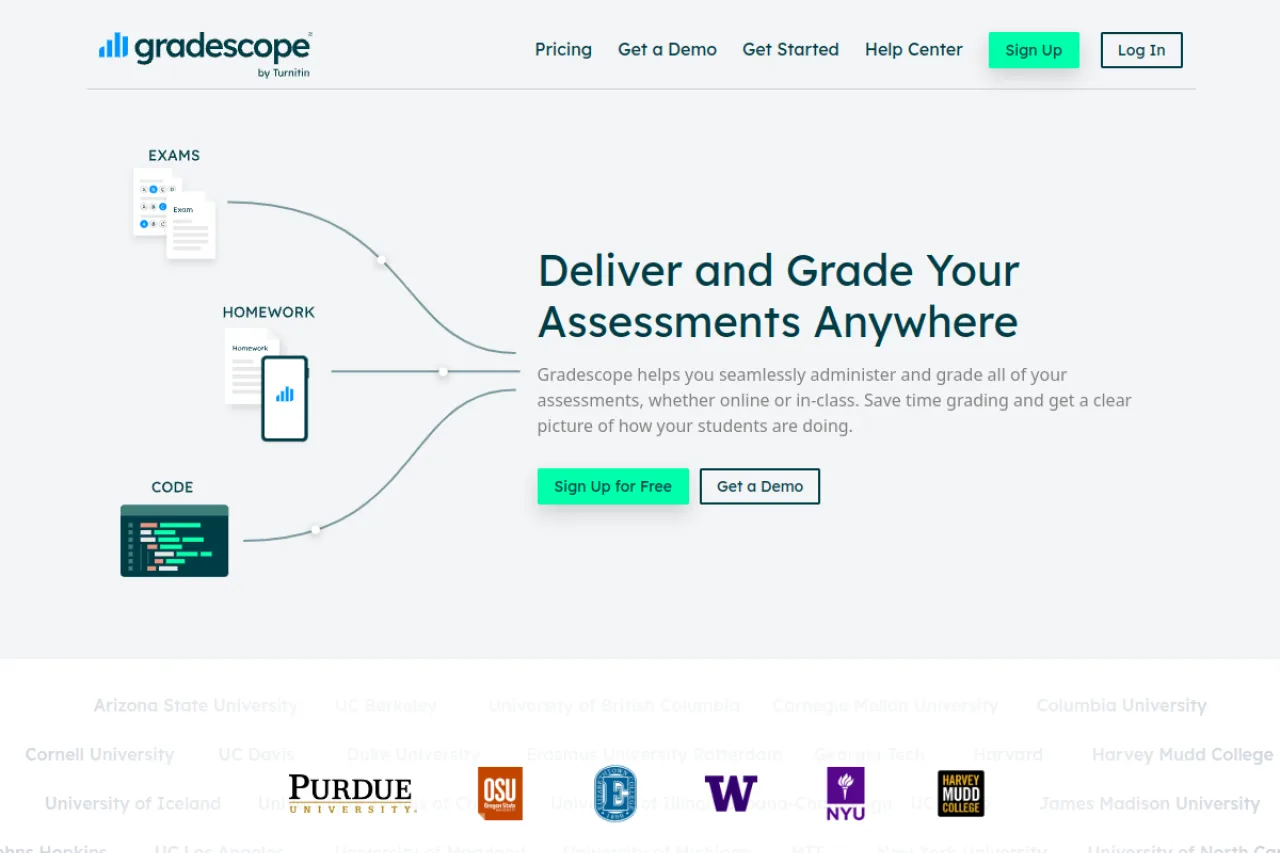
Gradescope is now owned by Turnitin and operates within its education assessment ecosystem. According to the company's own figures, the platform has been used to grade over 700 million questions across more than 2,600 universities, supporting over 140,000 instructors and more than 3.2 million students, with adopting institutions including Purdue University, Oregon State University, and the University of Washington.
Gradescope centers on a grading workflow designed for scale and consistency. Instructors grade one question at a time across all students, using dynamic rubrics whose items can be adjusted mid-grading and retroactively applied to every affected submission. The platform groups similar answers, overlays student responses onto answer templates to highlight differences, and automatically processes bubble sheets.
For technical courses, a code autograder runs student submissions against test cases and returns automated scores that can be combined with manual grading for style and documentation. Gradescope supports both variable-length assignments such as problem sets and projects and fixed-template assignments such as worksheets, quizzes, and exams across subjects including computer science, physics, math, chemistry, biology, engineering, and economics.
Beyond scoring, the platform provides assignment and item-level statistics, a structured regrade request process, grade export, and a student mobile app. Collaborative grading and AI-powered grading are available on the Institutional plan, enabling multiple staff members to grade together with shared rubrics.
Gradescope primarily serves higher-education institutions, with particularly strong fit in STEM disciplines where assessments range from bubble sheets and worksheets to open-ended problem sets and programming projects. Its buyers span individual instructors on the free Basic plan, teaching teams that need collaborative grading, and entire universities or departments adopting Institutional licensing. It also fits K-12 and other settings that administer structured, high-volume assessments.
Instructors, professors, and teaching assistants who grade assignments and exams, plus students who submit work and view feedback and grades. They value faster, more consistent grading and clear rubric-based feedback.
Department heads, deans, and institutional administrators who license Gradescope at scale and negotiate custom Institutional pricing based on enrollment and required features.
Instructional technology teams, LMS administrators, and faculty champions who evaluate assessment tools, data privacy, and integration fit before recommending adoption.
A university or college department teaching large-enrollment courses, especially in STEM, that needs consistent, efficient grading across many graders, autograded programming assignments, and item-level analytics, and is comfortable with Turnitin's institutional ecosystem.
Gradescope offers a free Basic plan that includes dynamic rubrics, question-by-question grading, assignment statistics, regrade requests, and data export. Advanced capabilities such as AI-powered grading and collaborative grading are part of the Institutional plan, which uses custom pricing based on your institution and enrollment. Because plans and pricing change, confirm current terms directly on the official Gradescope site.
Instead of grading each paper front to back, you grade one question at a time across all students using a dynamic rubric. As you grade, Gradescope groups similar answers and lets you adjust rubric items on the fly, applying changes retroactively to every affected submission. This structure keeps scoring consistent and speeds up marking for large classes.
Gradescope handles variable-length work like problem sets and projects as well as fixed-template assignments such as worksheets, quizzes, bubble sheets, and exams. It is used across computer science, physics, math, chemistry, biology, engineering, and economics. Both student-uploaded and instructor-uploaded PDFs are supported, along with paper scans and code submissions.
Yes. Gradescope includes a code autograder that runs student submissions against test cases and returns an automated score, which you can combine with manual grading for style and documentation. This lets technical courses automate the objective portions of code assessment while still reviewing quality by hand.
Yes. Gradescope provides a student mobile app that lets learners submit work and view their grades and feedback. The app is available on both the Basic and Institutional plans.
Gradescope is owned by Turnitin and operates within its assessment ecosystem, which is designed for institutional education use. Data handling, retention, and privacy terms follow Turnitin's institutional policies, so administrators should review the current data processing and privacy documentation during procurement to confirm it meets their compliance requirements.
Gradescope offers a free Basic plan with limited features including dynamic rubrics and assignment statistics. After an institutional trial ends, instructors can continue using the Basic plan at no cost. However, advanced features like AI-powered grading and code autograders require paid plans starting at $1-3 per student per course.
Integration details were not found in our research — check the official website. The platform is owned by Turnitin and offers login options through school credentials and Google, suggesting some institutional system integration capabilities.
According to G2 reviews, the best-rated alternatives to Gradescope include PowerSchool Schoology Learning, Canvas LMS, and Blackboard. Competitors like EduSageAI offer truly automated grading with zero-configuration code grading and transparent self-serve pricing, while Gradescope requires institutional negotiations for full features. Gradescope's strength lies in its template-based AI comparison system and widespread adoption at major universities.
Side-by-side pages for pricing, features, and best-fit use cases.
ClickUp AI (Brain²) is an AI productivity layer integrated into the ClickUp project management platform, offering context-aware assistance across tasks, docs, and conversations
MeetGeek is an AI meeting assistant that automatically records, transcribes, and summarizes video meetings across platforms like Zoom and Microsoft Teams
Sembly AI is an AI meeting assistant that records, transcribes, and summarizes meetings across Zoom, Google Meet, and Microsoft Teams
Fellow is an AI meeting assistant that records, transcribes, and summarizes meetings with a focus on privacy and security