
Make
Automation
Make is a visual workflow automation platform that connects over 3,000 apps and services, enabling users to build automated workflows without extensive coding
automate-workflows
Free planView →

Workday AI is a suite of AI capabilities embedded within Workday's enterprise HR and finance platform, designed to he...
Best if you already run Workday for HCM or finance and want AI woven directly into existing workflows like recruiting, expense, and reporting. The honest limit is it is only meaningful inside the Workday ecosystem and inherits its cost and rollout complexity.
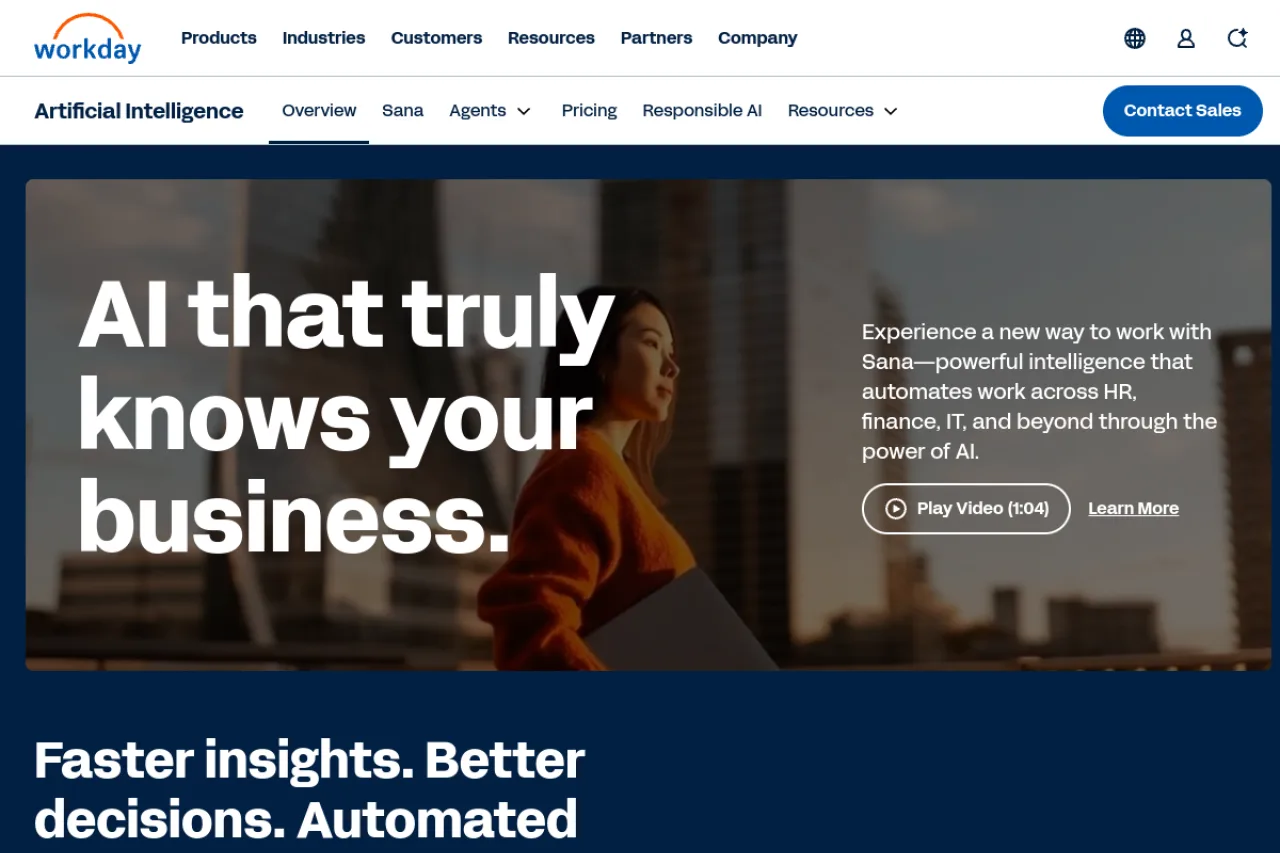
Workday AI embeds artificial intelligence directly into Workday's enterprise HR, finance, and planning platform, powering skills intelligence, workforce planning, recruiting, predictive analytics, and agentic automation using the large data volume flowing through Workday's cloud. It is aimed at large organizations already invested in Workday and is priced through a Flex Credits model layered onto existing subscriptions. It is a strong fit for enterprises seeking AI inside their system of record, but less relevant for smaller teams or organizations not on Workday.
Workday AI is a layer of artificial intelligence woven directly into Workday's enterprise HR, finance, and planning applications. Rather than sitting as a separate product, its capabilities surface inside the workflows organizations already run for talent management, workforce planning, recruiting, and financial operations. The goal is to make everyday decisions faster and more data-informed without forcing teams to leave the systems they use daily. The platform draws on the enormous transaction volume flowing through Workday's cloud to power features like Skills Cloud for talent and skills intelligence, AI-assisted workforce planning, predictive analytics, and agentic tools that can automate routine steps in people and finance processes. Because the intelligence is embedded, it reflects the organization's own data and business context rather than generic outputs. Workday positions these features around augmentation rather than replacement, emphasizing that human judgment, empathy, and relationship-building remain central to people operations. AI handles pattern detection, matching, forecasting, and repetitive administrative work, leaving strategic and interpersonal decisions to managers and HR teams. Commercially, Workday has moved to a Flex Credits model. Customers subscribe to the underlying services as they always have and receive a pool of credits that can be applied to AI agents and other applicable platform capabilities, including Agent-Ready Tools, Workday Data Cloud, and conversational AI usage. This is designed to give more predictability than pure token-based consumption pricing, though the exact economics depend on the negotiated contract. As with any enterprise platform, buyers should confirm current pricing, credit allocations, and feature availability directly with Workday, since packaging and AI capabilities continue to evolve.
Workday AI is a suite of AI capabilities embedded within Workday's enterprise HR and finance platform, spanning skills intelligence, workforce planning, recruiting, predictive analytics, and agentic automation. It is priced through a Flex Credits model layered onto existing subscriptions and targets large organizations already invested in Workday. Its strength is AI operating inside the system of record; its limitation is dependence on the Workday platform and opaque enterprise pricing.
Workday, Inc. was founded in March 2005 by David Duffield, founder and former CEO of PeopleSoft, and Aneel Bhusri, PeopleSoft's former chief strategist, following Oracle's acquisition of PeopleSoft in 2005. Kasper Hulthin is also credited among the founders. The company launched its product in November 2006 and went public in October 2012 with an IPO that valued it at $9.5 billion.
Workday provides cloud-based enterprise applications for human resources and finance, competing with SAP SuccessFactors, Dayforce, UKG, and Oracle. Co-founder Aneel Bhusri returned as CEO, reflecting a period of transition as the company invests heavily in AI across its platform. Workday AI represents the company's effort to bring intelligence and automation directly into the workflows its enterprise customers already run.
Workday AI embeds artificial intelligence across the company's HR, finance, and planning applications rather than offering it as a standalone product. Core capabilities include Skills Cloud for skills and talent intelligence, AI-assisted workforce planning, predictive analytics, recruiting support such as candidate and internal-talent matching, and automation of routine administrative tasks.
The platform increasingly emphasizes agentic AI, exposing AI agents and Agent-Ready Tools alongside Workday Data Cloud and a conversational AI interface. Because these features run inside Workday and draw on the large transaction volume flowing through its cloud, outputs reflect an organization's own data and business context.
Workday frames its approach around augmenting human work, automating repetitive steps while leaving strategic and interpersonal decisions to people. Governance, security, and administrative controls are inherited from the broader Workday platform.
Workday AI serves large and enterprise organizations, particularly those already running Workday for HR, finance, and planning. Primary segments include HR and talent management, recruiting, workforce planning and analytics, and enterprise finance teams. It is not positioned for small businesses, startups, or organizations outside the Workday ecosystem.
HR professionals, recruiters, workforce planners, and finance analysts who work inside Workday day to day and rely on its AI to surface skills matches, forecasts, and automated steps.
Enterprise CHROs, CFOs, and CIOs who own the Workday relationship and decide on AI adoption, Flex Credit allocations, and platform expansion.
HR technology leaders, finance operations managers, IT and security teams, and implementation partners who shape configuration, governance, and rollout decisions.
A large enterprise already standardized on Workday for HR and finance, with clean structured data and a strategic interest in skills-based talent management and AI-driven planning.
Workday went public in October 2012 with an IPO that valued the company at roughly $9.5 billion. Public reporting indicates strong cash generation, with full-year free cash flow rising 27% to $2.78 billion, and references approximately $400 million in AI-related ARR during a period of transition under returning co-founder and CEO Aneel Bhusri.
Workday does not publish flat pricing; customers subscribe to the services they want and receive a pool of Flex Credits that can be applied to AI agents and applicable platform capabilities. Actual cost depends on your subscription mix, credit consumption, and negotiated contract, and implementation services add to the total. Buyers should request a tailored quote and confirm current terms directly with Workday.
The AI is embedded inside existing Workday workflows rather than being a separate app, so capabilities like skills matching, workforce planning insights, and agentic automation appear within the HR and finance processes teams already use. It draws on the organization's own data flowing through Workday to generate recommendations, forecasts, and automated steps. Human review and decision-making remain central to the intended workflow.
Workday AI is designed for organizations already running the Workday platform, and value depends on having clean, well-structured HR and finance data. Standing up the capabilities typically involves configuration and implementation work, and training and rollout can span multiple sessions or phases. It is not a self-serve tool you can turn on independently of the underlying Workday deployment.
The AI capabilities are most tightly integrated with Workday's own HR, finance, and planning modules, including Skills Cloud, Workday Data Cloud, and its Agent-Ready Tools. Broader third-party connectivity is handled through Workday's platform integration options. Confirm specific integration availability with Workday based on your configuration.
Workday AI operates within Workday's broader enterprise platform, inheriting its governance, access controls, and security posture used by large regulated organizations. Because it processes sensitive HR and finance data, buyers should review Workday's current data handling, model usage, and compliance documentation. Verify specifics against your own regulatory and internal requirements.
Workday has shifted toward a Flex Credits pricing model that bundles access to AI agents and applicable platform capabilities into subscriptions rather than charging purely by token or usage guesswork. The company has also expanded its focus on agentic AI tools embedded across the platform. Packaging and available agents continue to evolve, so check the latest details with Workday.
No. Workday AI uses a consumption-based Flex Credits pricing model rather than offering a free plan or trial. The average annual cost for Workday HCM (which includes AI capabilities) is approximately $49,019 based on 293 purchases, though exact pricing depends on your organization's size and chosen features.
Workday AI is embedded within Workday's own HCM, Finance, and Adaptive Planning platforms rather than functioning as a standalone integration tool. Workday Adaptive Planning can be purchased through AWS Marketplace to draw down on AWS commitments, but specific third-party integration details were not found in our research—check the official Workday website for current integration capabilities.
Workday competes primarily with SAP SuccessFactors (which prioritizes employee experience), Oracle (offering powerful AI and financial modeling), UKG (strong for workforce management and scheduling), and Ceridian Dayforce (known for continuous payroll). Unlike these alternatives, Workday AI is deeply embedded in its own platform architecture and uses a Flex Credits consumption model. For smaller organizations, BambooHR offers a simpler HRIS alternative without enterprise complexity.
Side-by-side pages for pricing, features, and best-fit use cases.
Langflow excels at visual RAG and agent building, but teams often need stronger multi-agent orchestration, enterprise governance, or sales-specific workflows.
CrewAI excels at multi-agent orchestration, but these alternatives offer visual builders, enterprise workflows, or specialized B2B automation.
Make is a visual workflow automation platform that connects over 3,000 apps and services, enabling users to build automated workflows without extensive coding

n8n is an open-source workflow automation platform that lets users build complex automations through a visual, node-based interface

Relevance AI is an enterprise AI workforce platform for building and managing business agents at scale

Zendesk AI is an AI-powered customer service platform that automates ticket resolution and assists support agents across multiple channels