Stripe Radar logo

Stripe Radar

Stripe Radar is an AI-powered fraud prevention tool integrated into Stripe's payment processing platform

Updated Jun 2026
automation#analyze-data#automate-workflows
Free plan API Teams

About Stripe Radar

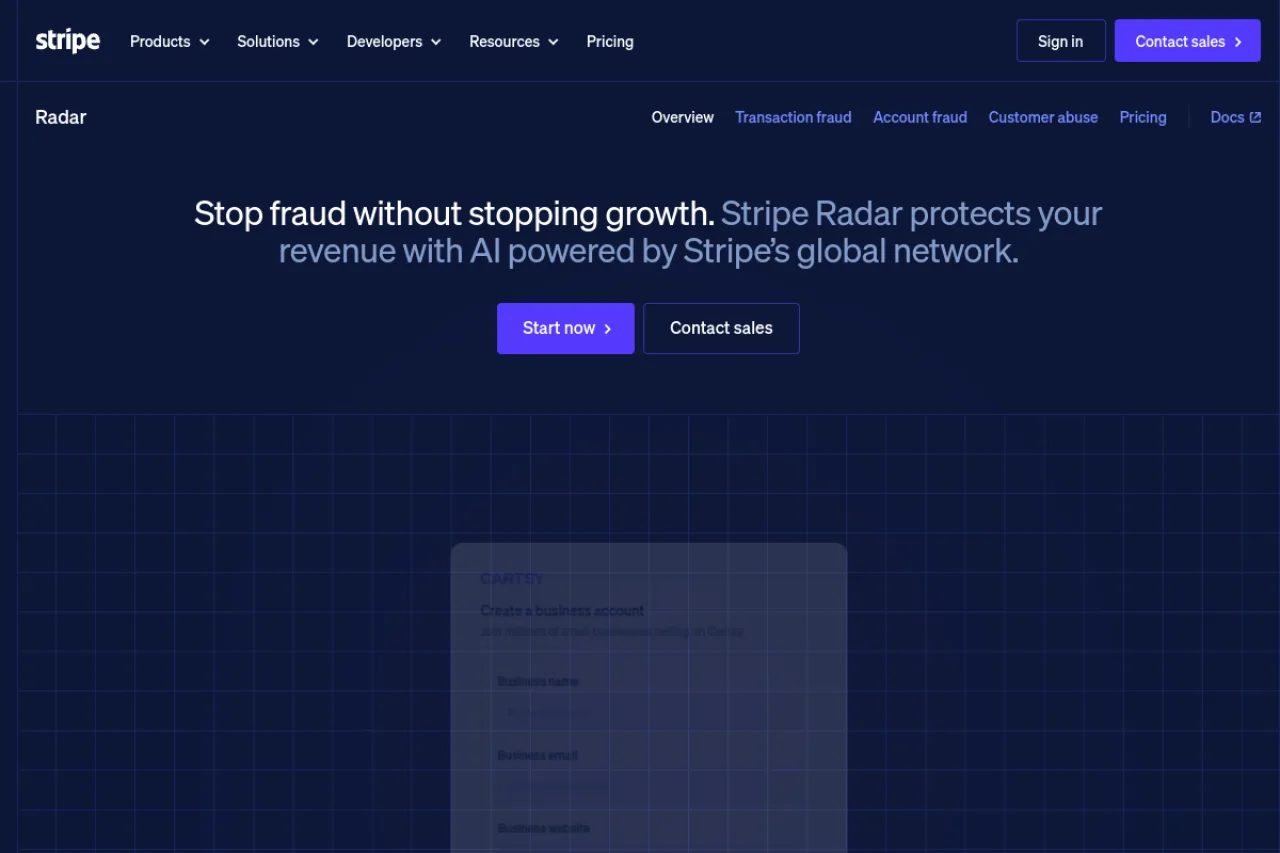
Stripe Radar is an AI-powered fraud prevention layer built into Stripe's payment platform. It scores transactions in real time using machine learning trained across millions of businesses on the Stripe network, automatically blocking fraud while offering manual review, custom rules, and analytics for teams that need finer control. It is ideal for businesses already processing payments on Stripe and less relevant for those using other processors.

Stripe Radar is a fraud prevention system built directly into Stripe's payment stack, using machine learning to score and block fraudulent transactions in real time. Because it operates inside the same infrastructure that processes the payment, Radar can draw on rich signals — customer details, billing and shipping addresses, device and buyer behavior patterns — to make decisions without adding friction to checkout. Radar's models are trained on data spanning millions of businesses across the Stripe network, which gives it a broad view of emerging fraud patterns that a single merchant could never assemble on its own. Every transaction receives a risk score, and Stripe's default rules act on those scores automatically, blocking obvious fraud while allowing legitimate payments through. Beyond the automated baseline, Radar offers manual review queues, customizable fraud rules, and analytics dashboards for teams that want tighter control. The more advanced tier (Radar for Fraud Teams) adds custom rule-building, allow/block lists, deeper review tooling, and richer reporting aimed at businesses with dedicated risk or fraud staff. The tool is best understood not as a standalone product but as a native layer of Stripe. If you already process payments through Stripe, Radar requires essentially no separate integration — it runs on the transactions flowing through your account. That tight coupling is Radar's biggest strength and its main constraint: it is designed for Stripe merchants and does not function as an independent fraud engine for other processors. Buyers should confirm current pricing and feature tiers on Stripe's official site, since fees and packaging can change and vary by account plan.

TL;DR

Stripe Radar is an AI-powered fraud prevention layer built natively into Stripe's payment platform. It scores transactions in real time using machine learning trained across millions of businesses on the Stripe network, and adds manual review, custom rules, analytics, and automated dispute handling for teams that need more control. It's a strong default for anyone already on Stripe, but it doesn't work as a standalone engine for other processors.

Company overview

Stripe is a global provider of financial infrastructure for payment processing and revenue operations, serving businesses from startups to large enterprises. Radar is one product within Stripe's broader suite, which spans online payments, billing, treasury, connect for platforms, and more, and it is designed to be tightly integrated with the rest of the Stripe stack.

Stripe has raised substantial venture funding over its history, with public reporting citing figures such as roughly $9.81B raised from investors including General Catalyst, Sequoia Capital, and Andreessen Horowitz. The company's valuation has fluctuated over time, reaching around $91.5B in a February 2025 secondary tender offer and rising to about $159B in a February 2026 tender offer.

Product features

Radar assigns a machine-learning-based risk score to every transaction, drawing on network-wide fraud signals plus rich contextual data from within the payment flow — customer details, billing and shipping addresses, and buyer behavior captured through Stripe's checkout tools. Stripe's default rules automatically block, allow, or flag payments based on these scores, providing fraud protection with no separate integration for merchants already on Stripe.

For teams needing more control, Radar for Fraud Teams adds custom rule-building, allow and block lists, manual review queues, and detailed fraud analytics. Radar also includes Smart Disputes, which uses AI to compile and submit evidence to fight eligible chargebacks, with countering fees waived regardless of whether the dispute is won or lost.

Target market

Radar serves the full range of Stripe's merchant base, from small online sellers and startups to SaaS companies, subscription businesses, marketplaces, platforms, and large enterprises with dedicated fraud teams. Its core audience is any business processing online card payments through Stripe, particularly ecommerce, SaaS, and platform businesses where transaction fraud and chargebacks are meaningful risks.

Buyer personas

End users

Fraud analysts, risk teams, and payment operations staff who review flagged transactions, tune rules, and monitor fraud analytics day to day within the Stripe Dashboard.

Buyers

Finance, operations, and engineering leaders at businesses already using Stripe who decide whether to enable advanced Radar tiers and pay per-transaction fraud fees.

Key influencers

Developers and engineering teams who integrate Stripe payments, along with finance leaders concerned about chargeback and fraud losses.

Ideal customer profile

An online business — ecommerce, SaaS, subscription, or marketplace — that already processes payments through Stripe and wants integrated, low-friction fraud protection, ideally with a risk team able to leverage custom rules and dispute automation.

Funding & performance

Stripe has raised approximately $9.81B in funding from investors including General Catalyst, Sequoia Capital, and Andreessen Horowitz. Its valuation reached around $91.5B in a February 2025 secondary tender offer, rising to about $159B in a February 2026 tender offer. (Radar is a product within Stripe and does not have separately disclosed funding.)

Pros & cons

Pros

  • Integrated directly into Stripe's payment processing with no separate setup required
  • Machine learning trained on data from millions of businesses across the Stripe network
  • Maintains API uptime above 99.999% with minimal downtime even during peak seasons like Black Friday
  • Users consistently praise ease of use and effective fraud detection that simplifies securing transactions
  • Customizable rules and actionable insights for businesses with specific fraud prevention needs

Cons

  • Increasingly expensive when factoring in dispute fees, auto-submission costs, and optional features like pre-dispute resolution
  • Advanced features in Radar for Fraud Teams cost significantly more (7¢ per transaction vs 2¢ for standard)
  • Stripe's algorithmic risk actions can freeze funds, and scaled support makes getting additional account review difficult
  • Only works with Stripe payment processing, limiting flexibility for multi-processor setups

Key features

API
Team collaboration
Multi-language
Integrations
Stripe Payments, Stripe Checkout, Stripe Connect, Stripe Billing, Stripe Dashboard
Input types
payment transactions, customer data, billing and shipping addresses
Output types
risk scores, fraud decisions, analytics reports

Compare key features

View all alternatives →
Feature
Stripe Radar
Workday AI
n8n
Pricing
Freemium
Freemium
Freemium
Free plan
Yes
No
Yes
Free trial
No
Yes
No
API
Yes
Yes
Yes
Self-hosted
No
No
Yes
Team support
Yes
Yes
Yes

Frequently asked questions

How much does Stripe Radar cost?+

Radar's core machine learning is available on every Stripe account, and the base fraud protection is waived for accounts on Stripe's standard payments pricing. On other plans it is priced around 5¢ per transaction. The advanced Radar for Fraud Teams tier carries an additional per-transaction fee, so confirm current rates on Stripe's pricing page.

How does Stripe Radar actually detect fraud?+

Radar assigns each transaction a risk score using machine learning models trained on data across millions of businesses on the Stripe network. Because it sits inside the payment flow, it can use signals like customer details, billing and shipping addresses, and buyer behavior to make decisions in real time. Stripe's default rules then block, allow, or flag payments based on those scores.

Do I need to integrate anything to use Radar?+

If you already process payments through Stripe, Radar's baseline protection runs automatically with no separate integration. You can enable manual review queues, custom rules, and analytics from the Stripe Dashboard. It does not require adding a third-party fraud tool.

Can I customize the fraud rules myself?+

Yes. Radar for Fraud Teams lets you build custom rules, maintain allow and block lists, and configure review workflows tailored to your business. This tier is aimed at merchants with dedicated risk or fraud staff who want to go beyond Stripe's automatic defaults.

Can I use Stripe Radar with a payment processor other than Stripe?+

No. Radar is a native part of Stripe's platform and only scores transactions that flow through your Stripe account. Businesses using other processors would need a different, processor-agnostic fraud solution.

How does Radar help with chargebacks and disputes?+

Beyond blocking fraud, Radar includes Smart Disputes, which uses Stripe's AI to automatically compile and submit evidence for eligible disputes. If you lose, no Smart Disputes fees are charged, and the fee for countering disputes is waived regardless of outcome, though the fee for receiving a dispute still applies.

Is Stripe Radar free?+

Stripe Radar is not free. For accounts with standard Stripe pricing (2.9% + 30¢), the basic machine learning screening costs 5¢ per transaction but is waived. For other accounts, it costs 2¢ per screened transaction. The advanced Radar for Fraud Teams costs 7¢ per transaction or 2¢ with standard processing pricing.

What does Stripe Radar integrate with?+

Stripe Radar is built directly into Stripe's payment processing platform and works with Stripe-supported payment methods. It integrates with Stripe's broader ecosystem including Checkout, Payment Links, and Terminal. Integration details with external third-party tools were not found in our research — check the official Stripe documentation for specific integration capabilities.

How does Stripe Radar compare to alternatives?+

According to G2 reviews, the top alternatives to Stripe Radar are Sift, Signifyd, and Kount. Users note that Radar's main advantage is seamless integration with Stripe payments and ease of use, while alternatives may offer more flexibility for multi-processor environments. Some users report trying multiple solutions and finding varying results, with cost being a consideration as Radar's pricing increases with dispute management features.

Reviews (0)

Write a review

Pick a rating
Loading reviews…
Compare

Compare Stripe Radar with other AI tools

Side-by-side pages for pricing, features, and best-fit use cases.

All comparisons →

People also compare

From the blog

All articles →

Similar tools you may like