Paxton AI
Paxton AI is an all-in-one legal assistant designed for attorneys and law firms, offering AI-powered legal research, document drafting, contract analysis, and medical chronology generation
Lexis+ AI (now branded as Lexis+ with Protégé) is a generative AI legal research and drafting platform built on Lexis...
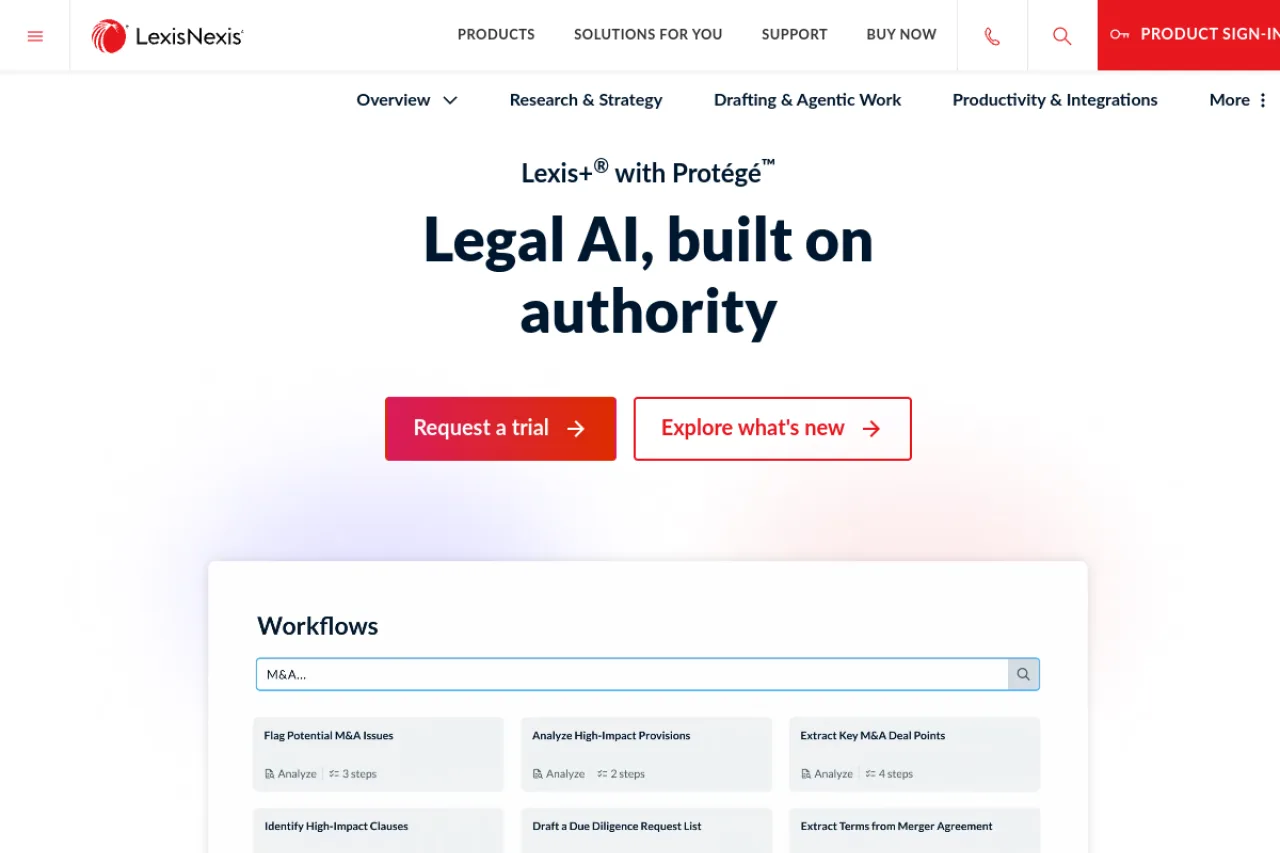
Lexis+ AI (Lexis+ with Protégé) is a generative AI legal research and drafting platform built on the LexisNexis content database. Its Protégé assistant handles conversational research, document drafting, summarization, and analysis while linking answers to authoritative sources and integrating Shepard's citation validation. It targets law firms and in-house counsel that want AI grounded in citable legal authority, though pricing is quote-based and buyers should scrutinize accuracy and the true cost of Protégé features.
Lexis+ AI—now branded as Lexis+ with Protégé—brings generative AI into the LexisNexis legal research ecosystem, layering conversational search, drafting, and analysis on top of one of the industry's largest authoritative legal content databases. The platform is powered by the Protégé AI assistant, which is designed to keep AI-generated answers grounded in case law, statutes, and secondary sources rather than the open web. The core value proposition is that AI outputs stay tethered to trusted legal material. Answers link back to authoritative sources, and the platform integrates Shepard's citation validation so lawyers can check whether cited cases remain good law. Beyond research, the tool supports document drafting, case summarization, and contract and brief analysis, with more recent releases adding litigation drafting and a Brief Analyzer workflow. Lexis+ with Protégé builds on the underlying Lexis+ plan, which bundles Practical Guidance, analytical tools, and Document Analysis. When enabled, an organization can also point the assistant at its own documents, allowing firm-specific knowledge to inform drafting and research. This positions the product as a workflow solution rather than a standalone chatbot. The platform is aimed at law firms and in-house teams that want AI assistance anchored to citable authority, particularly smaller and mid-sized firms looking to compete with larger practices. That said, accuracy remains an area to scrutinize: independent commentary has flagged errors in AI-generated legal content, and some practitioners view the platform's AI capabilities as trailing certain specialized competitors. Pricing is quote-based and can vary widely depending on which components you enable, so buyers should confirm exactly what Protégé access costs before signing and verify current terms on the official site.
Lexis+ AI, rebranded as Lexis+ with Protégé, is a generative AI legal research and drafting platform built on the authoritative LexisNexis content database. Its Protégé assistant handles conversational research, drafting, summarization, and analysis while linking answers to citable sources and integrating Shepard's validation. It targets law firms and in-house counsel, with quote-based pricing and lingering questions about AI accuracy.
Lexis+ AI is the generative-AI legal-research product of LexisNexis, part of RELX (LSE/NYSE: RELX), one of the world's largest information and analytics companies. Launched in 2023, it provides conversational legal research, drafting, and document summarization grounded in LexisNexis's proprietary legal content and citations (with Shepard's citation validation). It is a product of a large public company rather than an independent startup, competing directly with Thomson Reuters' CoCounsel.
Lexis+ with Protégé combines conversational AI search, document drafting, case summarization, and contract and brief analysis on top of the LexisNexis legal database. The Protégé AI assistant is designed to keep answers grounded in authoritative case law, statutes, and secondary sources, with responses linked back to those sources so lawyers can verify them.
Shepard's citation validation is integrated into the workflow, allowing users to confirm whether cited authority remains good law. When enabled, the platform can also reference an organization's own documents, letting firm-specific knowledge inform drafting and research. The product builds on the Lexis+ plan, which includes Practical Guidance, analytical tools, and Document Analysis.
More recent updates have expanded the platform with litigation drafting capabilities and a Brief Analyzer workflow, extending the assistant's usefulness across additional stages of legal work.
The platform serves law firms of varying sizes—from solo and small practices to mid-sized and larger firms—as well as in-house and corporate counsel. It is particularly positioned to help smaller and mid-sized firms compete with larger practices through AI-enhanced research and drafting. End users include partners, associates, paralegals, and law librarians who need AI assistance anchored to citable legal authority.
Attorneys, associates, paralegals, and law librarians who use the Protégé assistant for day-to-day research, drafting, and case analysis. They value linked authority and the ability to validate citations quickly.
Law firm partners, practice managers, and in-house legal operations leaders who evaluate subscriptions and negotiate quote-based pricing. They weigh the cost of Protégé features against productivity gains and existing LexisNexis commitments.
Law librarians, information professionals, and IT or knowledge-management staff who assess accuracy, security, and integration with firm document workflows. Their input shapes whether the AI features are enabled and how they're configured.
A small-to-mid-sized law firm or in-house legal team, ideally already using LexisNexis, that wants generative AI grounded in citable legal authority and is prepared to review AI outputs and negotiate quote-based pricing for the Protégé features.
Lexis+ AI is a product of LexisNexis, a division of RELX (LSE/NYSE: RELX), one of the world's largest information and analytics companies rather than an independently funded startup. RELX reports multi-billion-dollar annual revenue, of which the legal segment is a significant part; standalone startup-style 'funding rounds' or a startup valuation do not apply.
Pricing is quote-based and not published as fixed tiers, with reported ranges commonly falling between roughly $128 and $494 per user per month depending on which components you enable. The generative AI Protégé features are typically the most expensive part, and some firms report base quotes that don't fully reflect Protégé costs. Confirm exactly what's included and get Protégé pricing in writing before signing.
You interact with the Protégé AI assistant using conversational queries to research case law and statutes, draft documents, summarize cases, and analyze contracts or briefs. Answers link back to authoritative LexisNexis sources, and Shepard's citation validation lets you check whether cited cases remain good law. Recent releases added litigation drafting and a Brief Analyzer feature.
Yes—when enabled, an organization can allow Protégé to reference its own documents so drafting and research reflect firm-specific knowledge and templates. This capability is configured at the organization level rather than being on by default. Setup and access depend on your subscription and administrator configuration.
LexisNexis states that Lexis+ with Protégé was formerly branded Lexis+ AI, so they refer to the same evolving product line. It builds on the Lexis+ plan, which includes Practical Guidance, analytical tools, and Document Analysis, and adds the generative AI layer powered by the Protégé assistant.
It is designed to keep AI output anchored to authoritative legal content rather than functioning as a general-purpose chatbot. Responses are linked to LexisNexis sources and can be checked with Shepard's citation validation. Even so, generated content should always be reviewed by a qualified attorney before use.
The product was rebranded from Lexis+ AI to Lexis+ with Protégé, reflecting the assistant that now powers its capabilities. More recent updates introduced litigation drafting and a Brief Analyzer workflow. Check the official LexisNexis site for the latest feature availability and terms.
No. Lexis+ AI requires a paid Lexis+ subscription as the base, with AI features adding an estimated $50-125 per user per month on top of that subscription. Some firms report receiving AI features bundled at no additional cost during multi-year contract renewals as LexisNexis competes for business. There is no free plan or free trial mentioned in available research.
Lexis+ AI integrates with Microsoft 365 through Lexis Create+ for AI-assisted legal drafting. It also connects with LexisNexis's own ecosystem including Practical Guidance, Lex Machina analytics, and CounselLink+ for corporate legal operations. Specific third-party integrations beyond Microsoft were not detailed in the research.
According to user reviews, Lexis+ AI lags behind competitors like CoCounsel (Thomson Reuters) in capabilities—Reddit users report it's "about a year behind." Alternatives like Paxton AI offer coverage of all 50 states plus federal law at potentially lower price points. However, Lexis+ AI's advantage is deep integration with the established LexisNexis legal content database and Shepard's citation system, which competitors may not match in breadth.
Side-by-side pages for pricing, features, and best-fit use cases.
Humata excels at PDF analysis with citations, but legal professionals need specialized databases and researchers want broader source support.
Phind excels at developer-focused search, but these six alternatives offer specialized capabilities for legal research, academic citations, and AI-powered data retrieval.
Paxton AI is an all-in-one legal assistant designed for attorneys and law firms, offering AI-powered legal research, document drafting, contract analysis, and medical chronology generation
CoCounsel is an AI legal assistant from Thomson Reuters designed for legal research, document review, contract analysis, and drafting tasks
Scite is a research platform that analyzes how scientific papers cite each other, showing whether findings have been supported or contradicted by later research
Power BI Copilot is Microsoft's AI assistant integrated into Power BI that helps users create reports, write DAX formulas, and query data using natural language