
NotebookLM
Research
NotebookLM is Google's AI-powered research assistant that helps you summarize, analyze, and query your own documents with source citations
do-researchorganize-notesanswer-questions
Free planView →

Scite is a research platform that analyzes how scientific papers cite each other, showing whether findings have been ...
Strong for judging how a paper has been cited, flagging whether later work supports or contrasts it rather than just counting citations. The caveat is it is subscription-based and coverage varies by field.
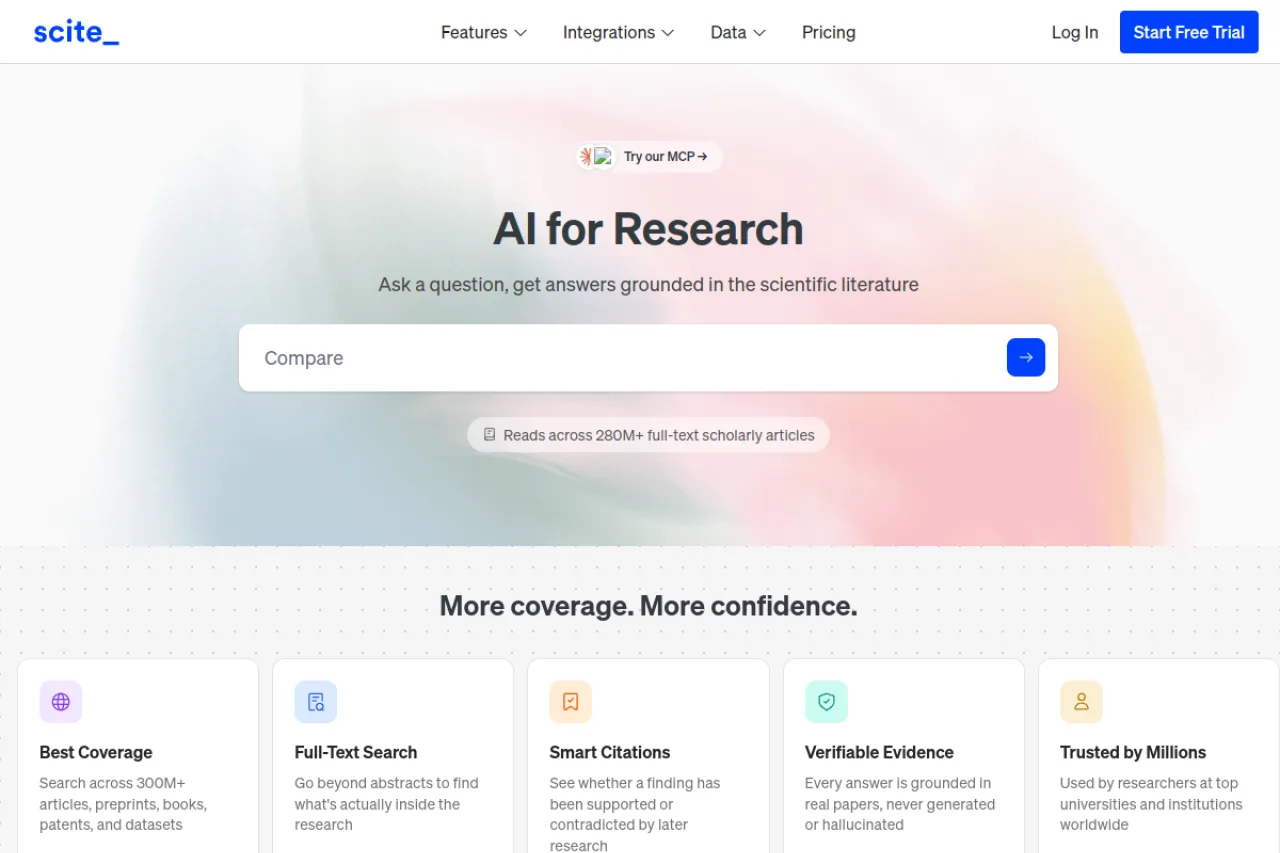
Scite is a research platform that analyzes how scientific papers cite one another, classifying citations as supporting, contrasting, or mentioning so users can gauge whether a finding has held up over time. Backed by licensing deals with 40+ publishers and coverage of 280M+ full-text sources, it pairs this citation intelligence with an AI assistant that grounds every answer in real papers and links back to source sentences. It's aimed at researchers, students, clinicians, and institutions who need verifiable, credibility-aware literature review.
Scite is a citation analysis and research platform built for academics, students, clinicians, and journalists who need to judge not just how often a paper has been cited, but whether those citations actually support or challenge its findings. It searches across more than 280 million full-text scholarly articles, preprints, books, patents, and datasets, reading inside the papers rather than stopping at abstracts. That depth is enabled by direct licensing agreements with Wiley, SAGE, and more than 30 other publishers, giving Scite access to content that many competing tools cannot reach. The platform's signature feature is Smart Citations, which classify every citation as supporting, contrasting, or simply mentioning a claim, and display the surrounding sentence in context. This same analysis can be applied to a paper, journal, author, institution, or funder, turning raw citation counts into a more meaningful picture of scientific consensus and controversy. Scite also includes an AI assistant that answers research questions grounded in peer-reviewed literature, with every claim linking back to the specific sentence in the specific paper it came from. This verification-first design is meant to reduce the risk of hallucinated or unsourced answers that plague general-purpose AI tools. Beyond core search and analysis, Scite offers citation alerts, custom collections, dashboards, and reporting. It integrates with Zotero, works inside Claude and ChatGPT through MCP connectors, and offers a developer API on higher-tier plans. Higher plans extend coverage to patents, clinical trials, grants, and, at the enterprise level, regulatory and safety datasets. With freemium and tiered paid plans, Scite is positioned for individual researchers through to labs, universities, and large organizations. Buyers should verify current pricing and feature availability on the official site, as plans and credit allowances change over time.
Scite is a citation intelligence and AI research platform that classifies citations as supporting, contrasting, or mentioning, helping researchers judge whether a finding has held up. Backed by publisher licensing deals across 40+ publishers and 280M+ full-text sources, its AI assistant grounds every answer in real, linkable papers. It serves individuals through universities via a freemium, tiered model starting around $20/month.
Scite (scite.ai) is an AI research platform best known for "Smart Citations," which classify whether a citing paper supports, contradicts, or merely mentions a claim — analyzing over 1.2 billion citation statements across 200M+ sources. Founded in 2018, Scite was acquired by Research Solutions (NASDAQ: RSSS), a research-intelligence company, and now operates as part of its portfolio rather than as an independent startup. It offers a free tier plus individual and institutional plans.
Scite's core is Smart Citations, which classify each citation to a paper as supporting, contrasting, or mentioning and display the surrounding sentence in context. That analysis can be applied to papers, journals, authors, institutions, and funders, giving a nuanced view of scientific consensus. Full-text search across 280M+ articles, preprints, books, patents, and datasets—enabled by direct agreements with Wiley, SAGE, and 30+ more publishers—lets users see what's actually inside research rather than relying on abstracts.
The AI assistant answers research questions grounded in peer-reviewed literature, linking every claim back to the specific source sentence for one-click verification. Supporting features include citation alerts, collections of up to 1,000–10,000 papers depending on tier, dashboards, and reporting.
Scite integrates into existing workflows through Zotero, a browser extension, and MCP connectors for Claude and ChatGPT, with metered MCP credits by plan. Higher tiers unlock patents, clinical trials, and grants, while Enterprise adds API access, SAML/SSO, regulatory and safety datasets such as FAERS, MAUDE, and 510(k), and institutional access controls.
Scite serves individual academic researchers, graduate and doctoral students, clinicians, and science journalists, scaling up to labs, universities, and large organizations. Its tiered plans map to this range—Basic for individuals, Pro for deep research, Team for small labs, and Enterprise for universities and R&D-heavy organizations that need pooled usage, SSO, and specialized regulatory datasets.
Researchers, students, clinicians, and journalists who run literature reviews, verify claims, and want AI answers they can trace back to real papers. They value context-rich citations and confidence in source credibility.
Individual academics purchasing Basic or Pro subscriptions, and library or institutional administrators procuring Team and Enterprise plans for their communities. Institutional buyers weigh coverage breadth, access management, and security.
Faculty advisors, librarians, and research office leaders who recommend evidence-based tools, plus power users who champion adoption within labs and departments.
A research-intensive university, medical center, or R&D organization whose members need full-text scholarly search, citation credibility signals, and verifiable AI assistance—ideally one that also needs SSO, pooled usage, and regulatory datasets at the enterprise level.
Scite has raised venture funding, including a Series round with the National Science Foundation listed among recent investors. Specific amounts, valuation, and revenue figures are not confirmed in the available research.
Scite uses a freemium model with a free tier plus paid plans. Paid pricing starts at around $20/month for the Basic plan aimed at individual researchers, with Pro at $50/month and Team at $100/month for two users. Enterprise pricing for universities and organizations is quote-based; verify current numbers on Scite's pricing page since plans and credit allowances change.
Smart Citations classify each citation to a paper as supporting, contrasting, or mentioning the claim, rather than just counting how many times it was cited. Scite shows the surrounding sentence so you can see the context, and you can apply the same analysis to a journal, author, institution, or funder. This helps you judge whether a finding has been reinforced or challenged by later research.
Scite connects to Zotero, offers a browser extension, and runs inside Claude, ChatGPT, and other MCP-compatible assistants via connectors. MCP usage is metered in monthly credits that vary by plan. A developer API is available for teams building their own tools, though it is offered at the Enterprise level.
Scite searches more than 280 million full-text scholarly sources, including articles, preprints, books, patents, and datasets, drawing on 1.6B+ citations. Its depth comes from direct licensing agreements with Wiley, SAGE, and 40+ other publishers plus the open access corpus, so it reads inside papers rather than stopping at abstracts. Higher tiers add patents, clinical trials, grants, and regulatory/safety datasets.
Enterprise plans include SAML/SSO, enhanced security and data confidentiality, flexible access by domain, IP, or email, and a dedicated customer success manager. These features are designed for universities and organizations that need managed, secure deployment across many users. Individuals and small teams on lower tiers get standard account-level access without these institutional controls.
Scite's assistant is designed to ground every answer in real papers and link each claim back to the specific sentence it came from, so answers are verifiable rather than generated from nothing. This verification-first approach is meant to reduce hallucinated or unsourced content. You should still click through to check the source to confirm the interpretation.
Scite does not offer a free plan. It operates on a freemium model with a 7-day free trial, after which users must subscribe to a paid plan starting at $20/month for the Basic tier. Student discounts of 30-50% are available on paid plans.
Scite offers a Zotero plugin, browser extensions, and MCP (Model Context Protocol) access. The platform also provides embedded badges and API access, though specific integration details for other research tools were not extensively documented in available research.
Scite's Smart Citations feature is uniquely useful for checking how papers cite each other and whether findings are supported or contradicted. Alternatives like Semantic Scholar offer free citation tracking but without Scite's citation context classification. Users often recommend using Scite alongside tools like Elicit (for finding papers) and Consensus (for understanding disagreements) rather than as a replacement.
Side-by-side pages for pricing, features, and best-fit use cases.
Scite specializes in citation analysis for academic research, while You.com offers AI-powered web search and productivity tools with API access.
Research Rabbit offers visual citation networks for literature discovery, while Scite analyzes citation context to show supporting or contradicting evidence.
Compare Scite's citation analysis with Smart Citations against Semantic Scholar's free AI-powered search across 235M+ papers to find the best research tool.
NotebookLM excels at document analysis with citations, but researchers need specialized tools for literature discovery, citation networks, and academic writing.
Scite excels at citation analysis, but researchers also need visual discovery, document chat, and multilingual search. Here are six alternatives.
Research Rabbit excels at visual citation networks, but these alternatives offer citation analysis, AI search, and document collaboration for different research workflows.
NotebookLM is Google's AI-powered research assistant that helps you summarize, analyze, and query your own documents with source citations

ResearchRabbit is a visual discovery tool for academic literature reviews that helps researchers find and organize papers through citation networks and algorithmic recommendations

Felo is a multilingual AI search and creation platform that combines search, document collaboration, and AI-powered content generation

Semantic Scholar is a free, AI-powered academic search engine that indexes over 235 million scientific papers across all fields