
Grok
Chatbots
Grok is xAI's conversational AI assistant that integrates real-time data from X (formerly Twitter) and offers advanced reasoning capabilities
answer-questionssearch-the-webdo-research
Free planView →
Gemini is Google's multimodal AI chatbot that handles text, images, audio, and video understanding with real-time Goo...
Our assessment — not a user rating. How we score
Verified against each vendor's own trust page. Not legal advice — confirm current status with the vendor.
The one to use if you live in Google — a huge context window and tight Workspace integration — though the standalone experience still trails ChatGPT.
Gemini is Google's multimodal AI assistant that handles text, images, audio, and video, with real-time Google Search grounding and tight Google Workspace integration. It offers a free tier plus paid Google AI plans that add advanced models, large context windows, generative media tools, and bundled cloud storage. It's an especially natural fit for people and teams already standardized on Google's ecosystem.
Gemini is Google's flagship consumer AI assistant, a multimodal chatbot that understands and generates across text, images, audio, and video. Because it's woven into Google's broader ecosystem, it can pull in real-time information through Google Search grounding and tap directly into Google Workspace apps like Gmail, Docs, and Drive, making it one of the most contextually connected assistants available. The product is built on Google's proprietary Gemini model family, which is engineered for large context windows that can reach into the millions of tokens. That capacity lets Gemini reason across long documents, lengthy chat histories, and dense reference material without losing the thread, which is a meaningful differentiator for research-heavy and document-centric work. Gemini ships with a capable free tier and paid subscriptions through Google AI plans that unlock higher usage limits, advanced models, video generation, and bundled Google cloud storage. The consumer tiers run from Google AI Plus at $7.99/month to AI Pro at $19.99/month (which includes the Gemini 3.x Pro model and a 1M-token context window) up to AI Ultra, restructured in 2026 into a $99.99/month tier and a top $199.99/month tier with the highest limits and creative tools. The paid tiers position the assistant as both a productivity layer and a creative studio, with credits for image and video generation alongside standard chat. For individuals already living inside Gmail, Docs, and Android, Gemini is the path of least resistance: it's available on the web, in mobile apps, and increasingly baked into Workspace surfaces. Buyers should confirm current model availability, usage limits, and pricing on the official site, since Google iterates on tiers and model names frequently. For individuals already living inside Gmail, Docs, and Android, Gemini is the path of least resistance: it's available on the web, in mobile apps, and increasingly baked into Workspace surfaces. Buyers should confirm current model availability, usage limits, and pricing on the official site, since Google iterates on tiers and model names frequently.
Gemini is Google's multimodal AI assistant, combining text, image, audio, and video understanding with real-time Google Search grounding and native Google Workspace integration. It offers a free tier plus paid Google AI plans — AI Plus at $7.99/month, AI Pro at $19.99/month, and AI Ultra from $99.99/month — that add advanced models, large context windows, and generative media tools. It's the natural choice for anyone embedded in Google's ecosystem.
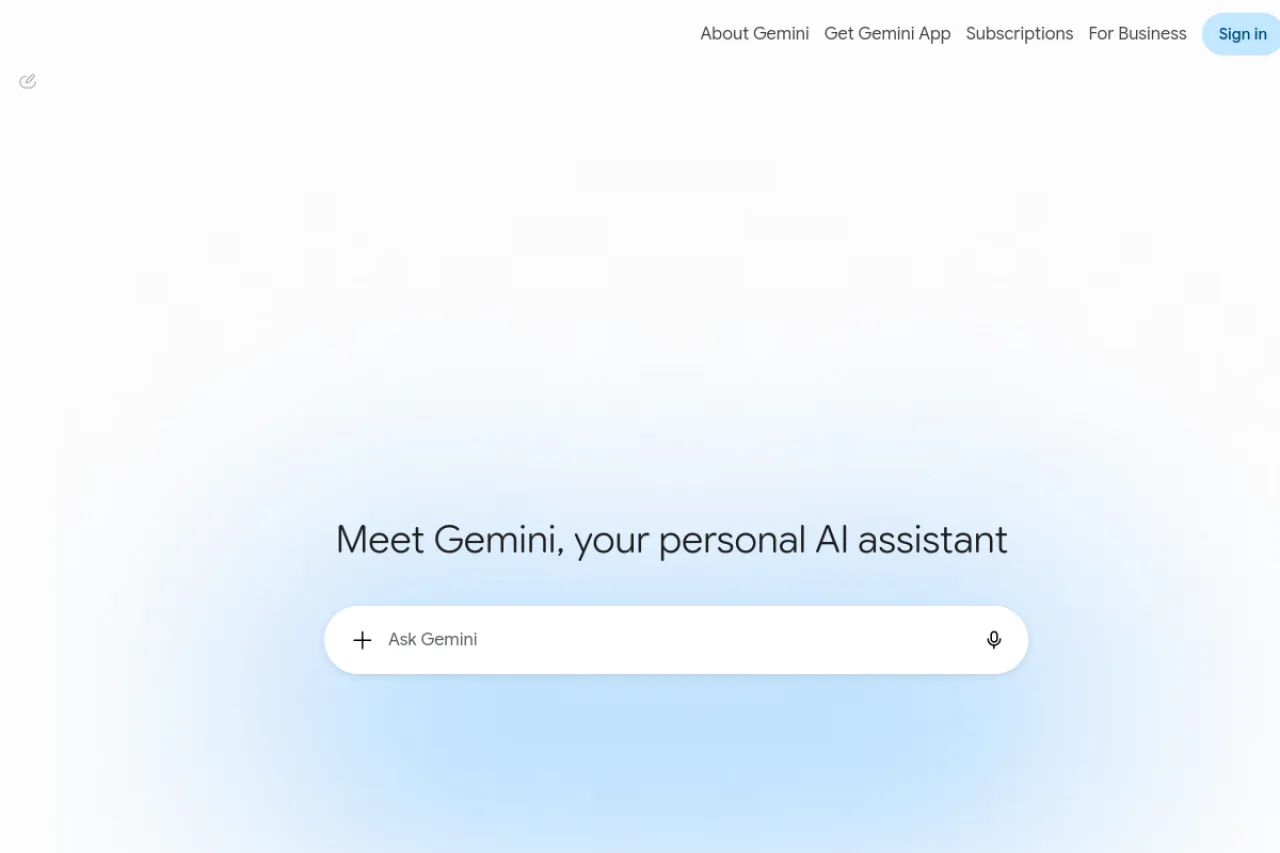
Gemini is developed by Google as its consumer-facing AI assistant, built on the company's proprietary Gemini model family. It is positioned as a personal AI assistant accessible via web and mobile apps, integrated across Google's product ecosystem including Search, Gmail, Docs, and Drive, and offered to consumers, businesses, and developers through tiered plans.
Google's stated direction with Gemini is to make a capable, multimodal assistant available wherever users already work, blending real-time information access with deep productivity integration. (Note: some external company databases list an unrelated cryptocurrency company also named 'Gemini' founded by Tyler and Cameron Winklevoss; that is a separate entity and not the Google AI product described here.)
Gemini handles multimodal input and output, understanding text, images, audio, and video within a single conversation. It grounds answers in real-time Google Search results, reducing reliance on a fixed training cutoff, and connects natively to Google Workspace so it can reference and act on a user's own email, documents, and files.
The product is notable for very large context windows that can reach into the millions of tokens, enabling reasoning across long documents and extended histories. Paid Google AI plans unlock advanced models in the Gemini 3.x Pro family (with Gemini 3.5 models rolling out through 2026), higher usage limits, generative image and video creation, credits for Google's AI creative studio, and bundled cloud storage. Developers can build on the separate Gemini Developer API, which is billed by token consumption.
Gemini serves a broad market spanning individual consumers, students and researchers, content creators, small businesses, and enterprises. Its strongest fit is with users and organizations already invested in Google's ecosystem, where Workspace integration and search grounding deliver the most value, while developers are served through the Gemini API and Google Cloud's enterprise agent platform.
Knowledge workers, students, researchers, and creators who use Gemini for writing, research, document analysis, coding, and multimodal tasks across web and mobile.
Individuals subscribing to Google AI plans, and IT or operations leaders purchasing Workspace business tiers with Gemini seats for their teams.
Productivity-focused team leads, developer advocates, and IT administrators who already standardize on Google Workspace and Google Cloud.
An organization or individual already operating within the Google ecosystem that wants a multimodal AI assistant with search grounding and deep Workspace integration, and is comfortable with a cloud-hosted service.
Gemini has a free tier with everyday usage, and paid access comes through Google AI plans starting around $10/month for Google AI Pro, which adds higher usage limits and advanced models like Gemini 3.1 Pro. Higher Ultra tiers and Workspace business plans (list-priced from roughly $20 per user per month with annual commitment) add more features and seats. Always verify current pricing on Google's site, since tiers and currencies vary.
You interact through a chat interface on the web or mobile app, typing prompts or uploading images, documents, audio, and video for the model to analyze. It can ground responses in real-time Google Search results and, on connected accounts, reference your Gmail, Docs, and Drive content. Paid plans also enable generative image and video creation alongside text.
All you need is a Google account; sign in at gemini.google.com or download the Gemini app for Android or iOS. The free tier requires no payment, and upgrading to a paid plan or enabling Workspace integration is done through your Google account settings. Connecting Workspace apps unlocks Gemini's ability to reference your own documents and email.
Gemini runs on Google's proprietary Gemini model family, with paid plans unlocking advanced versions such as Gemini 3.1 Pro and large context windows that can reach into the millions of tokens. It integrates natively with Google Workspace apps including Gmail, Google Docs, Drive, and Google Search grounding. Developers can also build on the separate Gemini Developer API with token-based pricing.
Gemini operates under Google's standard terms and privacy policy, and Google notes the assistant is AI that can make mistakes. Workspace and enterprise editions are governed by Google's business data protections, which differ from the consumer experience. Buyers with sensitive data should review Google's privacy documentation and the applicable plan terms before connecting accounts.
Google has continued advancing the model line, with paid plans now offering access to Gemini 3.1 Pro and expanded creative features like video generation and credits for Google's AI creative tools. Usage limits, model availability, and feature bundles evolve frequently, so the version and capabilities on each tier are worth re-checking before you subscribe.
Yes, Gemini offers a free plan that reviewers describe as 'unusually generous' compared to competitors. Paid plans start at $10/month for Google AI Pro, which includes $10 in monthly Google Cloud credits and access to Gemini 3.1 Pro. Higher tiers include AI Ultra at $100 and $200/month with advanced features like video generation and Deep Research.
Gemini has deep integrations with nearly every Google app, including Google Workspace (Docs, Sheets, etc.), Google Search (real-time integration), and comes bundled with cloud storage through Google One. The Google AI Pro plan also includes the Google Home Premium Standard plan at no additional cost.
Gemini competes directly with ChatGPT, Claude, Perplexity, Copilot, and Grok. Its main advantages are the generous free tier, massive context windows (1-2M tokens vs competitors), and Google ecosystem integration. However, ChatGPT is noted to handle multi-turn conversations better, Claude excels at reasoning tasks, and Perplexity is preferred for research. Gemini's advanced tier matches high-end market performance with best-in-class integrations.
Side-by-side pages for pricing, features, and best-fit use cases.
Claude and Gemini take opposite approaches: focused depth vs Google-wide reach. We compare coding, writing, price, and ecosystem to help you choose.
ChatGPT and Gemini both start at ~$20/month. We compare models, ecosystem, multimodal, and price — and explain which one fits your workflow in 2026.
Gemini is the multimodal assistant baked into Google; Perplexity is the specialist cited search engine. Here is which one deserves your default tab.
DeepSeek is a free, open-weight model with rock-bottom API pricing. Gemini is Google's deeply integrated assistant spanning Search, Workspace, and Android.
DeepSeek V4.1-Flash undercuts frontier pricing, Cognition raises $2B and ships SWE-2, OpenAI opens full-duplex voice to developers, and Sora’s API dies September 24.
The same prompt gets different results from Claude, ChatGPT, and Gemini. Here's how each model likes to be prompted — plus the fundamentals that work everywhere.
ChatGPT Pro costs 10x more than Plus — but runs the same model. Here's what the $200 tier actually buys, who it's for, and the cheaper path for everyone else.
Grok is xAI's conversational AI assistant that integrates real-time data from X (formerly Twitter) and offers advanced reasoning capabilities

Claude is an AI chatbot developed by Anthropic, offering conversational AI capabilities with multiple model tiers (Opus, Sonnet, Haiku) and specialized products including Claude Code for software deve

ChatGPT is an AI chatbot developed by OpenAI that handles conversational tasks including writing, coding, learning, and brainstorming

Mistral AI's fast, European-built assistant with strong open models behind it.