Claude
Claude is an AI chatbot developed by Anthropic, offering conversational AI capabilities with multiple model tiers (Opus, Sonnet, Haiku) and specialized products including Claude Code for software deve
ChatGPT is an AI chatbot developed by OpenAI that handles conversational tasks including writing, coding, learning, a...
ChatGPT is OpenAI's flagship conversational AI assistant, capable of writing, coding, research, brainstorming, and answering questions through an intuitive chat interface. It offers a freemium model spanning a free tier and paid Go, Plus, Pro, Business, and Enterprise plans, with higher tiers unlocking advanced reasoning models, larger context, and agentic features. It's the most accessible and widely adopted general-purpose AI assistant, with the main trade-offs being usage limits on lower plans and the need to verify factual accuracy.
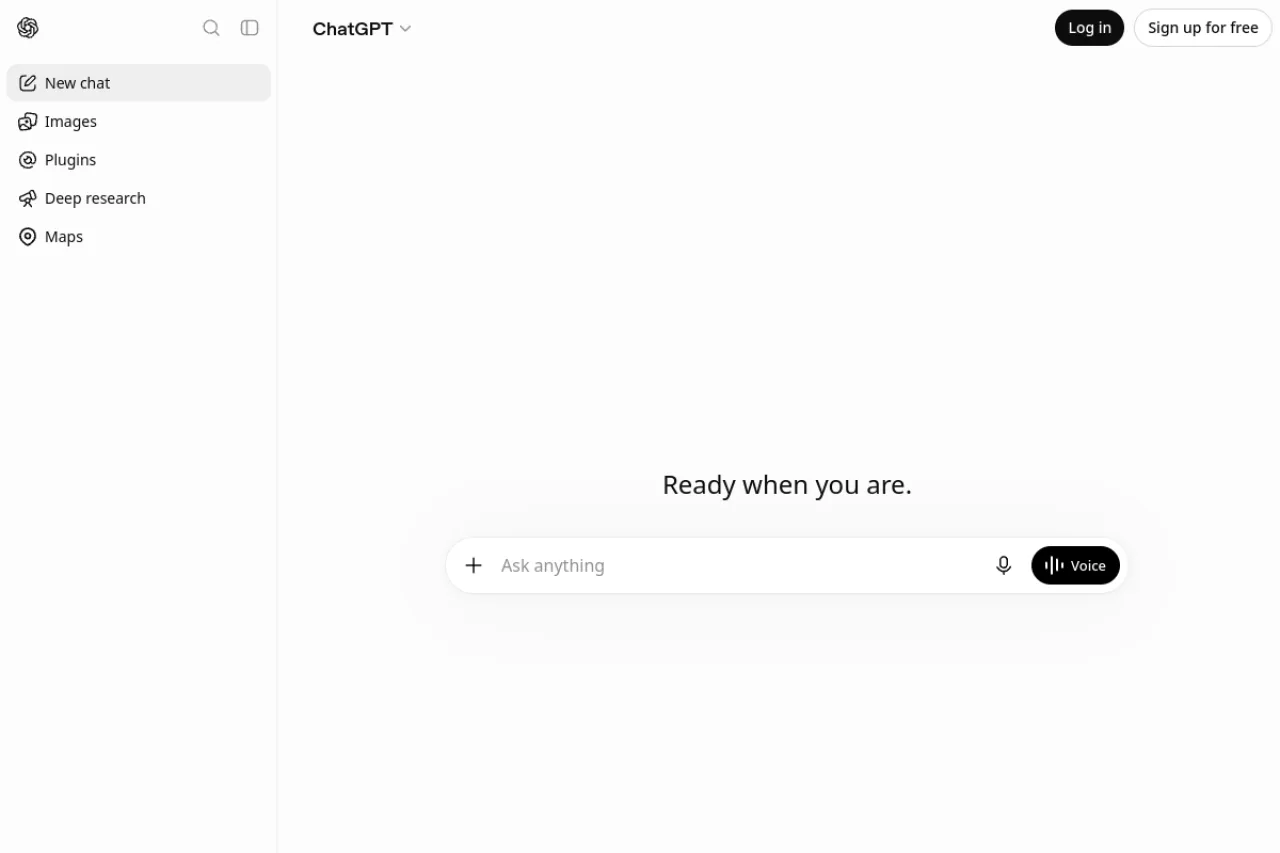
ChatGPT is OpenAI's conversational AI assistant and arguably the product that brought generative AI into the mainstream. Built on the company's GPT family of large language models, it handles an enormous range of text-based tasks through a simple chat interface: drafting and editing writing, explaining concepts, generating and debugging code, brainstorming, summarizing documents, and answering open-ended questions. Its versatility and low barrier to entry are the core of its appeal — almost anyone can be productive within minutes. The product has grown well beyond a text box. It now spans image generation, voice conversations, file and PDF uploads, deep research, agentic workflows, custom GPTs, and a coding-focused offering through Codex. A desktop app, mobile apps, and integrations with tools like Canva, Spotify, and PowerPoint extend it into everyday workflows, while Business and Enterprise tiers add admin controls and data-handling protections for organizations. Pricing follows a freemium model with a free tier and several paid plans. The free version offers limited access to OpenAI's latest models with capped messages, uploads, and memory; as of early 2026, the Free and Go tiers are ad-supported in the US. Paid individual plans run from Go at $8/month and Plus at $20/month up to two Pro tiers — $100/month and $200/month — progressively unlocking more usage, advanced reasoning models, larger context, and expanded research and agent capabilities. Business (from $20/seat/month, two-seat minimum) and Enterprise (custom) tiers layer on admin controls and data protections for teams. In practice, ChatGPT is the default starting point for most people exploring AI assistants. The trade-offs that matter most for buyers are usage limits on lower tiers, the variability of context retention across long sessions, and the need to verify factual output since the model can still produce confident but incorrect answers. For most general-purpose use, however, it remains the most capable and approachable option on the market. Pricing and plan details change frequently, so confirm current tiers and limits on the official site before committing.

ChatGPT is OpenAI's flagship conversational AI assistant and the product that mainstreamed generative AI. It handles writing, coding, research, image generation, and agentic tasks through a chat interface, with a freemium model spanning Free, Go ($8/mo), Plus ($20/mo), two Pro tiers ($100 and $200/mo), Business, and Enterprise. It is the most widely adopted general-purpose AI assistant, backed by OpenAI's $122B funding round at an $852B valuation (March 2026).
ChatGPT is developed by OpenAI, the AI research and deployment company widely credited with igniting the current generative AI boom following ChatGPT's public release in 2022. The product is built on OpenAI's GPT family of large language models and has since become the company's flagship consumer-facing offering.
OpenAI has positioned itself as core infrastructure for AI, expanding ChatGPT into a broad platform that spans consumer, developer, and enterprise use. The company has stated it generates roughly $2 billion a month in revenue and serves individuals and businesses globally.
ChatGPT centers on a conversational chat interface powered by OpenAI's latest models, including advanced reasoning tiers available on paid plans. Core capabilities include text generation and editing, code writing and debugging, question answering, summarization, and brainstorming.
The platform has expanded into a multimodal, multi-feature ecosystem: image generation, voice and voice-with-video conversations, file and PDF uploads, deep research, agent mode for multi-step tasks, group chats, and custom GPTs. A coding-focused Codex offering, desktop and mobile apps, and integrations with tools like Canva, Spotify, and PowerPoint extend its reach.
Business and Enterprise tiers add admin controls, expanded usage, and stronger data-handling commitments, including assurances that content on those plans is not used to train OpenAI's models. Memory and context capacity scale with higher-priced plans.
ChatGPT serves an unusually broad market spanning individual consumers, students, educators, writers, developers, and knowledge workers, as well as small businesses and large enterprises. Its tiered plans map to this range — from a free entry point through individual Go, Plus, and Pro plans up to Business and Enterprise offerings for organizations needing administration, scale, and data protections.
End users range from individuals using the free tier for everyday questions and writing help to professionals relying on paid plans for coding, research, and content production. They value the low learning curve and the breadth of tasks one tool can handle.
For individuals, the buyer is typically the end user choosing between Free, Go, Plus, and Pro. In organizations, buyers are IT, operations, or department leaders evaluating Business and Enterprise plans for productivity gains, admin controls, and data governance.
Team leads, engineering managers, and early-adopter power users often drive adoption from the bottom up, while procurement and security teams influence enterprise decisions around data handling and compliance.
The ideal customer is a knowledge-driven individual or organization that performs frequent writing, coding, research, or analysis tasks and wants a single versatile AI assistant. Teams that can deploy Business or Enterprise tiers benefit most from the combination of capability, scale, and data protections.
OpenAI closed a record funding round on March 31, 2026 — $122 billion in committed capital at an $852 billion post-money valuation — anchored by Amazon ($50B), Nvidia ($30B), and SoftBank ($30B), with Microsoft and Andreessen Horowitz among the participants. The company has said it generates roughly $2 billion per month in revenue, having made $13.1 billion in 2025. Its private valuation has climbed from about $300 billion (March 2025) to $500 billion (October 2025) to $852 billion (March 2026), and it has reportedly begun confidential IPO groundwork.
ChatGPT has a free tier available to everyone with limited model access and capped messages. Paid individual plans include Go, Plus at $20/month, and Pro at up to $200/month, with Business and Enterprise plans priced per user per month. What you'll really pay depends on how much usage and which advanced features you need, so heavy users should expect to land on Plus or higher.
At its core ChatGPT is a chat-based assistant for writing, editing, coding, brainstorming, summarizing, and answering questions. Beyond text, it supports image generation, voice conversations, file and PDF uploads, deep research, and agentic workflows on higher tiers. You simply type or speak a request and refine the output through follow-up messages.
You can use ChatGPT immediately through the web at chat.openai.com by signing up for a free account. OpenAI also offers native desktop and mobile apps, plus integrations with tools like Canva, Spotify, and PowerPoint. No installation is required to begin — the browser version works out of the box.
Paid plans unlock OpenAI's latest models, including advanced reasoning tiers, while the free plan provides limited access to current models. The platform supports custom GPTs, app integrations, and a coding-focused Codex offering. Developers can also access OpenAI's models through its separate API.
On consumer tiers, chats may be reviewed and used to improve OpenAI's models unless you adjust data controls in settings. Business and Enterprise plans add stronger data-handling commitments, and OpenAI states that content on those plans is not used to train its models. Privacy-sensitive users should review the current data settings and plan terms before sharing confidential information.
OpenAI has expanded ChatGPT well beyond text with deep research, agent mode, group chats, voice with video, and app integrations. The plan lineup has also grown to include a lower-cost Go tier alongside Free, Plus, Pro, Business, and Enterprise. Model versions update frequently, so the available capabilities on each tier shift over time.
Yes, ChatGPT offers a free tier, but it comes with significant limitations including 10 messages per five hours, no access to advanced models like GPT-4o or GPT-5.5, slower performance, and ads in the US. Verified U.S. K-12 educators can access a free enhanced plan through June 2027. Paid plans start at $8/month for the Go plan.
Integration details were not found in our research — check the official website for current integration capabilities and API options.
ChatGPT is considered the leading conversational AI chatbot, but alternatives may be better for specific use cases. Google Gemini is recommended if you primarily use Google apps and need AI image/video generation. Perplexity is positioned as a better alternative for research and search-focused queries. Other alternatives may offer better performance for specialized use cases, more flexible pricing, or stronger integration capabilities depending on your needs.
According to G2 users, ChatGPT Plus is worth $20/month if you need faster responses, higher usage limits, and access to advanced models like GPT-4o and o1/o1-mini. For casual users who only need occasional AI help, the free version may be sufficient despite its limitations. Heavy users for programming, writing, or professional tasks generally find the Plus subscription valuable.
Side-by-side pages for pricing, features, and best-fit use cases.
ChatGPT and Gemini both start at ~$20/month. We compare models, ecosystem, multimodal, and price — and explain which one fits your workflow in 2026.
ChatGPT and Claude both cost $20/month. We break down which wins for coding, writing, and everyday use — and why most power users end up running both.
Gemini excels at multimodal tasks and Google integration, but these six alternatives offer stronger reasoning, specialized learning tools, or different AI approaches.
Claude excels at nuanced conversation, but lacks real-time search, specialized tutoring, and customer support automation. Here are six alternatives.
ChatGPT excels at general conversation, but specialized alternatives offer deeper integration, subject expertise, and workflow-specific features.
Claude is an AI chatbot developed by Anthropic, offering conversational AI capabilities with multiple model tiers (Opus, Sonnet, Haiku) and specialized products including Claude Code for software deve
Gemini is Google's multimodal AI chatbot that handles text, images, audio, and video understanding with real-time Google Search integration and deep Google Workspace compatibility
Grok is xAI's conversational AI assistant that integrates real-time data from X (formerly Twitter) and offers advanced reasoning capabilities
Zendesk AI is an AI-powered customer service platform that automates ticket resolution and assists support agents across multiple channels