
Scite
Research
Scite is a research platform that analyzes how scientific papers cite each other, showing whether findings have been supported or contradicted by later research
do-researchanalyze-data
View →

Exa is an AI-powered search API and web crawler designed for developers building AI agents, RAG applications, and cha...
Best for developers building AI apps that need semantic, embeddings-based web search returning clean content rather than ad-cluttered result pages. The caveat is it is a developer API with usage-based pricing, not a consumer search tool you just open and use.
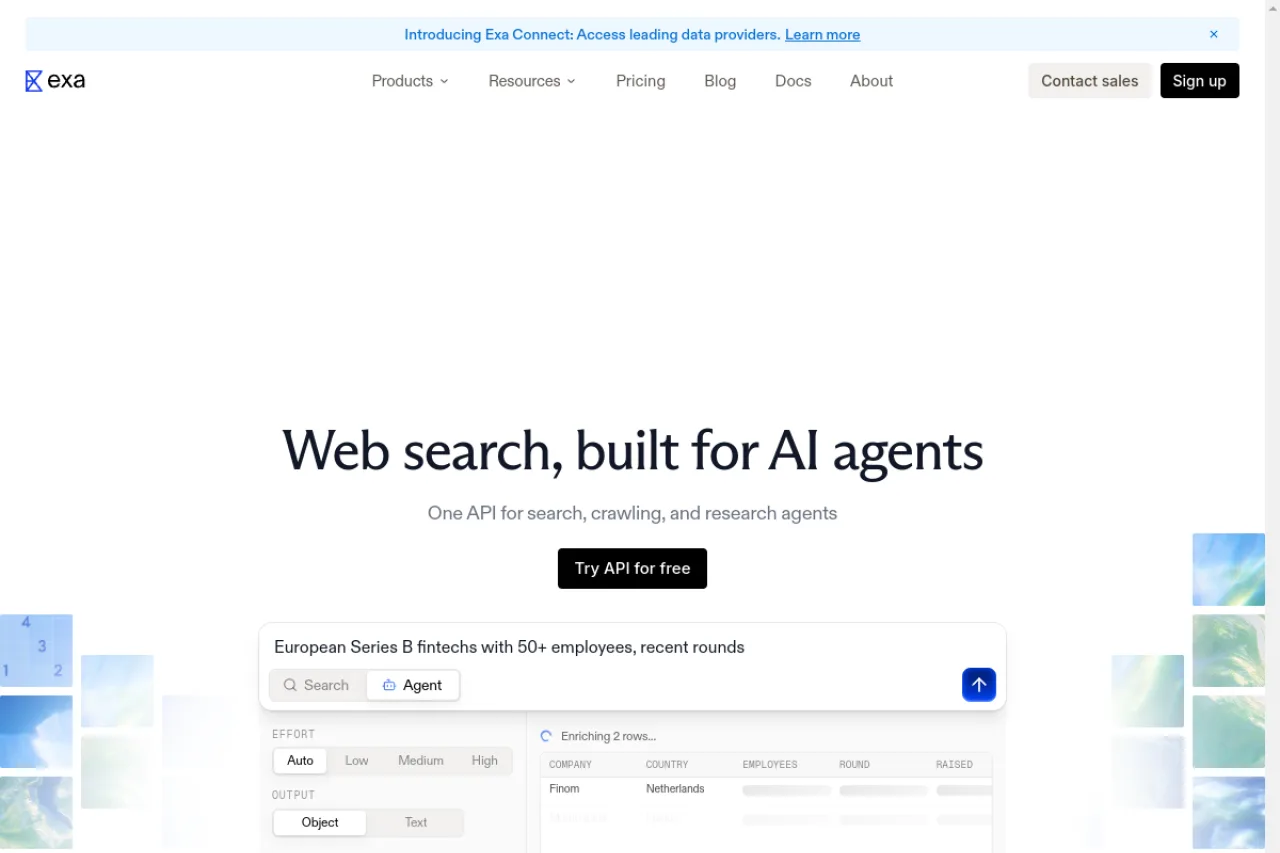
Exa is an AI-native web search and crawling API for developers building agents, RAG systems, and chatbots. It combines neural semantic search, real-time indexing, content extraction, and research-agent capabilities under one developer API, with configurable latency and pay-as-you-go pricing plus a free tier. It's widely adopted across coding, sales, and productivity tools and is best suited to teams that need programmatic, machine-readable web data rather than a consumer search interface.
Exa is a web search API and crawling platform built specifically for developers integrating search into AI applications. Rather than optimizing for a human browsing experience, it is designed for AI agents, retrieval-augmented generation (RAG) pipelines, and LLM-powered products that need to pull fresh, relevant content from the live web and feed it into a model as context. The platform uses neural, semantic search to interpret queries by meaning rather than keyword matching alone, and it maintains a real-time web index so results reflect current information. Exa exposes several complementary products under one API: Search for retrieving relevant URLs, Contents for extracting clean full-page text and token-efficient highlights, Deep for research agents, Agent for structured multi-step tasks, and Monitors for tracking topics over time. Exa positions itself as an alternative to traditional search engines for machine consumption. Latency is configurable, so teams building autocomplete, voice AI, or coding agents can trade depth for speed, while research-heavy workflows can lean on higher-effort modes that gather and synthesize across many sources. Adoption is broad, with the API serving thousands of companies and hundreds of thousands of developers. Notable users include Cursor, Cognition, HubSpot, OpenRouter, and Monday.com, spanning coding tools, sales platforms, and productivity software. Pricing follows a pay-as-you-go model with a free tier, which suits both experimentation and production scaling. As with any usage-based API, teams should confirm current per-request rates and plan limits on the official site before committing to production workloads.
Exa is an AI-native web search and crawling API built for developers powering agents, RAG systems, and chatbots. It unifies neural semantic search, content extraction, deep research, structured agents, and topic monitors behind one pay-as-you-go API with a free tier. Backed by significant venture funding and adopted by thousands of companies and hundreds of thousands of developers, it targets teams that need machine-readable web data rather than a consumer search interface.
Exa (also referred to as Exa Labs) is a San Francisco-based AI search company founded by Dan McArdle, Jeffrey Wang, and Will Bryk. Its mission centers on building web search designed for AI agents and LLM-powered applications rather than human browsing, providing a single API for search, crawling, and research.
The company has grown quickly, reporting adoption across thousands of companies and hundreds of thousands of developers, with notable customers including Cursor, Cognition, HubSpot, OpenRouter, and Monday.com. It continues to expand its product line, adding deep research, agent, monitoring, and data-provider connectivity capabilities.
Exa's core is a neural, semantic search engine paired with a real-time web index, so queries are matched by meaning and results reflect current information. The Contents API extracts clean full-page text and token-efficient highlights formatted for LLM context, while configurable livecrawl policies control how fresh the retrieved content is.
Beyond basic search, Exa offers Deep for research agents, Agent for structured multi-step tasks with user-defined output schemas, and Monitors for tracking topics over time. Configurable effort and latency settings let developers tune the same platform for low-latency real-time features like autocomplete and voice AI or for higher-depth research runs. Enterprise capabilities include custom rate limits and a zero data retention option.
Exa serves developers and engineering teams building AI-native products, from solo developers and startups prototyping on the free tier to enterprise product and platform teams. Its primary segments include makers of coding agents, AI chatbots and assistants, RAG and research applications, and sales/productivity tools that need up-to-date web data embedded programmatically.
Software engineers and AI developers who call Exa's API from within their applications to fetch web search results, extract content, or run research agents.
Engineering leads, CTOs, and product owners at AI-native companies who evaluate search infrastructure on latency, cost, quality, and security terms like zero data retention.
AI/ML engineers, platform architects, and developer advocates who champion tooling choices and prove out capabilities via the free tier and playground before purchase.
A product or platform team building an AI agent, RAG application, or chatbot that needs fresh, machine-readable web data at scale, values configurable latency, and prefers pay-as-you-go pricing with enterprise security options over building and maintaining its own crawler.
Exa has raised substantial venture funding, including a $250 million Series C led by Andreessen Horowitz that valued the company at $2.2 billion, bringing total funding to roughly $361 million. Earlier reporting also cited an estimated $12M ARR in 2025, up from $5.7M in 2024. Figures vary across sources and should be verified independently.
Exa uses pay-as-you-go pricing with a free tier that includes roughly 1,000 requests per month. Beyond the free tier, pricing is metered per request type: keyword search is billed at a lower per-1,000-request rate than neural search, and full-page content retrieval is priced separately per 1,000 pages. Enterprise plans with custom rate limits are available on request, so confirm current rates on the official pricing page.
You send a query to the API and Exa returns relevant results using neural, semantic search against a real-time web index. You can then use the Contents endpoint to pull clean full-page text or token-efficient highlights for feeding into an LLM. For more complex needs, the Deep and Agent products run multi-step research and return structured output based on a schema you define.
Exa is an API-first product, so you sign up for an account, get an API key from the dashboard, and call the endpoints from your application code. There is an API playground for experimenting with search, agent, and content requests before you integrate. No infrastructure setup is required since it is a hosted service.
Because Exa is delivered as a REST-style API, it integrates with virtually any language or framework and slots into RAG pipelines, agent frameworks, and LLM applications. It powers search inside developer and productivity tools such as Cursor, HubSpot, and Monday.com. Exa Connect also provides access to leading external data providers.
Exa offers a zero data retention option and enterprise-grade security controls aimed at teams embedding search into production products. This makes it suitable for security-conscious organizations that need assurances about how request data is stored and handled. Verify the specific terms and any compliance certifications with Exa directly for your deployment.
Exa has expanded from a search API into a broader platform, adding Deep research, Agent, and Monitors products alongside the core Search and Contents endpoints. It also launched Exa Connect for accessing leading third-party data providers. The company has continued to update its pricing and real-time capabilities for chat apps, voice AI, and coding agents.
Yes, Exa offers a free tier that includes up to 1,000 requests per month. This free plan provides access to web search tool calls for agents, webpage text and highlights, and configurable latency options from 180ms to 1 second. Beyond the free tier, Exa operates on usage-based pricing.
Exa is used by major platforms including Cursor, Cognition, HubSpot, OpenRouter, and Monday.com, serving over 400,000 developers. As an API-first service, it can integrate with any application that can make HTTP requests. Specific integration details for other platforms were not found in our research — check the official documentation for comprehensive integration guides.
Exa is positioned as an AI-native search API with neural search capabilities, competing with alternatives like Tavily, Firecrawl, and traditional search APIs. Reviewers note that Exa excels at semantic search and contextual understanding for LLM applications. However, alternatives like Tavily may offer more predictable costs and faster response times in some cases, while tools like Firecrawl provide deeper structured data extraction. The choice depends on whether you prioritize semantic search quality, cost predictability, or extraction depth.
Side-by-side pages for pricing, features, and best-fit use cases.
Phind excels at developer-focused search, but these six alternatives offer specialized capabilities for legal research, academic citations, and AI-powered data retrieval.
Exa excels at AI-native search APIs for developers, but these alternatives offer conversational interfaces, legal specialization, or BI integration.
From academic paper analysis to market intelligence, we reviewed 8 AI research tools to help you find insights faster and work smarter.
Scite is a research platform that analyzes how scientific papers cite each other, showing whether findings have been supported or contradicted by later research

Felo is a multilingual AI search and creation platform that combines search, document collaboration, and AI-powered content generation
Andi is a conversational AI search assistant that provides ad-free search results with a focus on user privacy

NotebookLM is Google's AI-powered research assistant that helps you summarize, analyze, and query your own documents with source citations