Hex
Hex is a collaborative analytics platform that combines code notebooks (SQL and Python), data apps, and AI-powered features for data analysis and visualization
DataRobot is an enterprise AI and machine learning platform that enables organizations to build, deploy, and govern p...
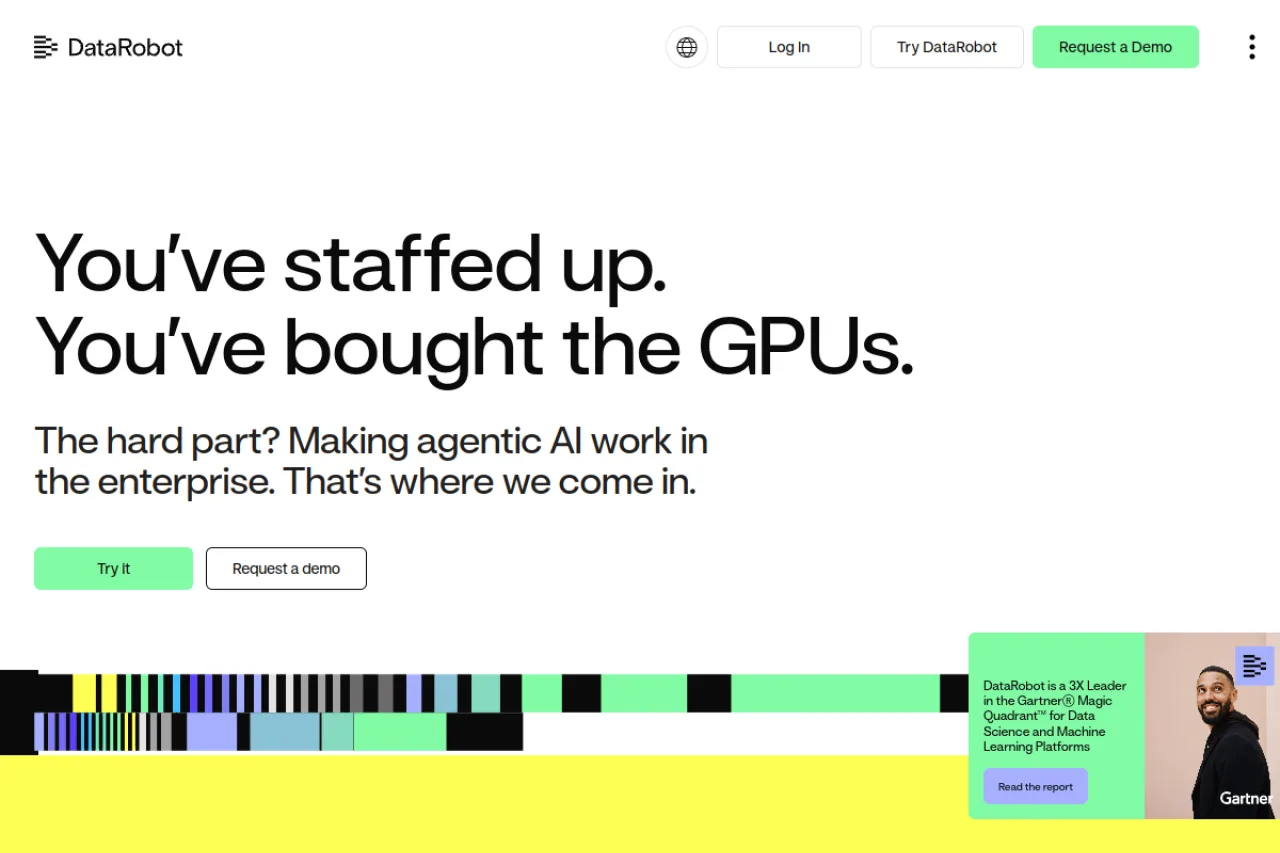
DataRobot is an enterprise AI and machine learning platform that automates the full model lifecycle—building, deploying, governing, and monitoring predictive, generative, and agentic AI at scale. It serves large organizations in regulated and data-intensive industries and emphasizes governance, observability, and integration into core business processes. Pricing is custom and enterprise-oriented, so buyers should verify current terms with DataRobot directly.
DataRobot is an enterprise AI and machine learning platform that automates the end-to-end model lifecycle, from data preparation and model building to deployment, monitoring, and governance. Founded in 2012, the company built its reputation on automated machine learning (AutoML), giving both experienced data scientists and less technical business users a structured path to production-grade predictive models. The platform spans predictive AI, generative AI, and a newer agentic AI layer that lets teams design and operate intelligent agents alongside traditional forecasting and regression models. Alongside model creation, DataRobot emphasizes AI governance and observability, giving organizations centralized control over how models are approved, deployed, and monitored once they are running in production. DataRobot is designed to integrate into core business processes rather than sit as a standalone lab tool. It offers packaged solutions for industries such as financial services, manufacturing, oil and gas, government, and life sciences, as well as function-specific solutions for finance and supply chain operations. The platform supports co-engineered technology partnerships with vendors including NVIDIA, Dell, Nebius, and SAP, reflecting its focus on large-scale, infrastructure-heavy deployments. This positions DataRobot as a full-featured, vendor-agnostic option for organizations that want an integrated ML platform rather than assembling one from separate tooling. DataRobot is aimed squarely at the enterprise. Pricing is quote-based and configured to the customer's needs, so prospective buyers should confirm current plans, trial availability, and total cost directly with DataRobot before committing.

DataRobot is an enterprise AI and machine learning platform that automates the model lifecycle—building, deploying, governing, and monitoring predictive, generative, and agentic AI. Founded in 2012, it serves large organizations in data-intensive and regulated industries. Pricing is custom and enterprise-oriented, so buyers should confirm current terms directly.
DataRobot, founded in 2012 and headquartered in Boston, pioneered enterprise-grade automated machine learning, delivering one of the first platforms to automate the model-building lifecycle at scale. Over time the company expanded from its AutoML roots into a broader enterprise AI suite spanning predictive AI, generative AI, and agentic AI, along with governance and observability tooling.
The company positions itself as a vendor-agnostic, full-featured AI platform that integrates into core business processes, with packaged solutions for industries including financial services, manufacturing, oil and gas, government, and life sciences. It maintains co-engineered partnerships with major technology vendors to support large-scale deployments.
DataRobot automates the end-to-end machine learning lifecycle, from data preparation and model building through evaluation, deployment, and ongoing monitoring. It supports advanced modeling techniques including regression, time series forecasting, and deep learning, and has expanded into generative AI and an agentic AI platform for building and operating AI agents.
Governance and observability are central to the platform, giving organizations centralized control over how models are approved, deployed, and tracked in production. The platform is designed to serve both experienced data scientists and business users, with automation lowering the barrier for less technical teams while retaining depth for advanced practitioners. Industry- and function-specific solutions—such as finance and supply chain operations—help teams reach production faster on common enterprise problems.
DataRobot primarily serves large enterprises and data-intensive, regulated organizations across financial services, manufacturing, oil and gas, government, healthcare, retail, and life sciences. Its buyers typically need scalable, governed AI that integrates into existing business processes rather than lightweight or single-purpose tooling.
Data scientists, ML engineers, and business analysts who build, deploy, and monitor models. Automation lets less technical users participate while advanced practitioners retain fine-grained control.
AI/ML leaders, heads of data science, and IT or analytics executives who need a scalable, governed platform and evaluate it against build-vs-buy and cloud-native alternatives.
MLOps and platform engineers, compliance and risk officers, and enterprise architects who weigh governance, observability, security, and integration requirements.
A large or mid-to-large enterprise in a data-intensive or regulated industry that wants to operationalize AI at scale with strong governance, and has the budget and technical resources to adopt an end-to-end platform.
DataRobot is an independent enterprise AI platform for building, deploying, and governing predictive and generative AI applications. It raised heavily during the 2020-2021 boom, reaching a peak valuation around $6.3 billion (2021), but has since gone through layoffs and leadership changes, and its valuation is widely understood to have come down from that peak. It remains a significant independent enterprise-AI vendor, now focused on agentic and generative AI for large organizations.
DataRobot uses custom, quote-based pricing tailored to each organization's needs rather than published tiers. Third-party sources suggest entry points can start in the range of a few thousand dollars per month for smaller deployments, but actual costs vary widely with usage and scope. Confirm current pricing and any trial or demo options directly with DataRobot.
Teams connect their data, and DataRobot helps build and evaluate models across predictive, generative, and agentic AI. Once a model is selected, it can be deployed and then monitored through the platform's governance and observability tooling. The goal is to manage the full lifecycle—from experimentation to production—within one environment.
DataRobot targets enterprises and larger organizations, particularly in data-intensive and regulated industries. It supports both experienced data scientists and business users through automation. Small teams or individual practitioners will likely find it more platform and cost than they need.
DataRobot maintains an integrations catalog and co-engineered technology partnerships with vendors including NVIDIA, Dell, Nebius, and SAP. These support large-scale and infrastructure-heavy deployments. Review the official integrations page to confirm compatibility with your specific stack.
DataRobot includes dedicated AI governance and observability capabilities, giving organizations centralized control over how models are approved, deployed, and monitored in production. This focus on oversight is a core reason regulated industries adopt the platform. Verify current compliance certifications and data-handling details with DataRobot for your requirements.
DataRobot has expanded beyond its predictive AI roots into generative AI and an agentic AI platform, letting teams build and operate AI agents alongside traditional models. This reflects a broader shift toward agent-based automation across the platform and industry solutions.
No, DataRobot does not offer a free plan or free trial. The platform operates on an annual subscription model with pricing starting around $2,500-$7,500 per month depending on deployment scale, number of users, data volume, and features required.
Integration details were not found in our research — check the official DataRobot website for current integration capabilities and supported data sources.
DataRobot is positioned as a market leader in enterprise data science lifecycle management and is recognized as a Leader in Gartner's Magic Quadrant. Top alternatives include Alteryx (rated ~4.6 stars on G2), Dataiku, and Altair AI Studio. DataRobot is considered one of the best AutoML solutions but lacks open-source alternatives. Users should compare based on pricing flexibility, ease of use, and specific feature requirements.
Side-by-side pages for pricing, features, and best-fit use cases.
Apollo combines contact data and email sequencing, but these alternatives offer deeper AI automation, multi-provider enrichment, or enterprise-grade orchestration.
Clay excels at multi-source data enrichment and AI research agents, but these alternatives offer stronger native CRM integration, enterprise AI governance, or simpler prospecting workflows.
Regie.ai focuses on AI-powered sales engagement and prospecting. These alternatives offer broader data enrichment, multi-channel automation, or enterprise AI capabilities.
Hex is a collaborative analytics platform that combines code notebooks (SQL and Python), data apps, and AI-powered features for data analysis and visualization
Akkio is an AI workflow automation platform designed for media agencies and marketing teams, offering predictive analytics, audience building, campaign strategy development, and performance measuremen
Obviously AI is a no-code machine learning platform that lets non-technical users build predictive models by uploading datasets and asking questions in natural language
MonkeyLearn was a text analysis and machine learning platform for extracting insights from customer feedback and unstructured text