U
Upstart
Finance
Upstart is an AI-powered lending platform that offers personal loans, debt consolidation, car refinancing, and home equity lines of credit
analyze-data
Free planView →

Datarails is an Excel-native FP&A (Financial Planning & Analysis) platform that automates financial consolidation, bu...
A strong fit for finance teams that want FP&A automation and reporting while staying in familiar Excel rather than migrating to a new platform. It is enterprise-oriented, so expect implementation effort and opaque pricing.
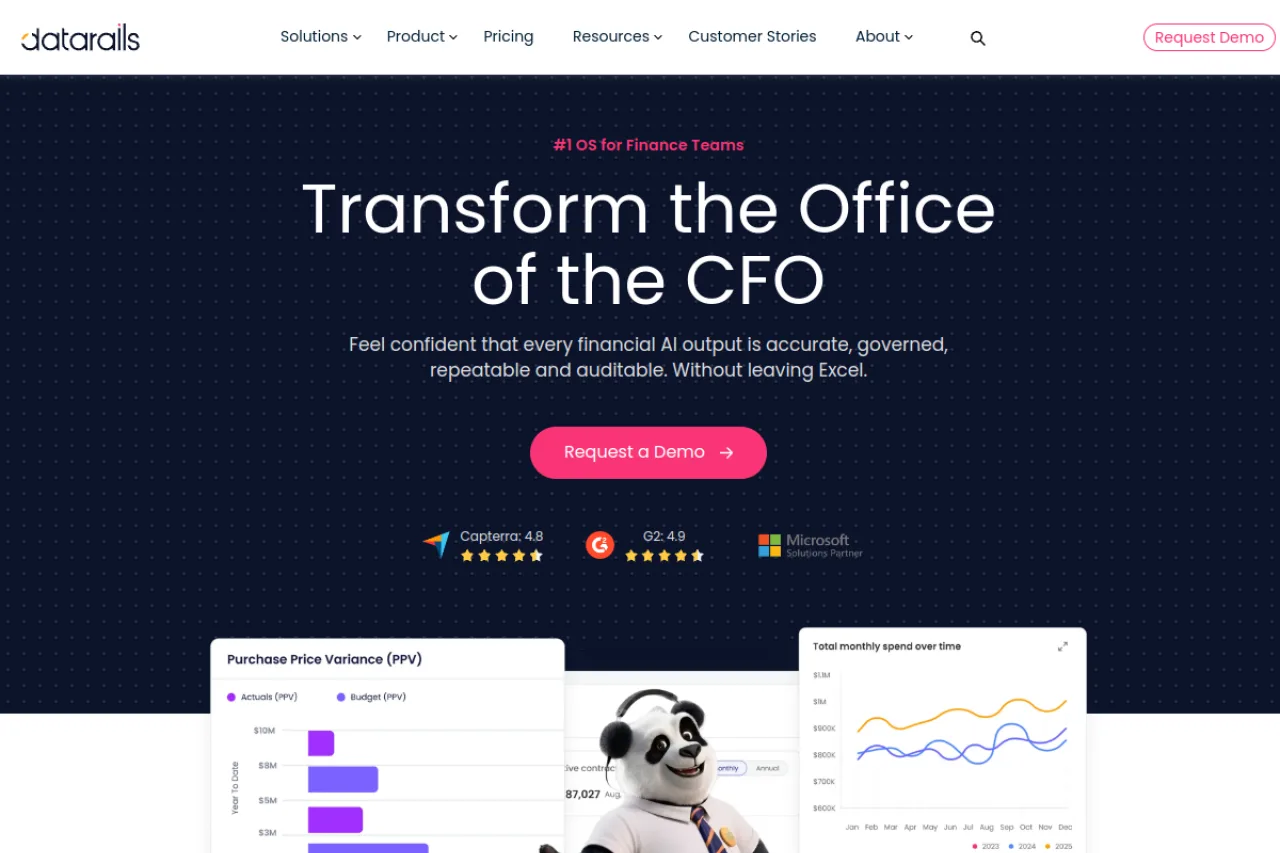
Datarails is an Excel-native FP&A platform and emerging AI finance operating system that automates financial consolidation, budgeting, forecasting, reporting, month-end close, cash management, and spend control—while letting finance teams keep working in their existing Excel models. It targets mid-market finance departments and fractional CFOs who want to cut manual data work and standardize reporting without migrating away from spreadsheets, and it is priced as a paid, quote-based enterprise product.
Datarails is an Excel-native FP&A platform positioned as an AI finance operating system for mid-market finance teams. Rather than asking analysts to abandon the spreadsheets they already know, it connects to existing Excel models and automates the tedious plumbing around them—collecting, consolidating, and validating financial data across departments, source systems, and business units. The platform centralizes planning, budgeting, forecasting, and reporting in one place while preserving spreadsheet workflows. Data flows automatically from ERPs, accounting tools, and other financial systems into a governed layer, so finance teams spend less time chasing numbers and reconciling versions and more time analyzing results. Version control and audit trails are core to the design, helping teams maintain data integrity across recurring reporting cycles. Beyond core FP&A, Datarails has expanded into a broader suite that includes month-end close management, cash flow visibility and forecasting, and spend control with approval workflows. A built-in visualization layer and dashboards let teams surface KPIs and financial insights, and the platform also connects with external BI tools. Datarails AI adds conversational and automated assistance on top of the governed financial data, and a FinanceOS AI Connector is designed to plug leading AI tools directly into that data layer. This reflects the company's shift from a single FP&A product toward a wider finance operating system. The platform is aimed squarely at mid-market organizations and finance leaders—including fractional CFOs and lean FP&A teams—who want automation and reporting speed without the disruption of a full rip-and-replace migration. As with any enterprise finance tool, prospective buyers should confirm current pricing, plan details, and implementation scope directly with Datarails.
Datarails is an Excel-native FP&A platform and AI finance operating system that automates consolidation, budgeting, forecasting, reporting, close, cash, and spend control for mid-market finance teams. Its key differentiator is letting analysts keep their existing Excel models while automating the data work around them. Pricing is quote-based and enterprise-oriented, with typical annual spend reported in the tens of thousands. The company raised a $70M Series C at a $550M valuation.
Datarails is an AI-powered financial planning and analysis company founded by Didi Gurfinkel, Oded Har-Tal, and Eyal Cohen. Its platform centralizes and automates the consolidation, reporting, planning, and forecasting of financial data while allowing finance teams to continue using their existing Excel models—reflecting a mission to let finance professionals spend more time analyzing rather than assembling data.
The company has grown into a global organization with a workforce reported at over 400 employees, including a significant presence in Israel. Over time it has expanded its scope from core FP&A toward a broader 'FinanceOS' finance operating system spanning month-end close, cash management, and spend control, layered with Datarails AI capabilities.
At its core, Datarails connects to ERPs, accounting systems, and other financial data sources to automatically collect, consolidate, and validate data into a governed layer, while preserving the Excel models finance teams already use. It supports planning, budgeting, forecasting, and standardized financial reporting, with strong version control and audit trails to maintain data integrity across reporting cycles.
The platform includes a built-in visualization and dashboard layer and integrates with external BI tools. Its expanded product suite covers Datarails FP&A, Month-End Close, Cash management with scenario analysis, and Spend Control with approval workflows.
Datarails AI and the FinanceOS AI Connector add conversational assistance and connect leading external AI tools directly to governed financial data, positioning the platform as an AI-enabled finance operating system rather than a single-purpose FP&A tool.
Datarails targets mid-market finance departments and finance leaders—including FP&A teams, controllers, and fractional CFOs—that rely on Excel and want automation without abandoning spreadsheets. It serves a broad range of industries, including retail, construction and real estate, professional and business services, healthcare, manufacturing, non-profit, financial services, hospitality, technology, and transportation and logistics.
FP&A analysts, financial planners, and controllers who build budgets, forecasts, and reports in Excel and want to eliminate manual data collection and version reconciliation.
Finance leaders such as CFOs, VPs of Finance, and fractional CFOs who authorize FP&A tooling investments and own reporting outcomes.
Financial systems and BI stakeholders, accounting managers, and IT/data teams involved in connecting source systems and safeguarding financial data.
A mid-market company with a lean, Excel-dependent finance team that consolidates data across multiple entities or departments, produces recurring management and board reporting, and wants automation without a full migration off spreadsheets.
Datarails raised a $70 million Series C at a $550 million valuation, bringing total funding since founding to $175 million. The round came amid reported 70% annual revenue growth and a near doubling of its workforce to over 400 employees worldwide.
Datarails uses a paid, quote-based model rather than public self-serve tiers, and pricing is tailored to company size and scope. Third-party estimates place typical annual spend in the tens of thousands of dollars—often cited starting around $24K/year and ranging into the $30K–$75K+ range once implementation and services are included. Confirm current figures directly with Datarails, since published estimates are not official price sheets.
Finance teams keep using their existing Excel models while Datarails automates the data collection, consolidation, and validation behind them. It centralizes financial data from connected systems into a governed layer, then supports planning, budgeting, forecasting, and reporting on top of it. Dashboards, version control, and audit trails round out the recurring reporting workflow.
No—Datarails is explicitly Excel-native and designed to preserve existing spreadsheet workflows. Analysts continue building and working in Excel models rather than migrating to a proprietary modeling interface. This is a core part of its appeal for teams that don't want a rip-and-replace transition.
Datarails connects to common ERPs and accounting/financial source systems to pull data into its governed layer, and it offers a dedicated integrations catalog on its site. It also works alongside external BI tools for visualization and reporting. The FinanceOS AI Connector is designed to connect leading AI tools directly to governed financial data.
The platform emphasizes governed financial data, comprehensive records, version control, and audit trails, which are important for finance and compliance needs. Because it centralizes sensitive financial data across departments, buyers should review Datarails' current security certifications, data handling, and access controls during evaluation. Verify specifics with the vendor for your regulatory requirements.
Datarails has expanded from a single FP&A product into a broader finance operating system, adding modules for month-end close, cash management, and spend control. It has also invested in AI through Datarails AI and a FinanceOS AI Connector that links external AI tools to governed financial data. The company raised a $70 million Series C at a $550 million valuation amid rapid growth.
No, Datarails does not offer a free plan or free trial according to available research. Pricing typically starts around $500-1,000+ per month for small implementations, with annual costs beginning around $24K and scaling based on organization size, number of users, and integrations required.
Datarails is positioned as a more approachable, Excel-native alternative to enterprise platforms like Workday Adaptive Planning, Anaplan, and IBM Planning Analytics. Compared to competitors like Vena Solutions and Cube, Datarails offers faster time-to-value and maintains Excel workflows, though some alternatives like Cube are noted as providing more streamlined, lower-friction experiences. Datarails typically costs more than simpler tools (one Reddit user mentioned alternatives at $12K upfront vs. $60K/year for Datarails) but less than full enterprise solutions.
Side-by-side pages for pricing, features, and best-fit use cases.
Upstart is an AI-powered lending platform that offers personal loans, debt consolidation, car refinancing, and home equity lines of credit
AI agents built for accountants to run accounting, tax, and audit work

Workday AI is a suite of AI capabilities embedded within Workday's enterprise HR and finance platform, designed to help large organizations automate workflows, improve talent strategies, and streamlin

People.ai is a revenue-intelligence platform that captures sales activity and surfaces insights to accelerate deals.