Delphi
Avatars
Create a conversational digital clone of yourself from your own content
digital cloneai avatarcreator economy
Free planView →

Synthesia is an AI video platform that generates videos using AI avatars and voices, designed for business training a...
Our assessment — not a user rating. How we score
Turns plain scripts into polished talking-head avatar videos across scores of languages, a genuine time saver for training and internal comms. The avatars still read a bit stiff and it is priced for enterprise, so skip it for emotive or cinematic storytelling.
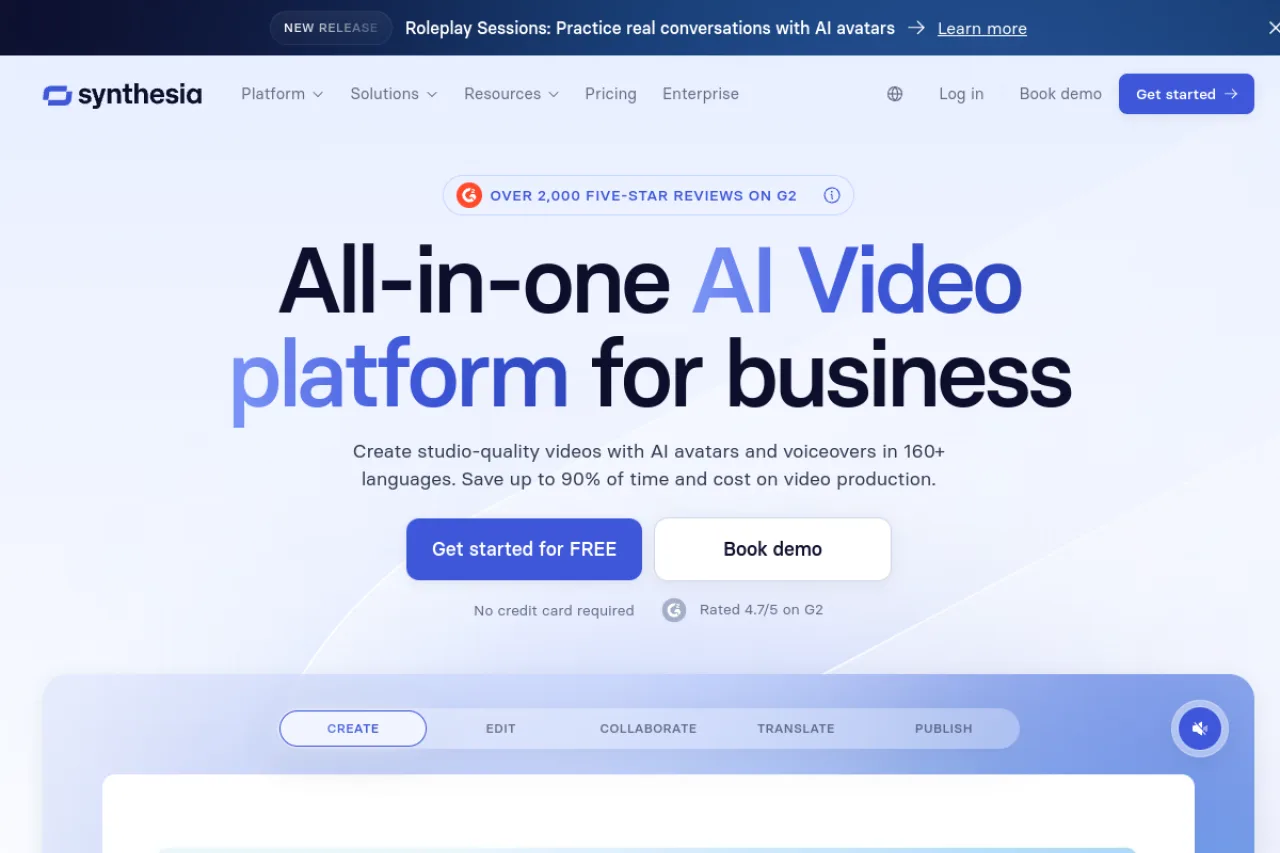
Synthesia is an enterprise-focused AI video platform that turns scripts into professional videos featuring AI avatars and voices in over 100 languages, removing the need for cameras, actors, or studios. It combines 240+ avatars, 1000+ voices, screen recording, translation, and dubbing with team collaboration, brand controls, version control, and analytics, all backed by strong security and compliance certifications. It's best suited to training, L&D, and corporate communications teams, with paid plans starting around $18/month and enterprise pricing for advanced features.
Synthesia is an AI video generation platform built specifically for business use cases, with a strong focus on training, learning and development, and corporate communications. Rather than requiring cameras, actors, or studios, users write a script and the platform renders a video featuring a lifelike AI avatar delivering the content in a chosen voice and language. This approach makes it possible to produce polished, on-brand videos at scale without traditional production overhead. The platform offers a library of 240+ AI avatars and 1000+ AI voices, along with the ability to create personal avatars that clone a specific person's likeness and voice. Creation tools include an AI video generator, an AI screen recorder, and AI motion graphics, while localization features such as AI dubbing, a video translator, a multilingual player, and captions make it straightforward to adapt a single video into many languages. Synthesia is designed for teams as much as individuals. Management features include a brand kit for visual consistency, live collaboration, workspaces and organization controls, version control through smart updates, and analytics for measuring how videos perform. Newer engagement capabilities such as interactivity and interactive avatars point toward more dynamic, learner-driven video experiences. Security and compliance are central to the pitch: the platform is SOC 2 Type II, ISO 42001, and GDPR compliant, and it markets itself as a secure environment suited to regulated industries like healthcare, financial services, and manufacturing. That enterprise posture is a big part of why Synthesia is widely adopted for compliance training, technical training, and standard operating procedure documentation. Pricing is freemium, with a free tier and paid plans that scale up to custom enterprise agreements. Buyers should note that some capabilities many L&D teams consider essential — such as SCORM export and broader translation — tend to sit in higher tiers, so it's worth verifying which features fall under which plan on the official site before committing.
Synthesia is a London-based AI video platform that turns scripts into professional videos led by AI avatars and voices, targeting business training and corporate communications. It combines a large avatar/voice library, screen recording, translation and dubbing, and enterprise governance with strong security certifications. Backed by more than $530 million in funding, it reached a $4 billion valuation in a late-2025 round.
Synthesia is a British (London-based) AI video generation company whose platform helps organizations create videos — particularly interactive training content — using AI avatars and voices. It has grown into one of the most recognized AI video platforms for business, serving enterprises across sectors including manufacturing, tech, healthcare, financial services, and retail, with customers such as Heineken featured in its case studies.
The company's mission centers on making professional video production accessible without cameras, actors, or studios, while maintaining an enterprise-grade, secure and compliant environment. It emphasizes responsible AI and holds SOC 2 Type II, ISO 42001, and GDPR compliance as part of its trust posture.
Synthesia's core is script-to-video creation: users pick from 240+ AI avatars and 1000+ AI voices, or build a personal avatar, and the platform renders a video of that avatar delivering the script. Creation tooling extends to an AI video generator, an AI screen recorder, and AI motion graphics.
Localization is a major pillar, with AI dubbing, a video translator, a multilingual player, and captions enabling one video to reach global audiences. Management and governance features include brand kits, live collaboration, workspaces and organization controls, version control via smart updates, analytics, and public or SSO-protected video pages.
More recent development focuses on engagement, including interactivity, interactive avatars (beta), and video agents (announced as upcoming), signaling a shift from static videos toward dynamic, learner-driven experiences.
Synthesia primarily serves mid-market and enterprise organizations with recurring video needs, especially learning & development, HR, sales enablement, marketing, IT/cybersecurity, and knowledge management teams. It targets regulated and global industries — manufacturing, technology, healthcare, financial services, professional services, and retail — where compliant, scalable, and easily localized training and communications video is valuable.
L&D specialists, instructional designers, HR coordinators, and internal comms creators who build and update training and communication videos regularly without needing video-production skills.
Heads of learning & development, HR leaders, and communications or enablement directors who own the budget and want to scale video output while reducing production costs.
IT, security, and compliance stakeholders who evaluate data handling and certifications, plus brand and marketing teams concerned with consistency and quality.
A mid-to-large enterprise with a global, often multilingual workforce that produces frequent training, compliance, or communications videos and values security certifications and centralized brand and version control.
Synthesia raised a $200M Series E in January 2026 led by GV (Google Ventures) at a $4 billion valuation — nearly double its $2.1B Series D valuation from January 2025 — bringing total funding to about $536M, with backers including NVIDIA's NVentures, Accel, Kleiner Perkins, and NEA. ARR reached roughly $146M by September 2025 (up from $88M at the end of 2024), with the company on track for $200M in revenue in 2026 and net revenue retention above 140%. Adobe took a $10M strategic stake in April 2025 and reportedly held (ultimately abandoned) acquisition talks around a $3B valuation. Synthesia serves 65,000+ customers, including 90% of the Fortune 100.
Synthesia uses a freemium model with a free tier and paid plans starting around $18/month billed yearly, scaling up to custom enterprise pricing. The important caveat is that features many teams need — such as SCORM export and advanced translation — tend to live in the enterprise tier, so the effective cost for a full-featured deployment can be considerably higher than the advertised entry price. Verify current plans and feature-to-tier mapping on the official pricing page.
You start from a script or template, choose an AI avatar and a voice, and the platform renders a video of that avatar speaking your text — no filming required. You can add screen recordings, motion graphics, and brand elements, then translate or dub the video into other languages. Finished videos can be published to a public or SSO-protected video page and updated later via version control.
Yes — Synthesia positions itself as an enterprise-grade, secure environment and holds SOC 2 Type II, ISO 42001, and GDPR compliance. It markets solutions specifically for regulated sectors such as healthcare, financial services, and manufacturing. Enterprise buyers should still review the security documentation and data-handling terms against their own compliance requirements.
Synthesia supports video creation and translation across a wide range of languages using its AI voices, plus AI dubbing, a dedicated video translator, a multilingual video player, and automatic captions. This makes it especially useful for producing one piece of content and distributing localized versions globally. Confirm the exact current language count on the official site as the roster expands over time.
Yes, Synthesia supports personal avatar creation, which clones a specific person's likeness and voice so they can appear in videos without being filmed each time. This is commonly used for executives, trainers, and brand spokespeople. Availability and setup requirements can vary by plan, so check which tier includes personal avatars.
Synthesia has been expanding beyond static avatar videos into interactive and engagement features, including interactivity, interactive avatars, and upcoming video agents for more dynamic, learner-driven experiences. On the pricing side, the company introduced lower entry-level pricing starting around $18/month. It also reached a $4 billion valuation following a $200 million funding round in late 2025.
No, Synthesia does not offer a free plan or free trial according to the research. The platform operates on a freemium pricing model, but specific pricing tiers and costs were not disclosed in the available information.
Integration details were not found in our research — check the official Synthesia website for current integration capabilities and API documentation.
Synthesia distinguishes itself with an extensive library of 240+ AI avatars and 1000+ voices, along with enterprise-focused features like brand kits, live collaboration, and comprehensive localization tools including AI dubbing and video translation. However, without pricing transparency in the research, direct cost comparisons with alternatives are not possible.
Side-by-side pages for pricing, features, and best-fit use cases.
Pika excels at quick text-to-video generation, but these alternatives offer avatar-based videos, advanced editing, and specialized workflows.
HeyGen excels at avatar-based videos, but alternatives offer better podcast editing, voice cloning, creative video generation, and social media workflows.
Synthesia excels at corporate training videos, but alternatives offer better options for social content, creative video generation, and voice-first workflows.
Create a conversational digital clone of yourself from your own content

An AI video studio for talking-head content — captions, editing, dubbing, and AI avatars.

Text and audio into animated and live-action videos
Enterprise personalized-video AI avatars at scale, proven in India campaigns