VoltAgent
Agent Frameworks
Observability-first open-source TypeScript framework for AI agents
typescriptagentsopen-source
Free planView →

Langflow is an open-source, low-code visual builder for creating AI agents, RAG applications, and MCP servers
Gives you a visual canvas for assembling LangChain-style flows, which speeds up prototyping RAG and agent pipelines and helps you learn the components. The caveat is it inherits LangChain abstraction churn, and the node interface can become clunky once your logic outgrows simple graphs.
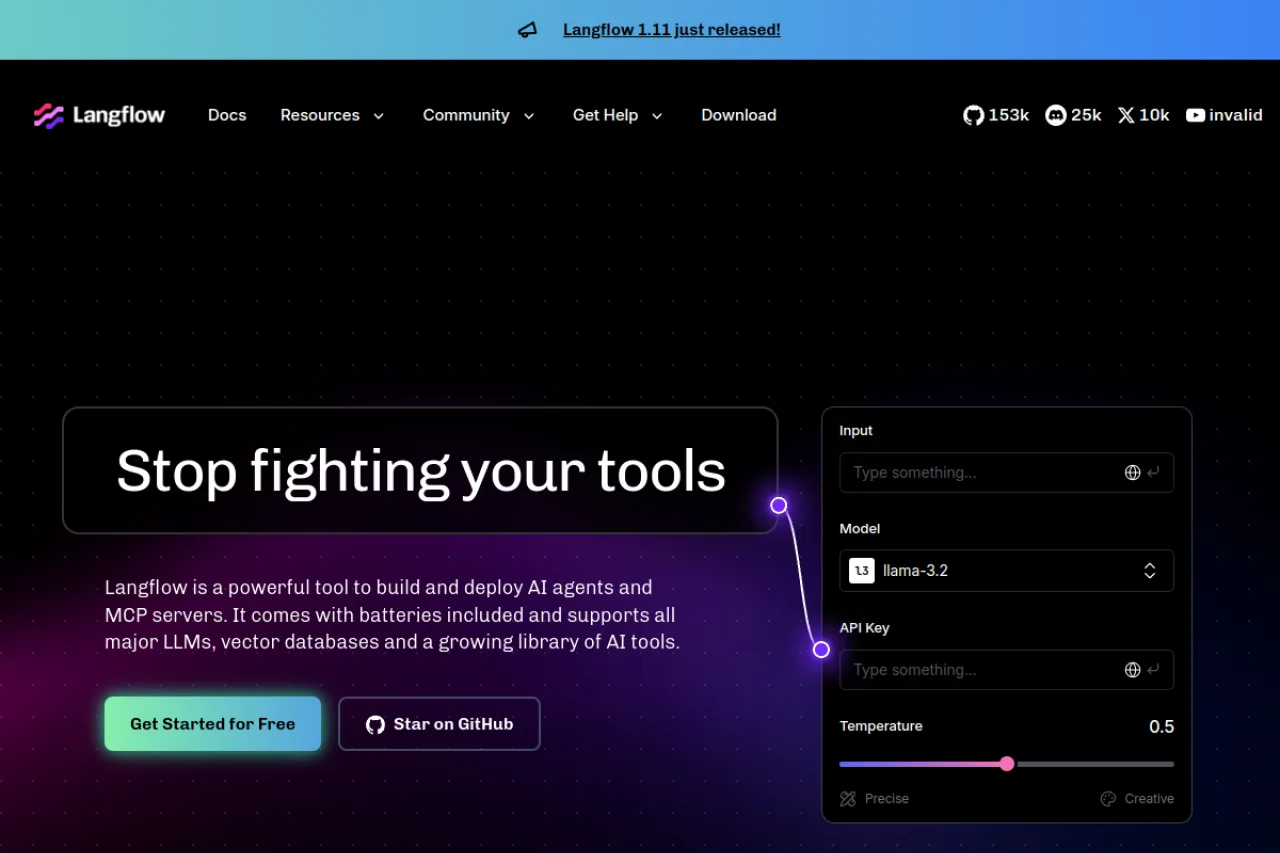
Langflow is an open-source, low-code visual builder for creating AI agents, RAG applications, and MCP servers. Built on Python components with drag-and-drop workflow design, it supports all major LLMs and vector databases while preserving full code-level control. It's available as a free self-hosted project or a managed cloud service, making it well suited to developers and teams who need to prototype and ship AI applications quickly.
Langflow is an open-source, low-code platform for building and deploying AI agents, RAG applications, and MCP servers through a visual, drag-and-drop interface. Built on Python components, it lets developers assemble workflows visually while retaining full code-level control over each node, striking a balance between rapid prototyping and production-grade customization. The platform ships with support for all major LLM providers, vector databases, and a growing library of pre-built components and flows. Users can compare models side by side, tune parameters like temperature and response length, and expose any flow as an API endpoint — making it straightforward to move from an experimental notebook to something real users can interact with. Because Langflow is built around reusable Python components, developers aren't locked into the visual layer. Anyone comfortable with code can drop into Python to customize logic, build bespoke components, or extend the system beyond what the canvas offers. This dual-mode approach is a core reason the project has attracted a large and active open-source community. Langflow is available both as a self-hosted open-source project and as a managed cloud offering, with the same experience across both. That flexibility appeals to teams that want to start free and self-manage, as well as those who prefer an enterprise-grade hosted platform without the DevOps overhead. As an agentic development tool, Langflow is best understood as infrastructure for AI builders rather than a finished end-user product. Teams should verify current cloud pricing and deployment options on the official site, since the hosted tiers and real operating costs can vary significantly with usage.
Langflow is an open-source, low-code visual platform for building AI agents, RAG applications, and MCP servers, built on Python components with support for all major LLMs and vector databases. It's available as a free self-hosted project or a managed cloud service, appealing to developers and teams that want fast prototyping without sacrificing code-level control. It has grown a large open-source community and is positioned as builder infrastructure rather than a turnkey no-code product.
Langflow is an open-source visual framework for building retrieval-augmented generation and agentic AI applications. Founded in 2020, it grew as a bootstrapped project and has built a substantial developer following, with a large GitHub presence and an active Discord community around the project.
The project's mission centers on removing boilerplate and infrastructure friction from AI development, letting builders move quickly from idea to deployed application while retaining full Python-level control. It is offered both as a self-hosted open-source tool and a managed cloud platform.
Langflow's core is a drag-and-drop canvas where developers assemble AI workflows from reusable components such as models, prompts, agents, memory, and data connectors. Every component is backed by Python, so users can configure nodes visually or extend and customize them in code, avoiding the black-box constraints common to no-code tools.
The platform supports all major LLM providers and vector databases, along with a wide range of data sources and tools. Builders can compare and swap models, tune parameters, run single agents or fleets of agents with components exposed as tools, and expose any completed flow as an API. Hundreds of pre-built flows and components accelerate common patterns like RAG and multi-agent orchestration.
Deployment spans self-hosting via a simple pip install through to an enterprise-grade managed cloud, with a consistent experience across both so teams can move from local development to production without rebuilding their work.
Langflow primarily serves developers, AI/ML engineers, and technical teams building custom AI applications — from solo builders and startups shipping MVPs to enterprise development teams needing a flexible, controllable AI stack. It is best suited to organizations comfortable with some code and infrastructure work, and less aligned with non-technical buyers seeking fully managed, no-code automation.
Developers and AI/ML engineers who build, test, and iterate on agents and RAG pipelines directly on the visual canvas and in Python.
Engineering leads, CTOs, and technical founders who choose Langflow to accelerate AI development while keeping control over data, deployment, and cost.
Senior developers, AI architects, and open-source community members who evaluate tooling and advocate for adoption within their teams.
A technically capable startup or engineering team building custom AI agents or RAG applications that values open-source flexibility, code-level control, and the option to self-host or use a managed cloud.
Langflow is an open-source, low-code visual builder for RAG and multi-agent AI applications (Python-based, model/API/database-agnostic), with 100,000+ GitHub stars. It was created by a Brazilian team (Logspace, founders Rodrigo Nader and Gabriel Almeida), acquired by DataStax in 2024, and became part of IBM when IBM acquired DataStax in 2025. Langflow now sits within IBM's watsonx AI portfolio while remaining open source — so it's an IBM-owned open-source project, not an independent startup.
Langflow is free and open-source when you self-host it. The real costs come from the infrastructure and DevOps needed to run it, plus any LLM and vector database usage. A managed cloud option is also available with a free tier and paid plans, so confirm current pricing and limits on the official site before budgeting.
You build AI workflows on a visual canvas by dragging and connecting components such as models, prompts, agents, and data sources. Each node is backed by Python, so you can configure it visually or customize it in code. Once a flow works, you can run it interactively, share it, or expose it as an API endpoint.
Both options are available. You can install and run Langflow yourself via pip for full control over your environment and data, or sign up for the managed cloud to skip infrastructure management. The experience is the same whether you use the open-source version or the cloud.
Langflow supports all major LLM providers and vector databases, including OpenAI, Anthropic, Mistral, Ollama, HuggingFace, Amazon Bedrock, and NVIDIA. It also connects to data sources and stores like Pinecone, Qdrant, Weaviate, Milvus, MongoDB, Notion, Slack, GitHub, and Google Drive, with a growing library of additional components.
Because Langflow can be fully self-hosted, teams can keep their flows and data within their own infrastructure, which is a strong fit for privacy-sensitive use cases. The managed cloud is positioned as an enterprise-grade, secure platform. Review your provider's terms and your own deployment configuration to match your compliance requirements.
Langflow 1.10 is the most recent release highlighted by the project, continuing its focus on agent building and MCP server support. Because the platform iterates quickly, check the changelog on GitHub for the current feature set and breaking changes before upgrading.
Yes, Langflow is free and open-source software. However, you'll incur costs for hosting infrastructure (typically $5-500+/month depending on scale), LLM API usage ($10-1,000+/month based on volume), and optionally vector databases like Pinecone (starting around $50/month for production). Langflow Cloud offers a free tier with limited resources for testing.
Langflow supports all major LLMs and vector databases according to its homepage. It's built on LangChain and can be called from any frontend, backend-for-frontend (BFF), or existing ETL pipeline. Users report integrating it with n8n for broader workflow automation. Specific integration details for individual services were not comprehensively documented in available research.
Compared to Flowise, Langflow is considered more intuitive for AI-specific workflows, though Flowise offers a greater range of components out of the box. Against n8n and Make, Langflow excels at AI agent prototyping but lacks their advanced scheduling and broader business automation capabilities. Users often combine Langflow for AI workflows with n8n for general automation. It's simpler for creating custom Python components than most alternatives.
Side-by-side pages for pricing, features, and best-fit use cases.
Langflow excels at visual RAG and agent building, but teams often need stronger multi-agent orchestration, enterprise governance, or sales-specific workflows.
Flowise offers visual LLM app building, but users seek alternatives for multi-agent orchestration, enterprise features, or broader workflow automation.
CrewAI excels at multi-agent orchestration, but these alternatives offer visual builders, enterprise workflows, or specialized B2B automation.
Observability-first open-source TypeScript framework for AI agents
TypeScript multi-agent networks with deterministic routing and MCP
Microsoft's enterprise SDK for orchestrating LLMs, plugins, and agents.
Framework for programming language models instead of prompting them