
Stable Diffusion
Image
Stable Diffusion is an enterprise-focused AI creative platform from Stability AI that generates and edits images, video, 3D/4D content, and audio
generate-imagescreate-videos
Free planView →

Krea is an AI creative suite offering real-time image generation, video creation, 3D object generation, and enhanceme...
Best known for real-time generation and an enhance and upscale workflow that lets you steer images live, and it aggregates several underlying models in one place. It is more a creative playground than a precision tool, and heavy use pushes you quickly toward paid tiers.
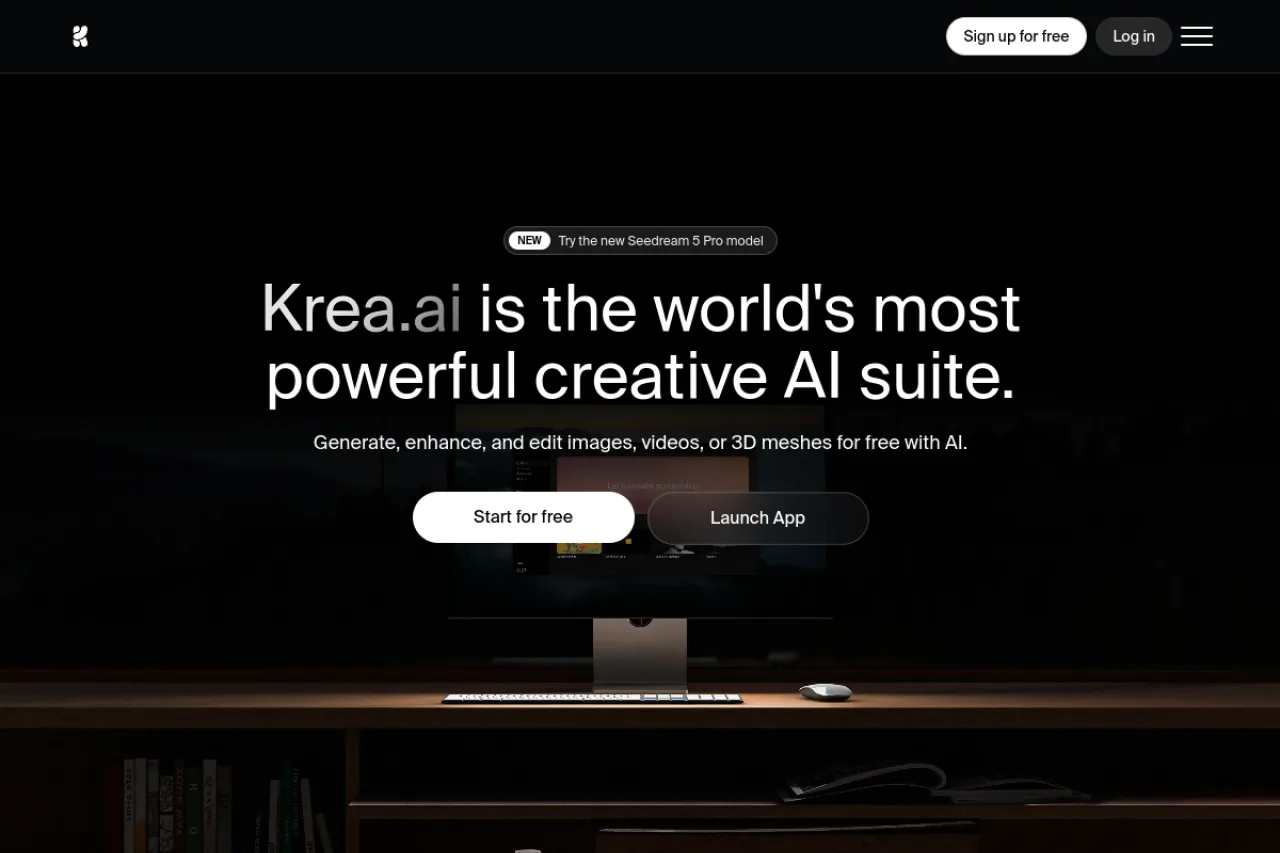
Krea is an all-in-one AI creative suite for generating and enhancing images, video, and 3D objects. It stands out for real-time image generation, a high-resolution upscaler, and access to multiple leading generative models under one subscription, making it well suited to designers, content creators, and studios that need fast, versatile visual production.
Krea is an AI creative suite that brings image, video, and 3D generation into a single workspace alongside a full set of enhancement tools. Rather than committing users to one underlying model, Krea aggregates a range of leading generative engines and its own Krea 2 model, letting creators pick the right tool for each task without juggling separate subscriptions. The platform's signature feature is real-time image generation, which renders results as you type or sketch, making iteration feel immediate rather than turn-based. Beyond generation, Krea covers text-to-video, motion transfer, and text- or image-to-3D object creation, plus editing tools like a background remover and AI image editor. Enhancement is a core strength. Krea's upscaler can push images toward very high resolutions and integrates professional-grade enhancement technology, while video tools include frame interpolation, video style transfer, and video upscaling. This makes Krea useful not just for creating assets from scratch but for polishing existing footage and imagery. For teams and power users, Krea offers LoRA finetuning for both image and video models, LoRA sharing, and an asset manager for organizing creative files. A developer API and enterprise plan extend the suite to production pipelines and larger organizations. Krea positions itself as a one-stop shop for generative creative work, and its main appeal is breadth combined with speed. Buyers should confirm current credit allowances, model availability, and pricing on the official site, since these evolve quickly in this category.
Krea is an AI creative suite unifying image, video, and 3D generation with enhancement tools like upscaling and frame interpolation. It differentiates through real-time image generation, access to many leading generative models under one subscription, and LoRA finetuning. Founded in 2022, Krea raised a $47 million Series B in April 2025 at a roughly $500 million valuation.
Krea is an AI company founded in 2022 that positions itself as a one-stop shop for generative creative work, spanning image, video, and 3D generation alongside enhancement and editing tools. Its mission centers on making powerful generative AI accessible to creators of all levels within a single, fast, unified workspace.
The company gained significant momentum in 2025, announcing its funding publicly and expanding its suite with its Krea 2 model, a high-resolution enhancer, and integrations with numerous third-party generative engines. It employs a team of roughly several dozen people and serves a broad base of creators, studios, and enterprises.
Krea's product combines multiple generative capabilities in one platform: text-to-image with real-time generation, text-to-video, motion transfer, and text- or image-to-3D object creation. Rather than relying on a single model, it aggregates leading engines such as Flux, Runway, Luma, Ideogram, Veo, and Gemini alongside its own Krea 2 model.
The enhancement toolkit is a core pillar, offering high-resolution image upscaling with professional-grade enhancement technology, plus video frame interpolation, style transfer, and video upscaling. Editing tools include a background remover and an AI image editor.
For customization and scale, Krea supports LoRA finetuning for both image and video models, LoRA sharing, an asset manager for file organization, a developer API, and an enterprise plan that includes intellectual property protection for AI-generated content under agreement terms.
Krea serves designers, illustrators, content creators, and social media producers who need fast visual iteration, as well as creative and production studios and marketing teams that require versatile, high-volume asset creation. Its API and enterprise plan extend its reach to developers building generative media into products and to larger organizations needing team access and IP protection.
Designers, illustrators, video creators, and 3D artists who generate and refine visual content daily. They value real-time iteration, model variety, and strong enhancement tools within a single workspace.
Creative directors, studio leads, and marketing managers who decide on tooling for their teams. They weigh the value of consolidating multiple generative models into one subscription against per-tool credit costs.
Senior designers, technical artists, and developers who evaluate model quality, API capabilities, and finetuning options. Their assessment of output quality and workflow speed shapes adoption.
A creative team or studio producing high volumes of images, video, and 3D content that wants access to many leading generative models and professional enhancement tools under one subscription, with optional API and enterprise IP protection.
Krea has raised a total of $83 million across multiple rounds, including a $47 million Series B in April 2025 led by Bain Capital Ventures with participation from a16z, Abstract, and Pebblebed. The round valued the company at approximately $500 million. Third-party estimates place its annual recurring revenue in the mid-single-digit millions.
Krea uses a freemium model with a free tier that includes a limited daily allowance of compute units, plus paid plans such as Basic, Pro, and Max that offer larger credit allotments. Image and video generation are metered in compute units, so your effective cost depends on how much and what type of content you generate. Always verify current tiers and credit allowances on Krea's official pricing page, as they change frequently.
You work inside a unified web app where you can generate images, video, or 3D objects from text prompts, then enhance or edit the results. Real-time image generation updates output as you adjust your prompt or reference, and finished assets can be upscaled, restyled, or organized in the built-in asset manager. The suite is designed so you can move from generation to enhancement to editing without leaving the platform.
Krea aggregates multiple leading generative engines under one subscription, including its own Krea 2 model plus options such as Flux, Runway, Luma, Ideogram, Veo, and Gemini across different generation tasks. This lets you choose the most appropriate model for a given image, video, or 3D job. Because Krea integrates third-party engines, the exact lineup can shift over time.
Yes. Krea supports LoRA finetuning for both image and video models, so you can train a lightweight custom model on your own subjects or aesthetic. It also offers LoRA sharing, making it easier to reuse or distribute trained styles across projects and, on team plans, collaborators.
Krea provides a developer API for integrating its generation capabilities into external pipelines and applications. It also has an enterprise plan that adds team access and intellectual property protection for AI-generated content when usage follows the agreement terms. Enterprise details should be confirmed directly with Krea.
Krea raised a $47 million Series B in April 2025 led by Bain Capital Ventures, bringing total funding to $83 million at a roughly $500 million valuation. The company has continued expanding its suite with newer model options and a high-resolution enhancer, reinforcing its positioning as a one-stop generative creative platform.
Yes, Krea offers a free plan with 100 daily compute units and no credit card required. This allows basic use of the platform's features on a pay-as-you-go basis with compute units. Paid plans start at $9/month for expanded credits and commercial licensing.
Integration details were not found in our research. Krea does offer an API according to their features page, but specific third-party integrations were not documented. Check the official website for current integration capabilities.
Krea is noted for significantly faster generation speeds than many alternatives and is described as a better base model than Flux Dev with superior prompt coherence. However, alternatives like Cuty AI offer more comprehensive one-stop platforms for both image and video, while tools like Freepik may be easier for beginners. Krea excels at speed and photorealism but may have limitations in customization compared to specialized tools.
Side-by-side pages for pricing, features, and best-fit use cases.
Midjourney excels at cinematic aesthetics but requires Discord and paid access. These six alternatives offer open models, text rendering, and browser-based workflows.
Stable Diffusion excels at enterprise-scale multimodal generation, but these six alternatives offer stronger aesthetics, real-time editing, or simpler workflows.
From text-to-image generation to photo editing, we reviewed 8 AI image tools to help you find the right fit for your creative workflow and budget.
Stable Diffusion is an enterprise-focused AI creative platform from Stability AI that generates and edits images, video, 3D/4D content, and audio

Canva AI is a suite of AI-powered design and image creation tools integrated into Canva's design platform
OpenAI's image generator, built into ChatGPT for conversational image creation and edits.
Cloud AI image generator and open model-hosting community with 300k+ models