Hex logo

Hex

Hex is a collaborative analytics platform that combines code notebooks (SQL and Python), data apps, and AI-powered fe...

Updated Jun 2026
research#analyze-data#write-code
Free plan Free trial API Teams

About Hex

Hex is a collaborative analytics workspace that unifies SQL and Python notebooks, no-code tools, and interactive data apps, with AI features layered throughout for query generation, code assistance, and natural-language analysis. Semantic models and its Context Studio keep AI answers grounded in governed business definitions. It suits data teams that want to move from ad hoc exploration to polished, shareable dashboards in one place, though heavy compute usage can make costs less predictable at scale.

Hex is a collaborative analytics platform that brings SQL and Python notebooks, spreadsheets, no-code tools, and interactive data apps together in a single workspace. Data teams can query databases, build visualizations, and publish polished dashboards and apps that stakeholders can use without touching code — all from one connected environment. At its core, Hex is built around agentic notebooks: a modular, cell-based interface where each step of an analysis is composable and reusable. Analysts can move fluidly between SQL, Python, and no-code cells, then wire the results into interactive apps using a drag-and-drop app builder. Real-time collaboration, commenting, and version control make it feel closer to a shared document than a traditional BI tool. AI runs throughout the platform. Hex's built-in assistance can generate queries, write and debug code, create visualizations, and answer natural-language questions about your data. Its Context Studio and semantic models let teams define standardized metrics and governed data definitions, so AI-generated answers stay grounded in the actual facts of the business rather than hallucinating relationships. Hex targets the full lifecycle of a data question — from quick exploratory analysis to deep dives to shareable data apps and embedded, customer-facing experiences. It also offers scheduled runs, Slack and email notifications, and a CLI for teams that want to manage analytics from the terminal. Hex uses a freemium model with a free tier plus per-seat paid plans, layered with credit grants and pay-as-you-go compute. That flexibility is powerful, but teams running heavy workloads should model compute usage carefully, since costs can climb at scale. Always verify current pricing and plan details on the official site.

TL;DR

Hex is a collaborative analytics platform that unifies SQL and Python notebooks, no-code tools, and interactive data apps, with AI woven throughout for query generation, code assistance, and natural-language analysis. Its semantic models and Context Studio keep AI answers grounded in governed business metrics. It fits data teams that want to move from exploration to shareable apps in one place, using a freemium model with per-seat pricing plus pay-as-you-go compute.

Company overview

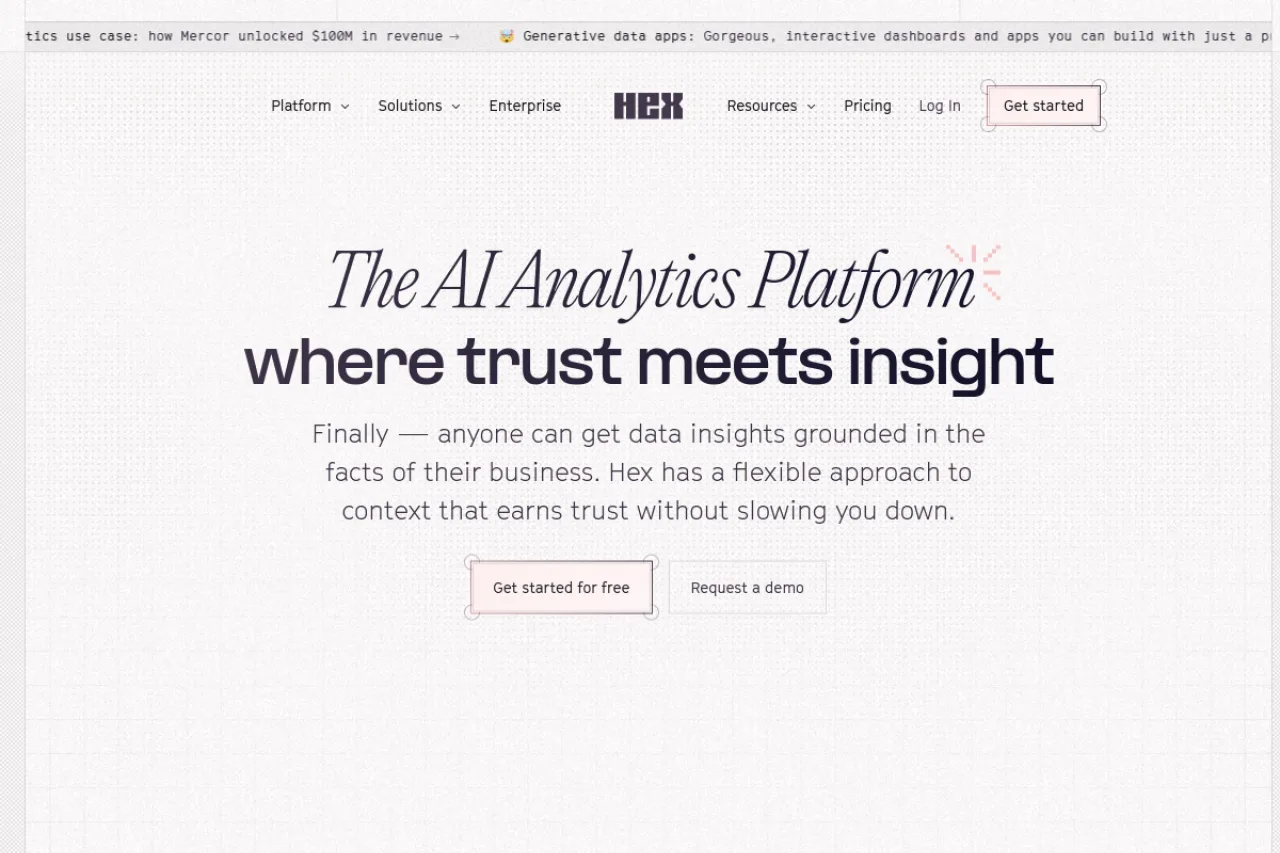
Hex is a data analytics company behind a collaborative workspace for SQL and Python notebooks, data apps, and AI-powered analysis. The company was founded by Barry McCardel, Caitlin Colgrove, and Glen Takahashi, and positions its platform around the idea of 'trust meets insight' — helping teams get data answers grounded in the facts of their business.

The product spans agentic notebooks, conversational self-serve BI, a semantic-modeling Context Studio, and a CLI, reflecting a mission to unify exploratory analysis, governed metrics, and shareable applications in one connected system.

Product features

Hex combines SQL, Python, R, spreadsheets, and no-code tools in a single, cell-based notebook, letting teams work with data using their preferred methods. Its drag-and-drop app builder transforms analyses into interactive dashboards and data apps that stakeholders can use without code, and embedded analytics extends this to customer-facing experiences.

AI features run throughout the platform, generating queries, writing and debugging code, and creating visualizations inline, with natural-language querying for less technical users. Context Studio and semantic models provide standardized metric definitions and AI governance so answers stay grounded in endorsed data. Collaboration features include real-time editing, comments, version control, scheduled runs, Slack and email notifications, and a CLI for terminal-based control.

Target market

Hex targets data teams — analysts, data scientists, and analytics engineers — in organizations from startups to large enterprises that want to combine SQL and Python notebooks, interactive data apps, and AI assistance in one collaborative workspace. Pricing spans a free tier, per-user Team plans, and Enterprise plans with advanced security and governance.

Buyer personas

End users

Data analysts, data scientists, and analytics engineers who write SQL and Python, build interactive notebooks and data apps, and use AI assistance to explore and share analysis with stakeholders.

Buyers

Heads of data, analytics leaders, and engineering managers who evaluate collaborative analytics platforms on collaboration, governance, warehouse integration, and per-seat cost.

Key influencers

Senior data scientists and analytics engineers who pilot Hex, set internal standards, and drive adoption based on notebook flexibility, data-app sharing, and AI features.

Ideal customer profile

A data team that wants a collaborative, notebook-based analytics platform with SQL, Python, data apps, and AI, connected to a modern cloud data warehouse.

Funding & performance

Hex has raised approximately $172 million to date. Its $70 million Series C closed in May 2025 at a roughly $420 million valuation, backed by Andreessen Horowitz, Amplify, Redpoint, Sequoia, and Snowflake. The company reports thousands of customers across data teams.

Pros & cons

Pros

  • Intuitive interface for combining SQL and Python in a single workflow, praised by G2 reviewers for flexibility
  • AI features like HexMagic help fix code quickly and enable natural language querying for ad hoc analysis
  • Allows entire analytical workflow within one system, from data exploration to sharing results with stakeholders
  • 14-day free trial available with no payment card required

Cons

  • Compute costs reported as too high compared to alternatives when working at scale, according to Reddit users
  • Some users question whether the platform is worth the cost relative to other options in the market

Pricing plans

Team
$36 / month
  • Collaborative notebooks with SQL and Python
  • Medium compute included
  • AI features like HexMagic
  • 14-day free trial available

Key features

API
Team collaboration
Integrations
Slack, Email
Input types
SQL, Python code, natural language, spreadsheets, database tables
Output types
charts, dashboards, data apps, code, tables

Compare key features

View all alternatives →
Feature
Hex
DataRobot
Tableau Pulse
Pricing
Freemium
Freemium
Freemium
Free plan
Yes
Yes
Yes
Free trial
Yes
No
No
API
Yes
Yes
Yes
Self-hosted
No
Yes
No
Team support
Yes
Yes
Yes

Frequently asked questions

How much does Hex cost and what will I actually pay?+

Hex uses a freemium model with a free tier and paid plans that are commonly cited around $36/month for Professional and $75/month per editor for Team. Paid plans include monthly per-seat credit grants that fund AI agents and other credit-consuming features, with add-on credits available if you exceed them. Because heavy compute is billed on a pay-as-you-go basis, your real bill depends on usage — verify current pricing on the official site.

How does the core Hex workflow actually work?+

You build analyses in a cell-based notebook, mixing SQL, Python, spreadsheet, and no-code cells so each step of the work is modular. Once the analysis is ready, you use the drag-and-drop app builder to publish it as an interactive dashboard or data app for stakeholders. AI assistance can help generate queries, write code, and create visualizations along the way.

What databases and integrations does Hex connect to?+

Hex offers out-of-the-box connections to common data warehouses and databases, along with flexible APIs and integrations for pushing results to tools like Slack and email. It also supports scheduled runs with notifications and automated screenshots. Check the integrations page for the current list of supported data sources and connectors.

How does Hex keep AI answers accurate and trustworthy?+

Hex uses semantic models and its Context Studio to define standardized metrics and governed data relationships. AI-generated answers draw on these endorsed models rather than guessing at table structures, which reduces hallucinated or inconsistent results. This governance layer is central to how the platform positions its 'trust meets insight' approach.

Is Hex suitable for enterprise data governance and security?+

Hex offers an enterprise tier with governance features built around semantic models and AI oversight, plus embedded analytics for secure customer-facing experiences. Access controls, versioning, and endorsed data models help teams standardize how data is queried. Confirm specific compliance certifications and security details directly with Hex for your requirements.

What are the most notable recent additions to Hex?+

Hex has leaned heavily into agentic, AI-native analytics, including generative data apps that let you build interactive dashboards from a prompt. It has also introduced Context Studio for semantic modeling and AI governance, plus a CLI for managing analytics from the terminal. These reflect a shift toward AI agents that work against governed business context.

Is Hex free?+

Hex offers a 14-day free trial of the Team plan with no payment card required. After the trial, paid plans start at $36/editor/month according to G2 data, though pricing varies by plan and compute usage.

What does Hex integrate with?+

Integration details were not found in our research — check the official website for information about database connections and third-party integrations.

How does Hex compare to alternatives?+

Hex competes with platforms like Deepnote and Count. According to comparisons, Hex and Deepnote are almost identical in offerings with slight differences in price and compute spend. Some users report Hex has nice features but question the cost-to-value ratio, particularly for compute at scale.

Reviews (0)

Write a review

Pick a rating
Loading reviews…
Compare

Compare Hex with other AI tools

Side-by-side pages for pricing, features, and best-fit use cases.

All comparisons →
Suggested comparison

Hex vs DataRobot

Generate in admin →
Suggested comparison

Hex vs Tableau Pulse

Generate in admin →
Suggested comparison

Hex vs Power BI Copilot

Generate in admin →
Suggested comparison

Hex vs Exa

Generate in admin →
Suggested comparison

Hex vs Scite

Generate in admin →
Suggested comparison

Hex vs Julius AI

Generate in admin →

From the blog

All articles →

Similar tools you may like