VoltAgent
Agent Frameworks
Observability-first open-source TypeScript framework for AI agents
typescriptagentsopen-source
Free planView →

Flowise is an open-source visual builder for creating LLM applications and AI agents using a drag-and-drop interface
A genuinely handy open-source, drag-and-drop builder for LLM apps and RAG pipelines, great for prototyping chains and agents without much code. The honest limit is that visual flows get unwieldy for complex logic, and production hardening still falls on you.
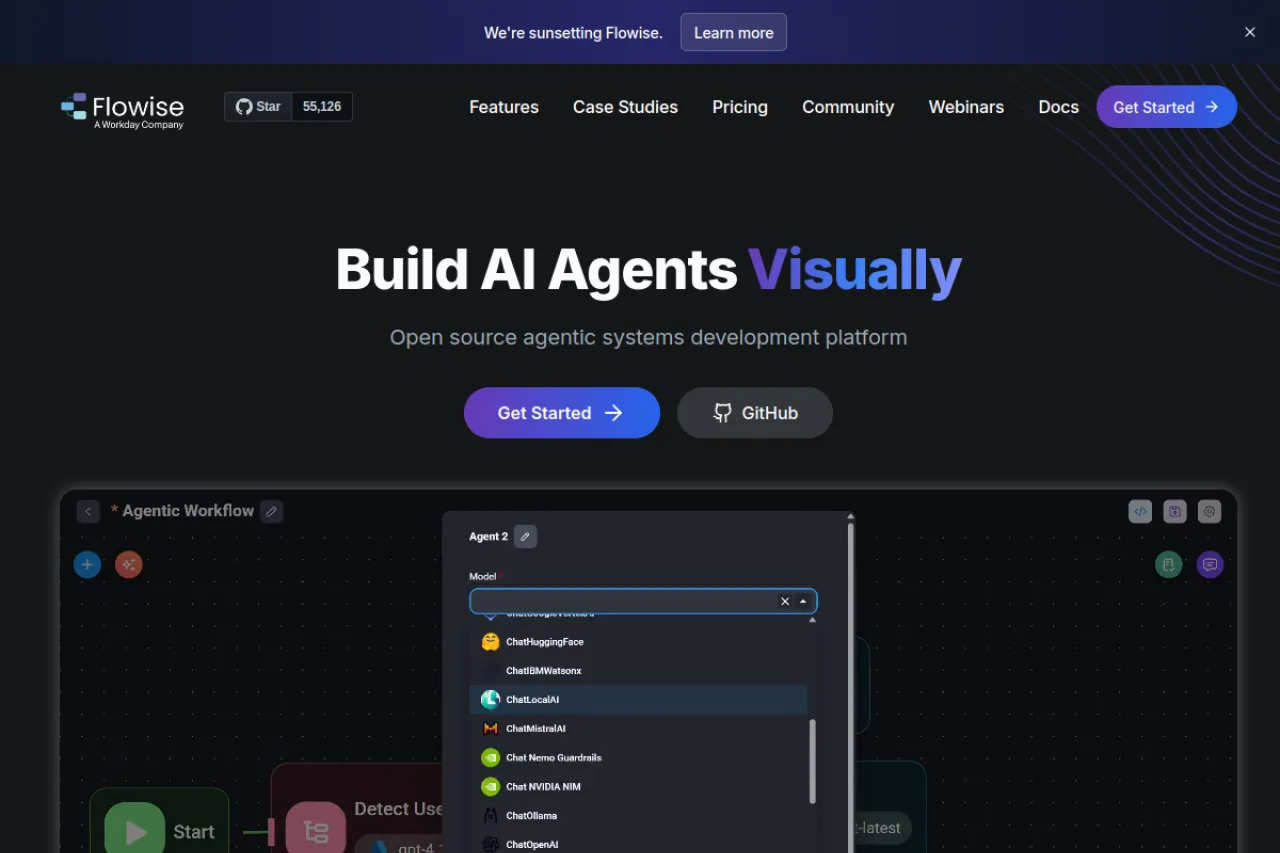
Flowise is an open-source visual builder for LLM applications and AI agents, letting developers assemble chatbots, RAG systems, and multi-agent workflows through a drag-and-drop canvas built on the LangChain ecosystem. It supports both self-hosted and managed cloud deployment, offers embedding and API access, and includes execution tracing and observability. It's best suited to developers and ML engineers who want customizable agent orchestration with infrastructure control.
Flowise is an open-source, visual development platform for building LLM applications and AI agents through a drag-and-drop interface. Rather than writing orchestration code by hand, users assemble modular building blocks — nodes for language models, retrievers, memory, tools, and logic — into flows that power chatbots, RAG pipelines, and multi-agent systems. It sits in the growing category of agentic systems development platforms and aims to shorten the path from prototype to working AI application. Built on top of the broader LangChain ecosystem, Flowise gives developers both a low-code canvas and the flexibility to drop into code when they need finer control. It supports single-agent setups like tool-calling chatbots with knowledge retrieval, as well as multi-agent systems with workflow orchestration across different agents. Finished flows can be embedded directly into web applications or exposed via API for integration into existing products. A core part of Flowise's appeal is deployment flexibility. Teams can self-host on infrastructure like AWS, Azure, or GCP for full control over data and models, or use the managed cloud offering to skip the operational overhead. The platform also emphasizes observability, with execution traces and support for tooling like Prometheus and OpenTelemetry. Flowise has gained strong traction in the developer community and is used by teams at organizations including AWS, Accenture, Priceline, Deloitte, and Publicis. Its open-source model appeals particularly to ML engineers and developers who want transparency and infrastructure control rather than a fully closed SaaS. Notably, Flowise has joined Workday, a signal of enterprise interest in its agentic tooling. Buyers should note that while the open-source core is free, real-world costs depend heavily on LLM token usage, vector databases, and hosting. Verify current plans and limits on the official site before committing.
Flowise is an open-source, visual drag-and-drop platform for building LLM applications and AI agents, from RAG chatbots to multi-agent systems. Built on the LangChain ecosystem, it supports both self-hosting and managed cloud deployment, plus embedding and API access. It's used by teams at organizations like AWS, Accenture, and Priceline, and has joined Workday.
FlowiseAI develops Flowise, an open-source platform for visually building customizable AI chatbots and agents. The company was founded by ZhenJing Heng and Chung Yau Ong, and its mission centers on making agentic systems development accessible through a modular, visual interface built on the broader LLM tooling ecosystem.
The project has gained significant traction in the developer community and is used by teams at organizations including AWS, Accenture, Priceline, Deloitte, and Publicis. Flowise has since joined Workday, reflecting enterprise interest in its agent-building tooling.
Flowise centers on a drag-and-drop canvas where users assemble modular building blocks — language models, retrievers, memory, tools, and logic nodes — into working AI applications. It supports single-agent systems such as tool-calling chatbots with knowledge retrieval, as well as multi-agent systems with workflow orchestration across agents. RAG capabilities let assistants answer from internal documents and websites.
Built on the LangChain ecosystem, Flowise offers broad flexibility across model providers, vector stores, and tools. Finished flows can be embedded into web applications or accessed through APIs and SDKs. The platform emphasizes observability, providing execution traces and support for tools like Prometheus and OpenTelemetry.
Deployment is flexible: teams can self-host on platforms like AWS, Azure, and GCP for full control, or use the managed Flowise Cloud offering to reduce operational overhead.
Flowise primarily serves developers, ML engineers, and technical product teams building custom AI agents and LLM applications. Its open-source, self-hostable model appeals to organizations with data-sensitivity or infrastructure-control requirements, while the managed cloud option broadens reach to smaller teams and startups. Adoption spans startups experimenting with agents through to enterprises like AWS, Accenture, and Deloitte.
ML engineers and developers who build, test, and deploy AI agents and RAG applications on the Flowise canvas. They value flexibility, transparency, and the ability to drop into code when the visual layer isn't enough.
Engineering leads and technical decision-makers evaluating agent-building platforms, weighing self-hosting control against managed convenience and total cost of ownership.
Open-source contributors, AI/ML practitioners, and platform engineers who shape adoption through community activity, internal evaluations, and infrastructure standards.
A technically capable team — from an AI startup to an enterprise engineering group — that needs to build customizable, production-grade AI agents and wants control over models, data, and deployment rather than a closed SaaS.
FlowiseAI reportedly reached $1M in revenue in June 2024, and research indicates Y Combinator among its investors. Specific funding amounts and valuation are not confirmed in the available research.
The open-source core is free to self-host, and there is a managed cloud plan reported to start around $35/month. Beyond that subscription, your real cost is driven by LLM token usage, vector database hosting, and infrastructure, and Flowise does not publish overage pricing. Confirm current plans and limits on the official site.
You assemble applications on a visual canvas by connecting modular nodes — language models, retrievers, memory, tools, and logic — into a flow. This lets you create chatbots, RAG systems that answer from your own documents, and multi-agent workflows, then test and iterate quickly. Completed flows can be embedded into a website or called through an API.
Flowise can be self-hosted on platforms including AWS, Azure, and GCP, giving you full control over data and models. Alternatively, the managed Flowise Cloud offering removes the operational overhead of running it yourself. The choice typically comes down to how much control versus convenience your team needs.
Because it's built on the LangChain ecosystem, Flowise supports a broad range of LLM providers, vector databases, and tools rather than a single vendor. It also provides APIs and SDKs for embedding chatbots and integrating with existing applications. Available nodes expand regularly through active open-source development.
Self-hosting is the primary privacy advantage: running Flowise on your own infrastructure keeps data and model calls within your environment. The platform also supports observability through execution traces and tools like Prometheus and OpenTelemetry. Teams handling sensitive data should still review their chosen LLM providers' data policies.
Flowise has joined Workday, signaling growing enterprise interest in its agentic development tooling. The project also continues to evolve rapidly as an open-source platform, adding agentflow capabilities and new integrations. Check the official site and GitHub repository for the latest details.
Yes, Flowise offers a free plan for both self-hosted deployment and cloud hosting. The Free Cloud plan includes 2 flows and 100 predictions per month. For unlimited usage, the Starter plan costs $35/month with unlimited flows and 10,000 predictions per month.
Flowise is built on LangChain and supports LLM integrations, vector databases like Pinecone, and offers API access to run flows and AI assistants. Specific integration details beyond LangChain components were not extensively documented in our research — check the official documentation for the complete list.
Flowise is open-source and optimized for flexible LLM chaining and RAG systems, while alternatives like Voiceflow focus on hosted conversation design with richer collaboration features. Compared to Langflow (42,000 GitHub stars) and Dify (58,000 stars), Flowise has around 30,000 stars but offers a clearer UI and greater out-of-the-box range according to user reviews. It's best for teams prioritizing self-hosting and infrastructure control over managed services.
Side-by-side pages for pricing, features, and best-fit use cases.
Langflow excels at visual RAG and agent building, but teams often need stronger multi-agent orchestration, enterprise governance, or sales-specific workflows.
Flowise offers visual LLM app building, but users seek alternatives for multi-agent orchestration, enterprise features, or broader workflow automation.
CrewAI excels at multi-agent orchestration, but these alternatives offer visual builders, enterprise workflows, or specialized B2B automation.
Observability-first open-source TypeScript framework for AI agents
TypeScript multi-agent networks with deterministic routing and MCP

Microsoft's enterprise SDK for orchestrating LLMs, plugins, and agents.
Framework for programming language models instead of prompting them