VoltAgent
Agent Frameworks
Observability-first open-source TypeScript framework for AI agents
typescriptagentsopen-source
Free planView →

CrewAI is an open-source framework for orchestrating multi-agent AI workflows, offering both a visual no-code editor ...
A developer framework for orchestrating multi-agent workflows — powerful for builders, but it's a toolkit, not a no-code product.
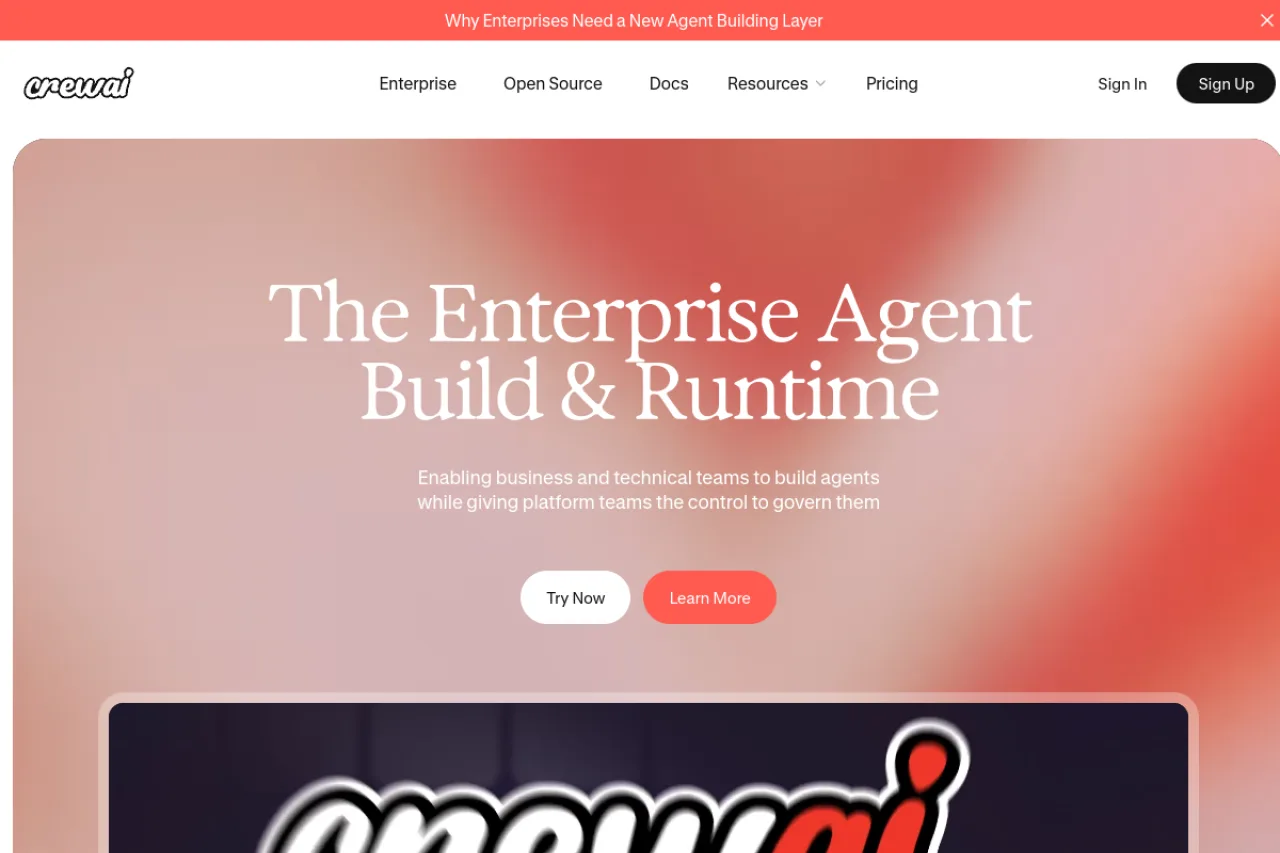
CrewAI is an open-source framework for building and orchestrating multi-agent AI workflows, pairing a free Python framework and CLI for developers with a visual no-code editor and AI copilot for faster assembly. It is model-agnostic, integrates with GitHub and external APIs, and offers an enterprise tier with private infrastructure and support for teams deploying agents at scale.
CrewAI is an open-source framework for orchestrating multi-agent AI workflows, letting developers and teams assign roles, tasks, and tools to a coordinated "crew" of AI agents that collaborate on complex work. The core orchestration framework is free and open source, while a managed cloud platform and enterprise tier layer on deployment, monitoring, and governance capabilities for organizations scaling agents into production. The platform meets two very different audiences. Developers can build agent systems programmatically through the CLI and Python framework for full control over logic, tools, and model choice. Less technical builders can use the visual editor with an AI copilot to assemble workflows without writing code. GitHub integration and API connectivity let agents plug into external systems and existing codebases. CrewAI is well suited to structured, multi-step processes such as research-then-write-then-review pipelines, where each agent handles a defined stage and hands off to the next. Because it is model-agnostic, teams bring their own LLM API keys and choose the provider that fits their cost and performance needs, which also means model usage is a separate expense to budget for. The commercial side is built around production scale: the free Basic tier caps usage at 50 workflow executions per month with a single seat, while the Enterprise tier adds private infrastructure options, on-site support and training, and dedicated development hours under custom pricing. This split model makes CrewAI approachable for experimentation but pushes serious deployments toward negotiated enterprise contracts. Buyers should verify current pricing, execution limits, and feature availability on the official site, since tiers and quotas evolve and the largest costs often come from LLM usage rather than the platform itself.
CrewAI is an open-source framework for orchestrating multi-agent AI workflows, offering both a no-code visual editor with AI copilot and a developer CLI and Python framework. The framework is free and model-agnostic, while a managed cloud and enterprise tier add private infrastructure, support, and production scale under custom pricing. It targets developers and enterprises automating structured, multi-step processes.
CrewAI was founded in 2023 by Joao Moura and develops a multi-agent automation platform that lets organizations build, deploy, and manage collaborative AI agents. The company centers its mission on accelerating enterprise adoption of agentic AI, guiding teams from discovering what to automate through launching and scaling agents in production.
The project pairs a widely adopted open-source framework with a commercial platform, and its homepage claims usage across a majority of the Fortune 500. Reporting on the company describes a team of over 30 employees, more than 300 internally deployed agents, and an open-source repository that has accumulated tens of thousands of GitHub stars.
At its core, CrewAI provides an orchestration framework where developers define agents with specific roles, tasks, and tools, then coordinate how those agents collaborate and hand off work across multi-step processes. The framework is model-agnostic and requires users to bring their own LLM API keys, giving teams freedom to choose their provider.
The platform is accessible through two paths: a CLI and Python framework for programmatic control, and a visual editor with an AI copilot for building workflows without code. GitHub integration and API connectivity let agents plug into external systems and existing codebases.
The enterprise offering extends the open-source foundation with deployment on CrewAI's cloud or private infrastructure, on-site support and training, dedicated development hours, and management capabilities for running agents at scale. A newer CrewAI Discovery capability helps teams identify automation opportunities before building.
CrewAI serves a spectrum from solo developers and small technical teams experimenting on the free tier to large enterprises deploying and governing agents in production. Its dual no-code and code-first design broadens appeal to both engineers who want programmatic control and operators who prefer visual assembly, with the enterprise tier tailored to organizations with security, infrastructure, and support requirements.
Developers and technical builders who design, run, and iterate on multi-agent workflows, plus operators using the no-code editor to assemble automations without writing code.
Engineering leaders, automation program owners, and enterprise decision-makers evaluating a platform to standardize and scale agentic AI across the organization.
AI/ML engineers, platform architects, and open-source contributors who assess the framework's flexibility, integrations, and production readiness.
A technically capable team or enterprise automating structured, multi-step processes that wants an open, model-agnostic framework with a path to governed, at-scale production deployment.
CrewAI, founded in 2023 by Joao Moura, is venture-backed rather than bootstrapped: it raised approximately $18 million in October 2024, with a Series A led by Insight Partners plus an inception round led by boldstart ventures, and participation from Craft Ventures, Andrew Ng, and Dharmesh Shah.
The core orchestration framework is open source and free to use, and the Basic cloud tier is $0 with 50 workflow executions per month and one seat. Beyond that, CrewAI moves to custom enterprise pricing negotiated per organization. Keep in mind you also supply your own LLM API keys, so model usage is a separate cost that is often the largest line item.
You define a "crew" of AI agents, each given a role, a set of tasks, and access to tools, then CrewAI orchestrates how they collaborate and hand off work across a multi-step process. Developers build this programmatically with the Python framework and CLI, while the visual editor with an AI copilot lets you assemble the same workflows without writing code.
Not necessarily. The CLI and Python framework are aimed at developers who want full control, but the no-code visual editor and AI copilot let less technical users design and run agent workflows. Complex, production-grade systems still benefit from engineering skills to tune reliability and performance.
CrewAI is model-agnostic and requires you to bring your own LLM API keys, so you can connect the provider of your choice. It includes GitHub integration and API connectivity for wiring agents into external systems and existing codebases. Because it is an open framework, agents can also be extended with custom tools.
Yes. The open-source framework can be self-hosted, and the Enterprise tier explicitly offers deployment on CrewAI's cloud or your own private infrastructure. This gives organizations with data residency or compliance requirements more control over where agents and data run, alongside on-site support and training.
CrewAI has introduced CrewAI Discovery, a capability aimed at helping teams identify what to automate before they start building agents. It reflects the platform's push toward guiding organizations through the full lifecycle from planning automation to launching and scaling agents.
Yes, CrewAI offers a free tier that includes access to the visual editor, AI copilot, GitHub integration, and 50 workflow executions per month. This is suitable for individual developers and researchers evaluating the platform, though production use typically requires upgrading to paid tiers.
CrewAI supports GitHub integration for version control and API connectivity for external systems through RESTful interfaces and webhook configurations. Agents can interact with third-party APIs and process incoming data, though specific pre-built integrations were not detailed in available research.
CrewAI is compared to LangGraph (for graph-based agent control), AutoGen (for multi-agent development), and frameworks like Pydantic AI and OpenAI Agents SDK. Users note CrewAI offers faster multi-agent teamwork setup than LangChain but may sacrifice fine-grained control. Alternatives like Lindy focus on no-code business workflows, while StackAI targets enterprise ease-of-use.
Side-by-side pages for pricing, features, and best-fit use cases.
Langflow excels at visual RAG and agent building, but teams often need stronger multi-agent orchestration, enterprise governance, or sales-specific workflows.
Flowise offers visual LLM app building, but users seek alternatives for multi-agent orchestration, enterprise features, or broader workflow automation.
CrewAI excels at multi-agent orchestration, but these alternatives offer visual builders, enterprise workflows, or specialized B2B automation.
Observability-first open-source TypeScript framework for AI agents
TypeScript multi-agent networks with deterministic routing and MCP

Microsoft's enterprise SDK for orchestrating LLMs, plugins, and agents.
Framework for programming language models instead of prompting them